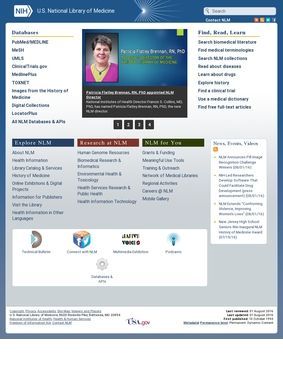
A clinician is trying to check whether a drug interaction is fact or folklore, a graduate student needs the primary study behind a claim in a textbook, and a worried parent wants to understand a diagnosis in plain English before the next appointment. Three different people, one starting point. The National Library of Medicine sits underneath all of these searches, usually without the person realizing they are using it, because so many of the tools that answer medical questions online trace back to this one institution in Bethesda, Maryland.
PubMed searches rely on MEDLINE and MeSH
The clearest example is PubMed. Almost anyone who has looked for a peer-reviewed medical paper has passed through it, and it draws on MEDLINE, the curated bibliographic database that indexes biomedical journal articles. That indexing is done with MeSH, the Medical Subject Headings vocabulary, which is what lets a search for "heart attack" also pull results filed under "myocardial infarction." It is unglamorous plumbing, and it is the reason a search on a serious clinical topic returns something coherent instead of keyword noise. The National Library of Medicine builds and maintains all three of these pieces, and they lean on each other. That vertical control is the reason results hold together across millions of records: the same organization that decides how an article is tagged is the one that runs the search reading those tags.
MedlinePlus and ClinicalTrials.gov serve patients
For readers who are not researchers, the more useful front door is MedlinePlus. It translates clinical material into consumer health information: what a condition is, what a test measures, what a medication does and what to watch for. The writing aims at the general public, which makes it a sensible place to send someone before they wander into forums and marketing pages. Sitting alongside it is ClinicalTrials.gov, a registry of clinical studies from around the world. A patient who has run out of standard options can search there for trials that are recruiting, and a journalist can check whether a study a company is bragging about was ever actually registered.
The registry is worth knowing about on its own, and the National Library of Medicine runs it. For patients and their families, MedlinePlus and ClinicalTrials.gov together cover a surprising amount of ground: one explains the condition, the other shows what is being tested for it, and both come without a paywall or a login demand.
Comparing tools for scientists and developers
The deeper tools show who else this place serves. BLAST aligns genetic sequences, which is a staple of molecular biology labs comparing DNA or protein sequences against known ones. The UMLS, or Unified Medical Language System, exists so that different health software systems can talk to each other, and it maps the many ways a single medical concept gets named across vocabularies. That kind of interoperability work is invisible to patients but indispensable to anyone building health IT. Open-i handles multimedia and image search; it pulls figures and clinical images out of the literature. None of these are consumer conveniences. They are working instruments for scientists and developers, and the National Library of Medicine treats that audience as seriously as it treats the public one.
Historical archives sit alongside the databases
There is a historical and archival side too, which is easy to overlook given how much attention the databases get. A Digital Collections repository holds digitized materials, LocatorPlus is the catalog of the library's own holdings, and there are historical medical collections and archives going back well beyond the digital era. This is a real library in the traditional sense rather than just a set of search engines wearing a library's name, and the National Library of Medicine preserves that older material with the same care it gives the live databases. It also publishes, through a Technical Bulletin and other titles that document changes to its systems and databases, which is the sort of thing power users of PubMed and MeSH actually need to follow.
Training programs support biomedical research
Beyond the tools themselves, the National Library of Medicine does original work in computational biology and bioinformatics, develops methods for biomedical research problems, and sets and manages health data standards. It runs training in biomedical informatics and administers funding programs, so the National Library of Medicine is a grant-maker and an educator as well as a service provider. The site organizes itself around who is arriving: separate sections point researchers, publishers, librarians, educators and trainers, healthcare professionals, and the general public toward the material meant for them. That segmentation is honest about the fact that a publisher depositing content and a parent reading about asthma have almost nothing in common except the door they walked through.
Place within the National Institutes of Health
Its place in the government structure is straightforward and worth stating plainly. The National Library of Medicine is a component of the National Institutes of Health, which in turn falls under the U.S. Department of Health and Human Services. It calls itself the world's largest biomedical library, and given the scale of what it indexes and stores, that reads as plain description. The scope of what the National Library of Medicine holds is genuinely enormous, which is also the one honest warning to give a newcomer: the breadth can be disorienting. Someone who only wants MedlinePlus can find themselves staring at portals meant for genomics researchers, and the interfaces of the older databases show their age after decades of iteration. This is a tool built for depth, and depth costs some friction.
What keeps that friction from becoming a real complaint is that the individual tools tend to be well signposted once someone lands on the right one. PubMed's search behaves predictably, MedlinePlus reads cleanly, and ClinicalTrials.gov structures its records the same way every time, so its layout is easy to learn. The consistency across such a large collection of separate systems is the thing that a smaller operation would struggle to match, and it comes from the same standards work the National Library of Medicine does behind the scenes. Few other bodies in health could keep so many distinct tools aligned, and the National Library of Medicine manages it because it wrote the vocabularies and standards those tools run on.
How does it compare to Mayo Clinic?
The natural point of comparison for a general reader is a place like the Mayo Clinic's health information site, which many people already reach for when they want to understand a symptom or condition. Mayo is polished, patient-facing, and easier to skim, and for a quick read on a common ailment it may be the more comfortable stop. But it is one institution's editorial product. The National Library of Medicine is the layer underneath the whole field: the citations, the trial registry, the terminology, the sequence tools, the archives.
Where the deeper research actually lives
If the question is "what does a good clinic tell me about this condition," Mayo answers it well. If the question is "what does the actual research say, where is the study, and is there a trial I could join," this is where that answer lives, and it is free, public, and about as authoritative as a source in medicine gets.