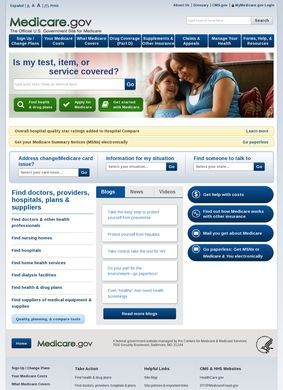
Who actually runs the website where a 64-year-old is supposed to figure out whether to sign up for a health plan, and what that plan will cost? On Medicare.gov the answer is the federal government itself, through the Centers for Medicare and Medicaid Services, and the site is built to answer that question in full. It is the official home of the program, so the guidance a person reads here is the guidance that governs, not a summary of it filtered through an insurance salesperson or a lead-generation form dressed up as advice.
Comparing plans with the Plan Finder
The centerpiece for most visitors is the Plan Finder. It lets someone compare Part A and Part B coverage against the private alternatives, Medicare Advantage and the Part D prescription drug plans, and it sorts them by cost and by what they actually cover. A person can enter the drugs they take and see how each drug plan handles them, which is the difference between a guess and a real monthly number. That single tool answers the question that sends most people to the site in the first place: which option leaves me paying less for the care I already know I need.
Handling enrollment deadlines and exceptions
Around that sits a full layer of eligibility and enrollment material. The site spells out who qualifies, the sign-up windows involved, and the mechanics of applying, which is where a lot of costly mistakes get made when someone misses an enrollment period and pays a lifelong penalty for it. There is specific direction for the situations that break the standard timeline: moving to a new address, losing coverage from an employer, qualifying through a disability, or dealing with end-stage renal disease. These are exactly the cases where general advice fails and a person needs the rule as it is written for their circumstance.
Managing coverage in the my Medicare account
For people already enrolled, the "my Medicare" account portal is the working part of the site. It shows claims, lays out the details of a person's Part D or Medicare Advantage plan, and handles the genuinely stressful task of ordering a replacement card when the original goes missing. That is the kind of function that keeps a beneficiary from having to sit on a phone line for an afternoon, and having it inside a secure account rather than a paper process is a real convenience for the age group that uses it most.
Checking provider quality ratings
The provider search deserves its own mention because it does more than list names. A person can look up doctors, hospitals, nursing homes, and other providers, and the tool attaches quality-of-care ratings, so a person can weigh who performs well alongside who is nearby. Pairing a directory with published quality measures is not something a private site can offer with the same authority, since the ratings come from the same body that oversees the program. Someone choosing a nursing home for a parent is making a heavy decision, and having a comparison built on official data changes how much that person can trust what they are looking at.
Breaking down premiums and covered equipment
Cost is handled directly. The site explains premiums, deductibles, and coinsurance in plain terms and backs the explanations with calculators, so a person is not left translating jargon on their own. It also gets specific about what is and is not covered, down to individual services and durable medical equipment, which is the level of detail that decides whether a wheelchair or a home oxygen unit will be paid for. That specificity is the point. A vague promise that "most equipment is covered" would be useless to someone standing in a medical supply store, and the site does not settle for that.
Locating handbooks and appeal forms
Beyond the tools there is a deep library of publications and forms. The "Medicare and You" handbook lives here, along with the appeals forms a person needs when a claim is denied and they want to push back. There is also a set of fraud-reporting resources, which fits the program's scale: a system this large draws scams aimed at older people, and giving beneficiaries a clear route to report suspected fraud is part of protecting the money and the people in it. A blog and news section tracks policy updates, so the material stays current with changes to the rules rather than freezing at whatever was true when a page was first written.
Who relies on Medicare.gov?
The audience is wider than the stereotype of a retiree at 65. The site serves prospective beneficiaries approaching eligibility, current enrollees managing their coverage, younger people who qualify through disability or end-stage renal disease, and the caregivers and family members who often do the research on someone else's behalf. Providers researching coverage rules land here too, because they need to know what Medicare will and will not pay for before they treat a patient. Building one resource that works for a confused son helping his mother and for a billing clerk verifying a rule is a hard balance, and Medicare.gov leans on plain language and strong search to hold it.
Reaching Medicare in two languages
Language access is not an afterthought. The whole site runs in English and Spanish, so the program reaches the millions of Spanish-speaking households among its beneficiaries, and it connects to 1-800-MEDICARE for anyone who would rather talk through a question than read it. The phone line and the website are meant to work as two doors into the same information, so a person who gets stuck online is not left without a human option.
Trusting primary program information
What makes the site worth trusting is that the information is primary. When a page here says a service is covered or an enrollment window closes on a certain date, that is the source of the rule and not a paraphrase that might be a step out of date or shaded to sell something. Private comparison sites and insurance brokers pull their coverage claims from this program in the end, so a person who starts on Medicare.gov is reading the original instead of a copy. For decisions this expensive and this permanent, working from the primary source is the sensible move, and the Plan Finder plus the coverage pages give a person enough to make those decisions without leaving the site.
It is not light reading. The subject is genuinely complicated, and even with plain-language pages a first-time visitor will spend real time working through the parts, the enrollment periods, and the trade-offs between original coverage and the private plans. The site does not pretend otherwise, and that honesty earns it some credit. A person willing to sit with it comes away knowing what they are signed up for, what it costs, and what to do when something goes wrong; plenty of health sites never get a visitor that far. The handbook runs to hundreds of pages for a reason, and the site mirrors that depth instead of trimming it down to something reassuring but incomplete.