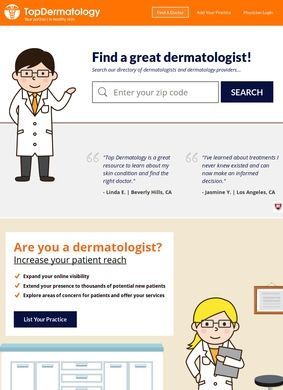
Type a city into Top Dermatology and you get back a list of skin doctors with their addresses, phone numbers, and a tally of patient reviews next to each name. Search Santa Monica or Beverly Hills and the page fills with local practitioners, each profile carrying credentials, specialty areas, and the count of reviews patients have left. That is the core of what Top Dermatology does: it pairs people looking for a dermatologist with providers in their area, organized by city and state, and it does that job in a fairly direct way.
How the directory organizes dermatologist listings
The directory side is the strongest part of Top Dermatology. Provider profiles are reasonably detailed, listing what a given doctor focuses on alongside contact basics and review totals, so someone trying to narrow down a few options near them can compare on more than just proximity. You can browse by location or search outright, and the comparison layout means a patient is not clicking through ten separate practice websites to figure out who handles, say, Mohs surgery versus general medical dermatology. The location pages do the obvious thing well: pull up Santa Monica or Beverly Hills and you get the local roster with addresses and review tallies laid out side by side, so distance and apparent track record are both visible at a glance. For a first pass at finding care, that structure does real work.
Comparing providers by specialty and location
Around that core sits a wide band of educational material. Top Dermatology has pages on the conditions people actually search for when something on their skin worries them: acne, psoriasis, eczema, warts, fungal infections, and the more serious territory of skin cancer, moles, melanoma, and atypical moles. It also covers cosmetic concerns separately, with entries on wrinkles, age spots, stretch marks, acne scarring, dry skin, and uneven skin tone. On the treatment side there are write-ups for Botox, dermal fillers, chemical peels, laser resurfacing, radiofrequency procedures, scar revision, and Mohs surgery.
Educational content on skin conditions and treatments
The split between medical and cosmetic is sensible too, since the person worried about a changing mole and the person asking about chemical peels are rarely the same visitor, and Top Dermatology keeps those tracks distinct instead of blending them into one undifferentiated pile. Taken together it reads less like a thin lead-generation shell and more like a place that wants you to understand the condition before you go shopping for someone to treat it.
Medical versus cosmetic information kept separate
That mix is genuinely useful, because the educational pages give the directory a reason to exist beyond the listings and a reason for a worried visitor to stay and read. A person who reads through the eczema or melanoma material and then searches their city is making a more informed choice than someone dropped straight onto a list of names. There is also a blog, plus active links out to Facebook and Instagram under the @topdermatology handle, which suggests Top Dermatology is maintained and not parked.
Inside the platform's business model
The other audience for Top Dermatology is the dermatologists themselves. Through a join page, providers can claim or create a listing, with both free and paid options, and the paid tier adds things like impression tracking and broader visibility to potential patients. That two-sided setup is worth keeping in mind when you read the profiles, since a directory that sells placement always has some commercial pull behind which names surface and how prominently. It does not make the listings untrustworthy, but it is the honest backdrop to how this kind of platform funds itself, and a reader is better off knowing the paid tier exists than assuming every prominent name rose there purely on merit.
Limited transparency about company operations
This is where Top Dermatology goes quiet. The homepage and the main landing pages do not show a phone number, an email, or a physical address for the company running the platform. There is a contact form reachable from a link in the footer, so a route to the operators does exist, but you have to go looking for it, and nothing about who they are greets you on arrival. For a service whose whole pitch is connecting patients with named, credentialed, locatable doctors, the contrast inside Top Dermatology is a little odd: the providers are transparent, the platform itself less so.
None of that is disqualifying. Plenty of legitimate directories run lean on their own contact details and route everything through a form, and the absence of a public email in particular is normal practice, not a red flag. Still, anyone leaning on this site to choose a doctor would want a clearer sense of who curates the listings and how the review counts are gathered and verified, and the site does not volunteer much on either front.
Review counts lack external verification
On outside opinion there is simply not much to go on. A search for independent reviews of the topdermatology.com platform itself, the kind you would expect on a consumer ratings site, turned up nothing concrete. What surfaces instead are the site's own directory pages and the individual doctor profiles it hosts, rather than any third party weighing in on the service. So the review counts you see attached to providers come from within the Top Dermatology ecosystem, and there is no external scorecard telling you how reliable that ecosystem is. That is not evidence against it, but it leaves a gap a cautious user should notice.
Using Top Dermatology as a starting point only
It is worth being clear about what those provider review counts do and do not tell you. They give a rough signal of how busy or established a practice is, which has some value when you are staring at a long list of unfamiliar names. They do not substitute for checking a doctor against your insurance, their state medical board, or the independent ratings hosted elsewhere. Top Dermatology works best as a starting point, the place where you assemble a shortlist, before you take that shortlist somewhere more accountable to confirm it.
Where it lands for me is positive but measured. The directory is well organized, the location search does what it promises, and the volume of plain-language education on conditions and treatments lifts Top Dermatology above a bare list of phone numbers. The reservations are real though: the platform keeps its own identity at arm's length, the review figures live entirely inside its walls, and there is no outside verdict to lean on. Use it to find local dermatologists and to read up on a condition before an appointment, and it serves that purpose well. Treat the profiles as a first filter to be confirmed elsewhere, not as the final word, and Top Dermatology holds up fine for what it is.