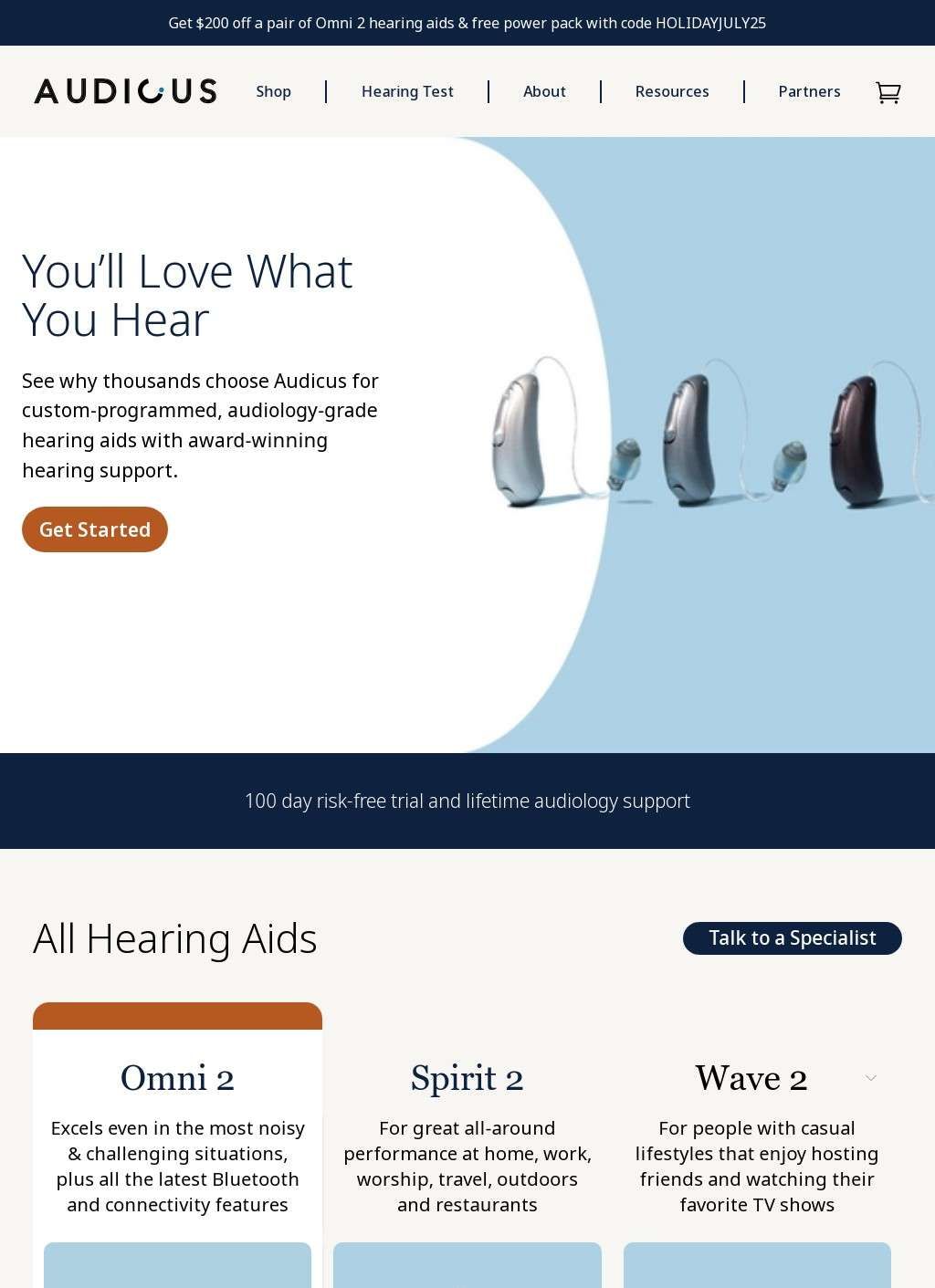
Can you buy a hearing aid without setting foot in a clinic and end up with something that actually fits your loss? That is the question this Audicus buyer's guide page sets out to answer, and it does so by laying the company's catalog on the table. The page is a comparison hub for the 2026 lineup: four models, Beam, Omni 2, Spirit 2, and Mini 2, split across in-ear and behind-the-ear styles at different price points. Every pair of Hearing Aids in the range carries an IP68 rating, so sweat and a sudden downpour are not supposed to end the device. An IP68 mark sits at the top of the ingress-protection scale and certifies resistance to dust and brief immersion in water, which is a fair claim to make for a product people wear from morning to night.
Four models across price points
Audicus is a New York based direct-to-consumer outfit, which means it sells its own branded Hearing Aids and skips the traditional audiology storefront. The pitch is aimed at adults with mild-to-moderate hearing loss who would happily avoid a clinic waiting room. You take an online hearing test or send in an audiogram you already have, and a hearing specialist programs the device remotely before it ships. The hardware arrives tuned. That remote-programming step is what separates these Hearing Aids from an off-the-shelf amplifier, and the guide page is reasonably upfront about it.
Remote programming and direct sales
The four models read like a deliberate spread instead of one product dressed up four ways. Beam, Omni 2, Spirit 2, and Mini 2 give you a choice between something that tucks into the ear canal and something that sits behind it, a choice that comes down to comfort and handling, since fit preference and dexterity vary a lot from person to person. The page treats price as part of that decision, so a shopper can weigh discretion against cost without emailing anyone first.
Choosing between styles and cost
There is also Audicus Plus, a membership starting at $99 a month that keeps a customer on the latest Hearing Aids on a rolling basis. For someone who dislikes a large one-time outlay, that is a sensible alternative to a single big purchase. Whether it pays off depends on how long you would otherwise keep a pair of devices. A buyer who swaps hardware every couple of years comes out ahead, while someone content to wear the same pair for a decade pays more over time, so the math is worth running. The option being there at all is a point in the site's favor.
Membership option for rolling upgrades
Around the product pages sit a review section, a blog, and a set of partner and B2B pages. The resource material is the kind of thing a first-time buyer needs, since Hearing Aids come with a vocabulary most people have never had to learn. It is not filler. It supports the buying decision the page is asking you to make.
Support resources and reviews
Reputation is where the picture gets more textured, and honestly more useful. Audicus holds an A+ accreditation with the Better Business Bureau in New York, yet customer reviews there average only 2.67 out of 5, with complaints on file. ConsumerAffairs tells a brighter story at 4.5 out of 5. Trustpilot carries a smaller pool of 14 reviews, and Shopper Approved hosts verified customer feedback as well. The spread is wide enough to deserve attention. An A+ accreditation reflects how a company handles disputes, not how satisfied its customers are, and the gap between the ConsumerAffairs score and the BBB average points to experiences that vary quite a bit depending on what goes wrong and how it gets resolved.
Customer service accessibility
Getting hold of a person looks straightforward. A phone line and a support route are listed on the site, and they turn up in search results too, so a buyer with a question about programming or returns can reach someone quickly. For a category where setup help is half the value of a pair of Hearing Aids, that accessibility counts.
Weighing strengths against post-sale risks
None of the mixed reviews sink the proposition, but they do shape how to approach it. The strength of the direct-to-consumer model here is the remote tuning, the water resistance across every pair of Hearing Aids in the lineup, and a membership that lowers the entry cost. The risk, as the complaint pattern at the BBB hints, tends to show up after the sale, in fitting adjustments and support follow-through. Reading the BBB complaints alongside the ConsumerAffairs reviews gives a fairer picture of that gap than any single rating would, and the two together set realistic expectations. Prospective buyers whose loss sits outside the mild-to-moderate range will also want to confirm upfront that these Hearing Aids are built for their situation, since the online hearing test may not catch edge cases a clinic audiogram would.