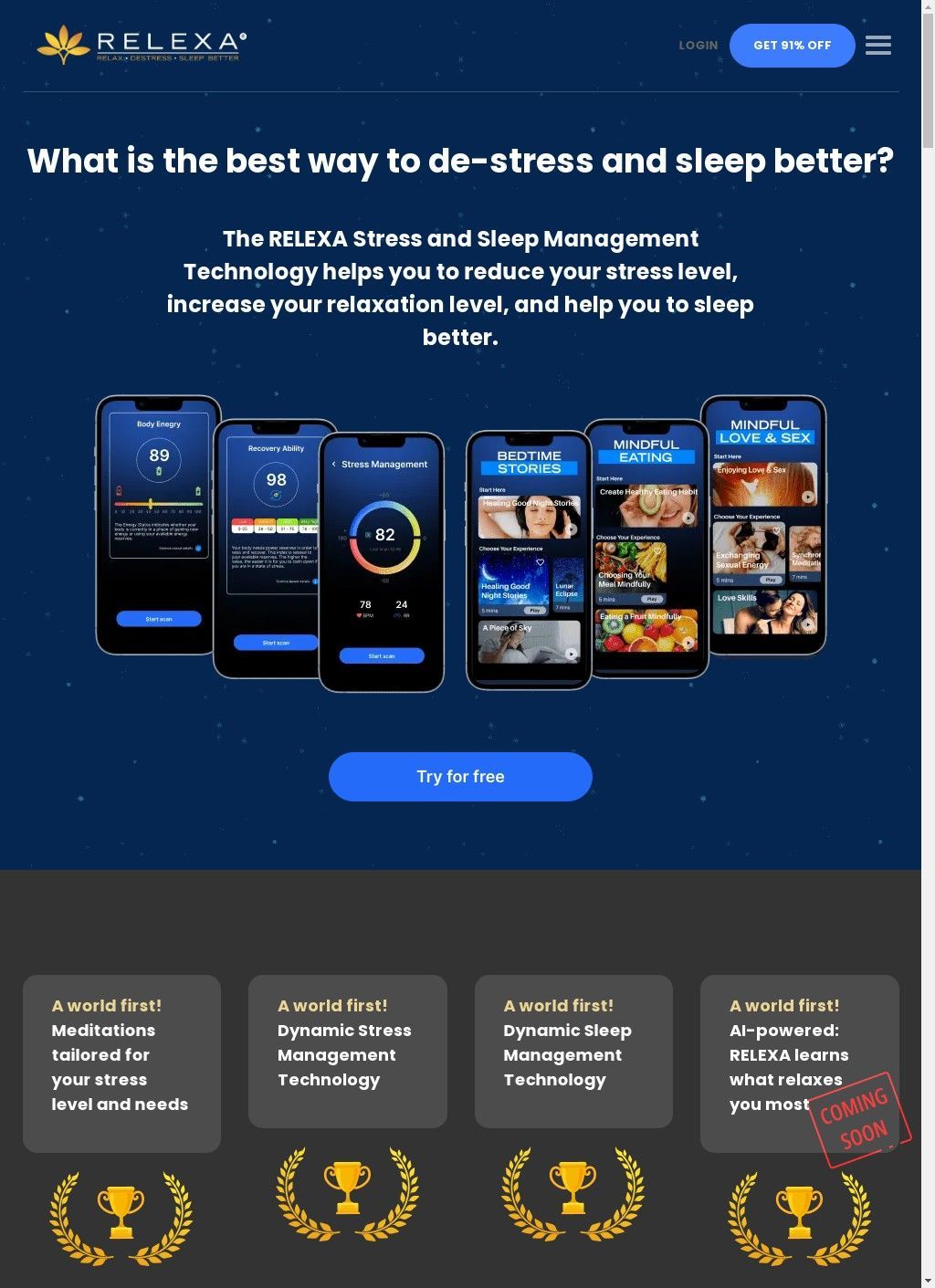
A lifetime pass to Relexa runs $289, which is the first thing worth pausing on, because most wellness apps in this space never offer a one-time price at all. The subscription path sits at $12.89 a month or $69.89 a year, both starting after a seven-day free trial. That spread of options tells you the people behind it, a company called GoodMood PBC, expect at least some users to commit hard and others to dip a toe. Relexa is built around stress, sleep, anxiety and flagging energy, and it leans on phone hardware and an Apple Watch to do something more than play soothing audio. The category it sits in is crowded with apps whose calming promise amounts to a folder of audio tracks, so the hardware angle is worth a proper look in any directory that lists wellness tools.
Pricing options from lifetime pass to monthly subscription
The watch integration is the part that separates this from the usual meditation library. Relexa reads heart rate variability, an energy reading, and a recovery rate, then claims to measure your stress level in real time and adjust what it shows you. So a video meditation is supposed to adapt to the number it just took off your wrist, instead of being a fixed clip you press play on. Whether that adaptation is meaningful or cosmetic is hard to judge from the outside, but the mechanism is at least specific and stated plainly.
How watch data shapes meditation sessions
Most apps that claim to gauge your mood do it by asking you a question and logging the answer. Relexa is reaching for an objective signal off the wrist, and even if the science behind reading stress from heart rate variability is debated, the design intent is clearer than a self-report slider.
Sleep programs, anxiety content, relaxation videos
Around that core sit the things you would expect from a calm-and-sleep app, and they are described with enough detail to picture. Sleep programs run in five-minute sessions. There is content aimed at anxiety and at panic attacks specifically, separate energy-boosting sessions, and a catalog of calming music and sleep sounds. Relexa also pushes what it calls multi-sensory relaxation videos, mixing visualization, sound and music together, and says new material lands every month. Monthly additions matter for a subscription, since a static library is the fastest way for this kind of product to feel stale by month three.
Store and positioning claims to examine
One detail that stands apart is the second storefront. Beyond the Relexa app, store.relexa.us sells digital goods, e-books and audiobooks tied to the same wellness theme. It is a different revenue line bolted onto the same brand, and it raises a flag worth noting: the product pages over there currently read "no reviews yet" on the individual items. That is not damning on its own, since a young store starts empty, but it does mean the store offers no social proof at the point of purchase.
Verify the AI-powered app claim
Relexa describes itself as "the world's first" AI-powered interactive relaxation app. That is a bold piece of positioning, and it is the kind of superlative no listing can verify and no buyer should take at face value. Plenty of meditation apps have folded biometric data and adaptive content into their offering, so "first" is carrying more positioning than evidence. The more useful question is not whether the label is literally true but whether the biofeedback loop actually changes the experience in a way a user notices. The brief cannot answer that, and neither can a quick look at the site.
Finding Relexa on iOS and Android platforms
What can be said is that the AI framing is wired to a real input, the watch data, rather than being a buzzword pasted over a normal content app. Relexa exists on both platforms: iOS through the App Store, where it is listed under the slightly different name "Relexa: Stress Management" with app ID 1488298967, and Android through Google Play. The split between the marketing name and the store name is minor, but anyone searching the App Store should know to look for the longer title, since a plain search for Relexa may not land on the exact card.
The audience is spelled out without much hedging. This is for people who are stressed, sleeping badly, anxious, or running low on energy, which is a broad slice of the population and not a narrow clinical niche. There is no suggestion in the material that Relexa is a medical device or a treatment, and a reasonable reader should treat it as a self-help wellness tool. The anxiety and panic-attack content in particular is worth approaching with that framing in mind, since those are conditions where an app is a companion at best.
On the question of who stands behind it, the developer is named, GoodMood PBC, and the public-benefit-corporation suffix is at least a stated structure and not an anonymous shell. That is more transparency than a lot of app-store wellness products bother with. It does not, by itself, say anything about whether Relexa works, but knowing the corporate entity gives a buyer somewhere to start if they want to dig.
Lack of independent reviews or ratings
Reputation is where the picture runs short, and honesty demands saying so. The Apple listing is confirmed, sitting under that app ID, but the actual rating and the number of ratings did not surface, so there is no star figure to report. No Trustpilot, no Google business reviews, no Yelp, no BBB entry turned up for Relexa or its domain. For a paid subscription that wants people to hand over $69.89 a year or nearly three hundred for lifetime access, the absence of any independent verdict is a genuine gap. The App Store reviews, if there are enough of them, would be the place a prospective user should read first, since this listing cannot stand in for that.
Support access and company transparency
Reaching a person is handled in a way that is functional but reserved. The main landing page shows no phone number and no physical address, and there is no email printed on the homepage. Support is routed to a dedicated subdomain, support.relexa.us, and full support is said to live there. For a software product that is a defensible setup, since most app users expect to get help through a portal rather than by calling someone. Still, a buyer who likes to know there is a human and a place behind a charge they cannot cancel will have to go hunting to confirm it.
Weighing it all, Relexa presents as a thought-through product with a real differentiator: the watch-driven biofeedback is concrete, the content range covers the obvious bases, and monthly updates plus a lifetime tier imply the makers are planning past launch. The pricing is laid out clearly, which is more than many apps manage.
Set against that is a subscription asking for a recurring or large up-front commitment while offering almost nothing in the way of outside validation, a second store with no reviews, and a "world's first" claim that reads more like positioning than verified fact. The free trial is the one safe move. A week is enough to feel whether the adaptive meditations are doing anything the wrist data can confirm, and the honest answer from everything published so far is that the measurement's effect on the actual experience remains an open question.