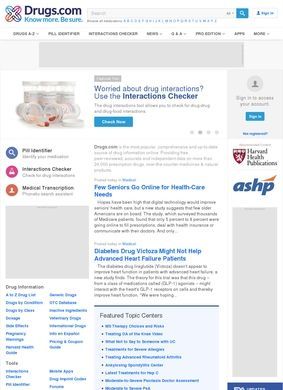
The first thing to settle with any free medical reference is whether you can trust who wrote it, because the internet is full of drug pages published by someone hoping to sell you the drug. So that is where I started with Drugs.com, and the answer reframes everything else. The content is described as pharmacist-reviewed and independent, kept at arm's length from commercial interests. That is a meaningfully different proposition from a manufacturer's product page, and it is the reason Drugs.com gets cited and bookmarked instead of glanced at once and forgotten.
Pharmacist-reviewed content built on independence
Independence is the claim, and the structure backs it up instead of leaning on a slogan. Drugs.com runs as a free, peer-reviewed online reference covering more than 24,000 prescription drugs, over-the-counter products, and natural remedies. The catalog runs deep enough that the long tail of uncommon medications gets the same treatment as the household names. A paid Plus Plan strips advertising and unlocks extra features, but the core reference stays free, which keeps the commercial layer optional and visible rather than baked into the content itself.
Tracking FDA alerts and new drug approvals
Currency is the other half of credibility in a field where guidance changes, and the site keeps several feeds live. An FDA Alerts feed and FDA MedWatch alerts surface safety warnings. A New Drug Approvals tracker logs what has cleared regulatory review. Daily medical news runs alongside the reference material, and the trending coverage clusters around whatever people are actually searching, Ozempic, Mounjaro, Zepbound, Dupixent, Botox among them. That gives a fair read on how closely the editorial side tracks real demand instead of sitting frozen.
Pill identifier, interaction checker, dosage tools
The backbone of Drugs.com is the Drugs A-Z index, browsable letter by letter, with a Spanish-language version running in parallel. Around that index sits a cluster of practical tools, and this is where the site does its most distinctive work. A Pill Identifier matches a loose tablet to its name. A Drug Interaction Checker flags conflicts for anyone taking several medicines at once, and a separate Side Effects Checker and Symptom Checker handle the self-assessment side. Dosage guidelines are spelled out per drug.
Comparing drugs and checking prescription prices
A Compare Drugs tool lines two or more options up side by side. A Drug Discount Card and Price Guide are there for anyone weighing what a prescription costs. There is even a Phonetic Search for the common moment when you know roughly how a drug name sounds but not how it is spelled. Compared with a plain lookup page, the density of features is striking.
Personal med list for tracking your regimen
For someone managing an actual regimen, the My Med List feature lets a user keep a running record of what they take, and that record feeds the interaction checks. It turns Drugs.com from a one-time lookup into something closer to a personal tracker, and it rewards repeat visitors over the occasional searcher. It sits naturally next to the comparison and dosage tools.
From diagnoses to treatment guides in Spanish
The reference also connects diagnoses to treatment. Treatment Guides and a Conditions and Diseases section link a condition to the drugs associated with it. Harvard Health Guides appear on the site, and care guides are published in Spanish as well. None of this is filler, and it points to a resource that wants to be the place you stay, not the page you bounce off.
Separate editions for consumers and health professionals
There are two distinct audiences here, and the build reflects that honestly. General consumers get the plain-language drug pages, the checkers, and the news. Health professionals get a Pro Edition built around clinical-grade content. It is the same underlying database written and presented at two depths, which is a smart split, and Mobile apps push the whole thing onto phones. That last format is the one most people reach for while standing in a pharmacy aisle or squinting at a label at home, so it is the right thing to invest in.
One caveat deserves to be said plainly, and Drugs.com says it too. The site is a reference, not a stand-in for a clinician. The Symptom Checker and Side Effects Checker are framed as ways to shape a question for a doctor or pharmacist, and the whole site reads in that register: thorough on the what and the how, deliberately short of telling anyone what to do. Used that way, the depth of the dosage and interaction data earns its keep, especially for someone juggling several prescriptions who wants to understand the moving parts before a clinic visit. The restraint is a point in its favor, not a gap.
Hold it up against MedlinePlus, the consumer health service run by the U.S. National Library of Medicine, and the contrast does the work of a verdict. MedlinePlus comes with the authority of a government institution and a broader remit across health topics. Drugs.com is narrower and far more tool-driven, with the pill identifier, the interaction checker, the price guide, and the personal med list all built for one job: looking up and managing medication. That focus is the whole pitch of Drugs.com. Someone after a quick official summary of a condition might well start with MedlinePlus.
But for the specific task, working through a particular drug, its dosing, its interactions, what it costs, Drugs.com is the more practical place to land, and you can act on what you find without needing anyone to vouch for it first. The independence claim and the pharmacist review are enough on their own to trust the reference, and the breadth of the catalog plus the daily news and approval tracking are what keep pulling you back. For a free tool, the surprise is how little it asks of you and how much of the routine medication-management job it quietly does.