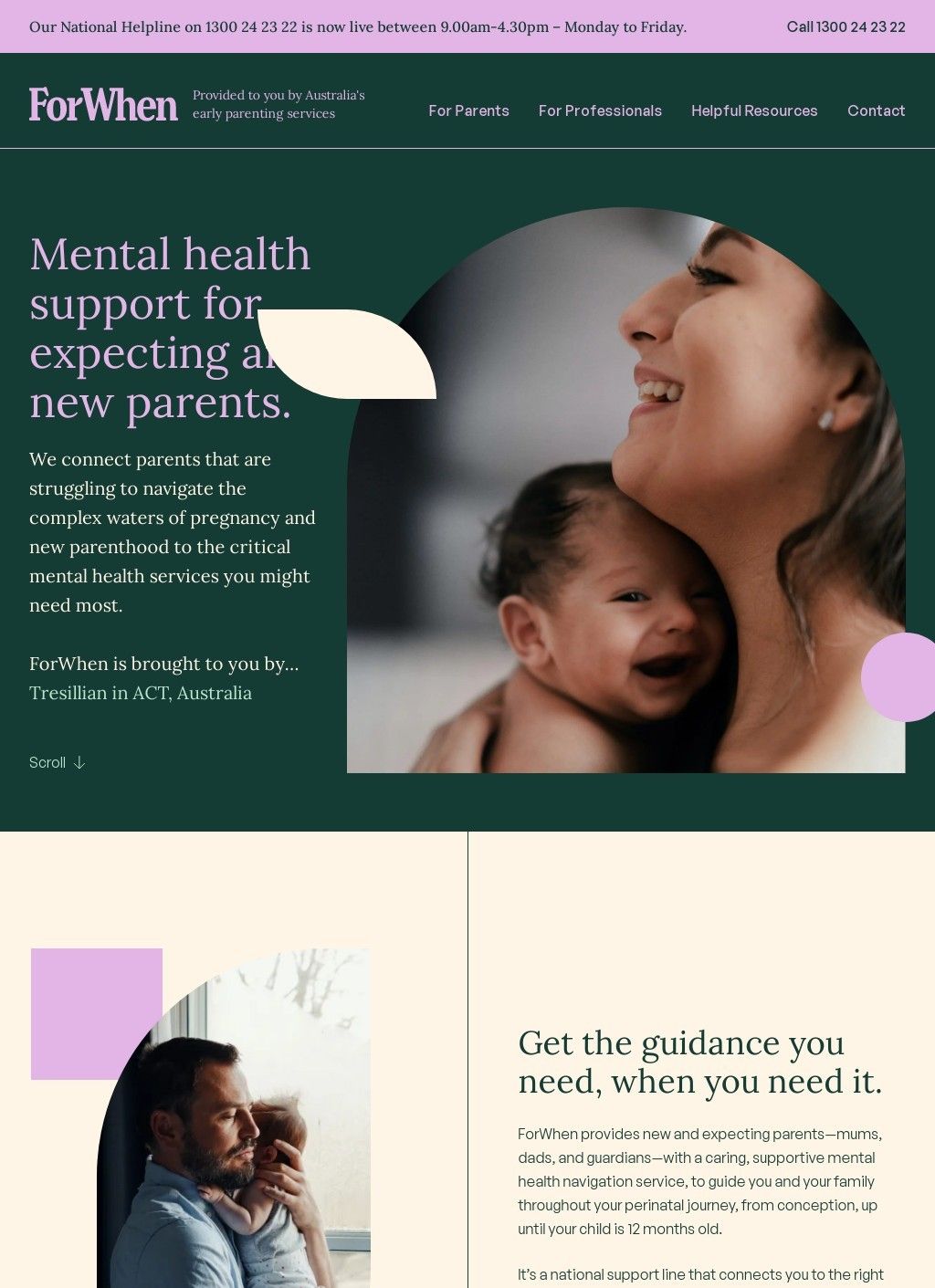
Dial 1300 24 23 22 in Australia and a trained local navigator picks up, listens to where you are, works out what kind of mental health and wellbeing support fits, and then connects you to it. That is the whole premise of ForWhen - Perinatal Mental Heathline, and it is worth being clear about what that means in practice. This is a free national navigation line for people who are pregnant or caring for a baby under twelve months, plus the family members and health professionals around them. It does not run therapy sessions itself. It works out who should, and gets you there.
How the navigation service works
The four-step model the site describes is straightforward enough that it actually tells you something useful before you call. A navigator listens, assesses what is going on, identifies services that match, and makes the connection. I find the honesty of that scope reassuring, because perinatal distress is the kind of thing where the hardest part is often not the lack of services but knowing which door to knock on when you are exhausted and frightened. A bridge between a parent and the right early-parenting service counts as genuine infrastructure, and the line is staffed by people who know the local landscape in each state and territory.
Four-step model for connecting callers
Coverage is genuinely national. ForWhen - Perinatal Mental Heathline is available across every Australian state and territory by working through partner early parenting organisations, with Karitane named as one of them. That partner model has practical consequences: perinatal services are organised differently from one jurisdiction to the next, and a single line that can route into the local provider saves a parent from cold-calling a list of agencies that may or may not take them.
National coverage through partner organisations
The site splits its content sensibly. There is a For Parents area, a For Professionals area aimed at clinicians who want to refer, and a Helpful Resources section. The piece that stands out is the dedicated For First Nations pathway, a separate route for Indigenous families rather than a generic page with a token mention. Perinatal mental health support that ignores cultural safety tends to fail the families who most need it, so building a distinct pathway is a deliberate design decision with real implications for reach.
Separate pathway for First Nations families
Accessibility gets real attention too. Interpreter services are available through ForWhen - Perinatal Mental Heathline, and the National Relay Service is supported for callers who are deaf or have difficulty hearing or speaking. Those two provisions are easy to leave out and frequently are, so their presence tells you the people behind the service thought about who might be locked out of a phone line and quietly removed those barriers.
Interpreter services and relay support
What you will not find here is direct clinical treatment, and the service is upfront about that limit. Calling expecting a counselling session in the moment would lead to a mismatch of expectations. Calling because you do not know where to start, or because the parent in front of you needs more than you can offer, is exactly the use case the line was built around.
What the service does not provide
On the question of whether the model works, ForWhen - Perinatal Mental Heathline has put itself up for outside scrutiny in a way that is uncommon for a helpline. An independent evaluation protocol has been published in BMJ Open and is indexed through PubMed and PMC, and the Parenting Research Centre is running an ongoing outcome evaluation with positive preliminary results. The service also reports complete caller satisfaction in its own figures, which is a strong claim and one worth weighing alongside the independent work instead of on its own. A self-reported satisfaction number is encouraging; a peer-reviewed evaluation protocol and an external research partner are the part that gives the claim some backbone.
Independent evaluation and research partnership
There is also a useful external anchor for anyone wary of who is behind a phone number that promises to sort out mental health support. ForWhen - Perinatal Mental Heathline appears in the Australian Government's Medicare Mental Health directory, which places it inside the recognised national mental health system rather than off to one side of it. Combined with the published research and the Parenting Research Centre case study, the standing of the service is not something a reader has to take on faith.
Recognition within the mental health system
It is worth saying plainly who this is for and who it is not. A parent in immediate crisis needs an emergency line, and ForWhen - Perinatal Mental Heathline does not pretend otherwise. The much larger group sitting in the murky middle, the new parent who is not coping but is not sure it counts as a problem, the partner watching someone slide and not knowing what to do, the GP who wants a referral route that will actually land, that is the population this line was designed around. Operating hours run on weekdays during business hours, which is a constraint worth knowing before you build it into a plan.
Who this service is designed for
Set against the keyword territory of perinatal depression and postnatal mental health, where plenty of listings are underdeveloped commercial pages chasing the same searches, ForWhen - Perinatal Mental Heathline is different in kind. It is a funded, evaluated, government-recognised navigation service with a clear and modest sense of its own role. It knows it is a connector, builds proper pathways for the people who call, and has invited researchers to check whether the connecting actually helps. That combination of institutional grounding, published evaluation, and cultural-safety design is genuinely uncommon in a sector where a phone number and a few paragraphs often pass for a resource.
Business address
ForWhen
138-150 The Horsley Dr, ,
Carramar,
NSW
2163
Australia
Contact details
Phone: 1300242322