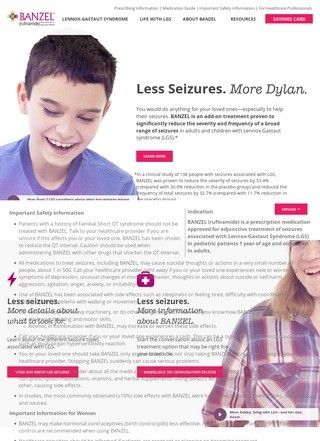
A parent whose child has just been given a diagnosis of Lennox-Gastaut Syndrome usually arrives here with one blunt need: what is this medication the neurologist mentioned, and what does taking it actually involve. That is the moment BANZEL.com is built for. The site is the official manufacturer resource for BANZEL (rufinamide), and it reads as a place to steady yourself and learn, not a place to be sold to. The listing gathered here under LGS Treatment points at exactly that page, and the fit is close.
BANZEL is a prescription antiepileptic drug approved by the FDA in November 2008 for adjunctive use, meaning it is added on top of other seizure medicines, not swapped in for them. The approval covers adults and children one year and older who have seizures tied to LGS, a rare and hard-to-control form of childhood-onset epilepsy. Those two facts, the add-on role and the specific patient group, shape everything the site chooses to explain, and they set the boundaries of what this LGS Treatment page will and will not tell you.
Rufinamide is the generic name behind the brand. Eisai Medical Research Inc. developed and marketed it, with distribution later connected to Jazz Pharmaceuticals, a company known in the epilepsy and LGS space. None of that history is hidden. An informed reader can trace who stands behind the drug, which counts for something when the subject is a medicine a young child may take for years.
What the site lays out for families and clinicians
The content is organized around the questions people bring, and it stays narrow on purpose. This is a single-drug resource for a single syndrome, so it does not wander into general epilepsy coverage. That discipline is a strength.
Someone researching LGS Treatment options can read about how BANZEL is meant to work, what the approval actually permits, and what the daily reality of dosing and side effects looks like, without wading through material about conditions that do not apply to their child.
How the drug works and why it was approved
The About section explains the mechanism in terms a non-specialist can follow and sets out the approval history: what BANZEL was cleared to do, and the evidence that it can reduce how often and how severely LGS-associated seizures strike. This is the part of the site that answers the first anxious question a caregiver asks, which is simply whether the thing works and on what basis anyone can say so.
I appreciated that the framing stays honest about the adjunctive label. The site does not pitch BANZEL as a cure or as a standalone fix. It presents a medicine added to an existing regimen to bring seizure activity down, which is the accurate picture of what this class of drug does in LGS. Families weighing LGS Treatment decisions are better served by that plain description than by anything more dramatic, and the page seems to know it.
Dosing, safety, and the caregiver's daily questions
Prescribing and dosing information sits alongside safety and side-effect detail, and the two belong together. LGS is managed over long stretches, often in children who cannot report clearly how they feel, so the burden falls on parents and caregivers to watch for problems and to get the dose right. The site gives them a reference for both. It is the sort of material a family will return to more than once, not read a single time.
Safety content on a drug site can be perfunctory, buried, or written only to satisfy a regulator. Here it is treated as something a reader genuinely needs. The side-effect information is presented as part of the decision, not tucked away from it. For a medication given to a one-year-old, that placement is one of the clearer marks of a serious LGS Treatment resource.
There are also resources aimed at the practical grind of managing LGS day to day, the kind of support a caregiver needs between appointments. That the diagnosis reshapes a whole household, and the page acknowledges as much, tells you the people who built it thought past the pharmacology.
The audience is clearly threefold: patients, the caregivers who administer and monitor the medicine, and clinicians confirming details before they prescribe. A neurologist double-checking dosing and a frightened parent reading for the first time need different depths of the same facts, and the LGS Treatment material tries to hold both without dumbing either down. It mostly succeeds. The material is specific enough for a professional to trust and plain enough for a family to follow.
What you will not find is breadth beyond the drug itself. This resource for LGS Treatment covers BANZEL and the syndrome it addresses, full stop. If a family needs a wider map of every therapy on the table, they will assemble that elsewhere, in conversation with the care team. As a deep source on one specific option, though, the page does its single job thoroughly.
The tone throughout is measured. Rare-disease drug sites can drift toward either false cheer or clinical coldness, and this one avoids both. It reads like a reference a doctor might point a family toward, which is probably the highest compliment a page like this can earn. For anyone comparing LGS Treatment paths, that steadiness is worth more than polish.
The value of the resource tracks directly to how narrowly it is scoped. Because rufinamide was studied and cleared specifically for LGS, a page devoted only to that use can go deeper than any general epilepsy overview would. The tradeoff cuts both ways: someone whose child has a different seizure disorder will find little here that applies. For the exact population it names, the depth pays off, and the LGS Treatment focus is the whole point rather than a limitation to apologize for.
One more thing worth saying plainly. This is manufacturer content, and a reader should hold it as such. It describes the drug the company makes, and it will naturally frame that drug in its best accurate light. That does not make the information untrue, and nothing here reads as inflated. It does mean the page belongs in a caregiver's research alongside a neurologist's judgment and independent medical sources, as one strong input among several.
Outside opinion on the site itself is scarce, which is normal for a manufacturer page rather than a business listed in a business directory. A search turns up no meaningful pool of independent reviews or star ratings tied to the domain, only mentions of BANZEL in medical literature and patient forums, so there is no outside score to weigh against the content described above.
The page is well built and honest about its own limits. Whether rufinamide, added to a specific child's regimen for a specific and stubborn syndrome, is the right next step comes down to a conversation with a neurologist who knows the case. This site supplies the facts for that conversation; it cannot supply the judgment that follows.