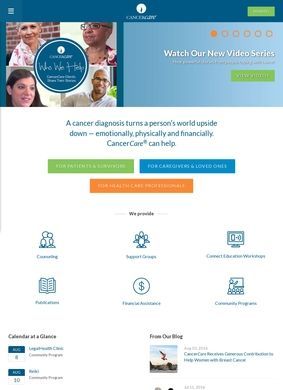
What does a cancer diagnosis cost a family beyond the medical bills, and who picks up the slack? Cancer Care answers that question with a wide menu of free help: counseling from licensed oncology social workers, money toward treatment costs, education sessions led by clinicians, and a navigation service that helps people get around the practical roadblocks between them and their care. It is a national nonprofit, headquartered in New York but reaching patients across the country, and every service it lists carries the same price tag, which is nothing.
Counseling and education from oncology experts
The counseling is the backbone. People can talk to a licensed oncology social worker by phone, online, or in person, one to one or in a group. Grief, fear, and the logistics of treatment do not always fit a single format, and Cancer Care lets the person choose how they want to be met. The Connect Education Workshops sit alongside that, bringing in oncology clinicians and specialists to walk through specific diagnoses and treatments. For someone who has just been handed a diagnosis they cannot pronounce, hearing a specialist explain it plainly is worth a great deal.
Financial assistance for treatment costs
Money is the other half of the picture, and the organization does not dodge it. There are co-pay grants and financial assistance aimed squarely at treatment-related costs, the kind of expenses that quietly drain a household while someone is too sick to work. Resource Navigation rounds this out by helping patients clear the barriers that keep them from care in the first place, whether that is paperwork, transport, or simply not knowing where to turn next. A free library of publications covers diagnoses, treatments, and coping, so the reading is there for anyone who prefers to absorb information at their own pace.
Programs tailored to specific patient groups
Where Cancer Care goes further than a generic helpline is in how specifically it carves up its programs. There are separate tracks for children with cancer, for caregivers, for young adults, and for people who are grieving a death. Each of those groups sits with a different problem, and lumping them together would serve none of them well. A parent caring for a sick child and a young adult facing their own diagnosis are not in the same place, and Cancer Care seems to understand that.
Pet care and wellness during treatment
Then there is the PAW Program, which deals with pet care for patients in treatment. It is an unusual thing for a cancer charity to take on, and it tells you something. A person in chemotherapy who cannot walk or feed their dog faces a small crisis that no oncologist is going to solve, and the fact that someone thought to address it points to an organization paying attention to the texture of daily life well past the clinical chart. Virtual Coping Circle workshops and wellness or exercise classes fill out the community side, giving people structured ways to keep moving and stay connected while treatment grinds on.
Measuring impact through service data
The scale figures printed on the site put numbers to all of this. Cancer Care reports 106,699 hours of support provided, 36,614 participants in its education workshops, 25,609 people receiving financial assistance, and 41,956 calls answered by oncology social workers. Figures like these can read as decoration on a charity page, but here they line up cleanly with the services described, so they come across as a tally of work done. Tens of thousands of answered calls is a lot of people on the worst day of their year reaching a human being.
Free access across all services
The consistency of the no-cost promise is what sets Cancer Care apart across the whole offering. Many organizations in this space gate their better material behind a donation or a membership, but Cancer Care extends the free model to professional counseling, expert-led education, and direct cash help all at once. That combination is rare. Plenty of groups do one of those things; doing all three without charging the patient is the harder thing to pull off, and it shapes who can actually use the service, which is to say almost anyone affected by cancer regardless of means.
The audience is broad by design. Patients and survivors are the obvious core, but Cancer Care also names caregivers and healthcare professionals among the people it serves. That breadth could dilute a smaller charity, yet the program structure here keeps each group in view instead of blurring them into a single category of beneficiary. A social worker looking for a referral source and a newly diagnosed patient looking for their first phone call both have a clear door to walk through.
A search for independent reviews of Cancer Care on the usual rating platforms turned up no aggregated consumer scores, which is common for a professional-services nonprofit of this type. The absence does not reflect poorly on the organization; the population using it is not typically in a position to leave Google reviews. What is available is the IRS nonprofit designation and decades of operational history, a longer track record than many charities in the same space can point to.
If there is a limit, it is the one inherent to any single nonprofit: Cancer Care cannot replace a treatment team, and it does not pretend to. What it does instead is occupy the wide territory between the hospital and home, the part of the cancer experience that medicine alone leaves untended. The emotional load, the bills, the questions that come at two in the morning, the dog that still needs walking. These are the things Cancer Care has organized itself around, and it does so with a coherence that many larger institutions never manage. The published record is enough to act on.