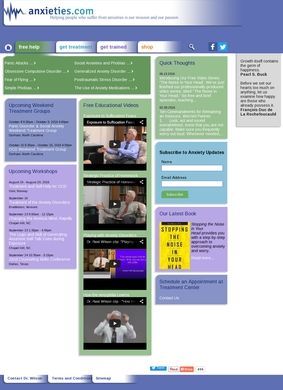
Where does a person turn the first time a panic attack hits and every search result reads like the same recycled pep talk? Anxieties.com answers with free, specific self-help guides written by a clinical psychologist, Dr. Reid Wilson, who has run the site for more than twenty-five years. It bills itself as the internet's longest-running anxiety disorder self-help resource center, and the amount of material behind that claim backs it up once you start reading through it.
The material splits into two clear halves. There is a large body of free reading, and there is a smaller set of paid programs. Both come out of the same practice, the Anxiety Disorders Treatment Center, so the whole thing carries one clinical voice instead of a committee tone stitched together from many hands. That single-authorship quality is unusual for a site this old and this broad, and it is part of why Anxieties.com reads as a genuine resource instead of a lead-generation funnel.
Free guidance and paid programs under one practice
Anxieties.com works for two audiences at once. One is the individual in the middle of a hard stretch, looking for something concrete to read at two in the morning. The other is the mental health professional hunting for treatment methods and continuing education. That dual purpose shapes almost everything on the site, and it is worth walking through what each side actually contains before weighing whether the resource holds up.
What keeps it from feeling like a storefront is the sheer volume of free reading. A visitor can get real substance without paying, and the courses sit alongside that as a deeper option, not a paywall blocking the door. The whole thing is anchored to one named psychologist with a long record in the field, which is more than can be said for the anonymous content mills that crowd this topic.
The free self-help guides
This is the core of Anxieties.com, and it covers a wide slice of the anxiety field. There are guides on panic attacks and panic disorder, on Obsessive-Compulsive Disorder, on fear of flying, on specific phobias, on social and performance anxiety, on generalized anxiety disorder, and on PTSD. A separate section walks through anxiety medications, which is a topic many self-help sites skip because it strays toward clinical territory that most bloggers are not qualified to cover. Free educational videos and a blog round out the reading.
For someone who wants to understand what they are dealing with before deciding on any next step, the breadth here is genuinely useful, and none of it costs a cent. The panic and OCD material in particular reflects the specific angle Dr. Wilson has built his practice on, so the free pages read as an extension of real clinical work instead of a generic overview lifted from a textbook.
The social and performance anxiety section and the fear-of-flying guide are the sort of narrow, high-demand topics people search for by name, and having each treated as its own body of guidance rather than a single catch-all page is a point in the site's favor. A reader arriving with one specific fear will find a page built for exactly that fear, which is not the norm across the wider field of anxiety self-help.
The courses, kits, and the shop
The paid side is where the specific method comes forward. Anxieties.com sells online courses with names like "OCD and the 6-Moment Game" and "Stop Worrying," along with digital kits built around particular problems. There is also a shop selling books and audiobooks the psychologist has written, so a reader who finds the free guides helpful has an obvious path to something more structured.
The pricing is not something I can vouch for from what the site lays out, so a prospective buyer should read each course description closely before paying. Still, the structure is honest. The free guides give you the lay of the land, and the courses on Anxieties.com go deeper for those who want a guided program rather than a stack of articles to work through alone.
Training and CE for clinicians
The professional track is easy to overlook, and for the right reader it is one of the more distinctive parts of Anxieties.com. It runs training and workshops for clinicians, tied to continuing education credit. The site cites participant feedback claiming 98 percent rated a training as excellent or very good.
That figure is self-reported, so treat it as the practice's own testimonial and not an independent audit. It does signal that the training arm of Anxieties.com is an established part of the operation and not an afterthought bolted on to sell a few extra courses. A therapist looking for a concrete anxiety-treatment approach has a real reason to check what the workshops cover.
Finding the practice behind the site
Contact is straightforward. Anxieties.com lists a phone number, a fax line, and a physical address in Chapel Hill, North Carolina, alongside a contact page and links out to Facebook, Instagram, Twitter, and YouTube. For a health resource that someone might first come across through a business directory instead of a friend's recommendation, that transparency counts. A reader can see there is a named psychologist and a real practice address behind the guidance.
The outside reputation is thinner. The Anxieties.com Facebook page shows 84 percent recommend, based on only five reviews. A MapQuest listing for the Chapel Hill practice turns up but carries no visible rating. Beyond that, searches came back empty on Google Reviews, Trustpilot, Yelp, and the rest, so there is no broad public scoreboard to consult here at all. One thing worth flagging for anyone who tries to check further: a separate "Anxieties.com" advertising firm in Phoenix is a plain name collision and has nothing to do with this practice, so any Arizona result belongs to a different business entirely.
Five reviews is a slim public record, and it would be dishonest to pretend that hands the site much crowd validation. What carries the credibility instead is the author's long track record and the visible clinical grounding, not a wall of star ratings. A cautious visitor should weigh that honestly before treating the site as authoritative.
Weighed together, this is a qualified but favorable read. The free guides on Anxieties.com are the real draw: broad, specific, and written by someone with the credentials to write them. The paid courses and the clinician training extend that for people who want more, and the contact details are open enough to trust.
The one honest caveat is that the independent review footprint is small, so a first-time visitor is trusting the depth of the content and the psychologist's name over any large chorus of outside voices. Set against that gap, someone trying to understand panic, OCD, or a specific phobia will still find more substance on Anxieties.com than on the average self-help site covering the same ground.