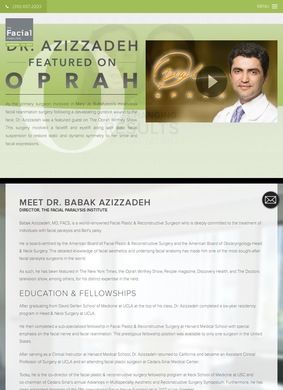
The Facial Paralysis Institute is a Beverly Hills medical practice devoted to disorders of the facial nerve, led by Dr. Babak Azizzadeh, MD, FACS, a board-certified facial plastic and reconstructive surgeon. The focus is narrow and deliberate, built around the face and the single nerve that drives its movement. A patient shopping for a general cosmetic clinic is in the wrong place. A patient whose smile has gone slack on one side, or whose eye no longer closes, is close to the exact person this practice was set up to treat.
Azizzadeh's own credentials point the same way, since a board-certified facial plastic surgeon who has chosen to concentrate on facial nerve disorders has narrowed his practice to a problem most surgeons meet only occasionally.
The surgical menu is where that specialization shows most clearly. Selective neurolysis, gracilis muscle transplant, nerve transplants, facial nerve decompression, and full facial reanimation surgery are all offered under The Facial Paralysis Institute, which spans the range from repairing a damaged nerve to importing living muscle when the original can no longer be salvaged.
These are demanding procedures. A gracilis muscle transplant, for instance, moves living muscle from the inner thigh to the face and wires it to a working nerve so a paralyzed side can move again, which is about as far from a routine cosmetic tuck as facial surgery gets.
A practice that lists such procedures individually, by name, is signaling that it performs them as regular work instead of occasional exceptions squeezed in between simpler cases.
Not every case needs an operating room, and the non-surgical side reflects that plainly. BOTOX, physical therapy, and targeted facial exercises give The Facial Paralysis Institute ways to manage or improve a condition without cutting, which suits patients whose paralysis is mild, recovering, or better left alone. Physical therapy in particular does quiet work here, since much of the progress after a facial nerve injury comes from retraining muscles over weeks rather than from a single intervention.
A set of smaller specialized procedures fills the ground in between: gold eyelid weights, eyelid springs, endoscopic brow lifts, and static slings. Each of those addresses a specific mechanical failure the paralysis produces, such as an upper eyelid that will not drop to protect the eye, and the fact that they are named separately points to a practice that tailors the fix to the fault instead of reaching for one standard operation.
The list of conditions treated reads like a map of what can go wrong with the facial nerve. Bell's palsy is the one most people recognize, and it sits alongside facial paralysis with synkinesis, acoustic neuroma, hemifacial spasm, Ramsay Hunt Syndrome, congenital facial paralysis, and hemifacial microsomia. That spread matters. A child with a rare congenital condition and an adult recovering from a sudden Bell's palsy episode need very different care on very different timelines, and The Facial Paralysis Institute claims real competence across both ends of that spectrum, which is a stronger position than treating one narrow slice well.
Several of those conditions, acoustic neuroma and Ramsay Hunt Syndrome among them, damage the facial nerve as a side effect of something else entirely, so a practice that recognizes them by name is one that has seen the nerve fail in more than the obvious way.
Distance is handled too. Virtual consultations and dedicated support for out-of-town and international patients mean The Facial Paralysis Institute is built to take cases from well beyond Beverly Hills, which is what a genuinely specialized center tends to do once its reputation carries past the local market.
Facial nerve surgery is niche enough that a patient in another state or country may have no comparable option nearby, so a first appointment by video, followed by travel only when surgery is actually on the table, is a practical answer to a real problem. It also filters the caseload toward people who need this specific expertise, which tends to sharpen a practice over time.
How the practice is put together
A single surgeon, however skilled, cannot cover the whole span of facial nerve work alone, and The Facial Paralysis Institute describes a team assembled to do exactly that. This is the part most worth a careful look, because facial reanimation sits at the intersection of several specialties that seldom share one address, and pulling them together is harder than any one operation on the list. A patient who has bounced between a neurologist, an ophthalmologist, and a plastic surgeon at separate offices will understand the appeal of finding them under one name.
The value of the setup is easiest to see in what the practice manages to keep in-house instead of farming out. A facial nerve case that might otherwise mean referrals to three or four separate offices, an eye specialist here, an ear specialist there, stays under one roof from the first diagnosis through the slow work of recovery.
A team built around the facial nerve
The practice lists facial plastic and reconstructive surgeons, oculoplastic surgeons, head and neck surgeons, neuro-otologists, and physical therapists working in concert. That mix is telling. An oculoplastic surgeon handles the eye complications that paralysis brings on, a neuro-otologist supplies the ear-and-nerve expertise that a condition like acoustic neuroma demands, and the physical therapists carry the slow, unglamorous rehabilitation that follows any nerve surgery. Assembling all of them under The Facial Paralysis Institute is the difference between a surgeon who operates and then refers the aftercare elsewhere and a center that shepherds a case from first diagnosis through months of recovery.
For a patient facing a long haul, that continuity is worth as much as any single technique on the surgical list. It also cuts down the number of times a patient has to repeat the same history to a new specialist, which sounds minor until you have done it five times.
What outside listings and patients say
The independent footprint is modest but genuinely positive. A Facebook business page shows 98 percent of reviewers recommending the practice, drawn from 21 reviews, which is a strong ratio even if the sample is small. A Yelp profile exists under The Facial Paralysis Institute name, filed in the Doctors category with 56 photos attached, which confirms an active, established listing, though a specific star rating was not visible in the search results and cannot be quoted here as if it were.
Fifty-six photos is a fuller gallery than a dormant profile carries, which suggests real activity behind the page even without a headline number to point at. A prospective patient can still open that Yelp listing and read whatever individual reviews sit there, which is more useful than a single averaged star anyway.
Smaller review platforms add very little to the picture. A Wowpilot page carries no ratings yet, and a Flokii listing has a reviews section with no rating count showing at all. The honest reading is that the credible outside signal sits in one or two places, chiefly that Facebook recommendation rate, so a prospective patient weighing The Facial Paralysis Institute would do well to read the actual comments behind the percentage rather than trusting the headline figure on its own.
Contact is refreshingly easy to run down. A street address and a phone number both sit directly on the site, so a patient who wants to call the office or map the location does not have to dig through menus to find them. For a practice actively inviting people to travel in, and to book virtual consultations from other countries, putting those basics in plain sight is the right instinct, and it is one thing The Facial Paralysis Institute clearly gets correct.
What the whole record leaves is a practice with deep, narrow expertise, a genuinely multidisciplinary team, and a light but favorable outside reputation. The medicine reads as substantial, and what the online trail lacks in volume it makes up in tone, since nothing in the Facebook numbers or the Yelp listing points the other way. The credentials are stated plainly enough; what is left to weigh is fit, whether The Facial Paralysis Institute is the right match for a given diagnosis and worth the trip to Beverly Hills to find out.
Business address
Facial Paralysis Institute
9401 Wilshire Blvd #650,
Beverly Hills,
CA
90212
United States
Contact details
Phone: 888-470-6432