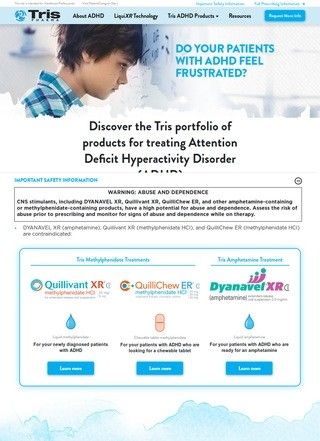
Open the Prescription Treatment Website and you land on four drug entries, each one a click away from its full prescribing PDF. This is a manufacturer portal run by Tris Pharma for its ADHD line. It is built for healthcare professionals and says so plainly, routing consumers off to a separate address. That boundary is correct for a regulated drug portal, and the Prescription Treatment Website keeps to it. Nothing on the landing page tries to be all things to everyone. The structure is a product index, four entries deep, and it stays that way.
Four ADHD medications on the LiquiXR platform
The four share one technology: Tris Pharma's LiquiXR, which produces extended-release suspensions and chewables for patients who cannot or will not swallow a standard pill. DYANAVEL XR is an amphetamine, sold as a tablet and an oral suspension. Quillivant XR is a methylphenidate oral suspension. QuilliChew ER is the same drug class in chewable form. ONYDA XR steps outside the stimulant pattern: a once-nightly clonidine suspension, non-stimulant, for cases where a stimulant is clinically unsuitable. All four are indicated for patients aged six and up, so the prescribing context sits squarely in paediatric and adolescent practice alongside adults.
Formulation choices for different patient needs
Putting all four on one portal earns its keep because the formulation differences are the whole decision. A clinician choosing between these needs them side by side: suspension or chewable, stimulant or non-stimulant, amphetamine or methylphenidate. Pulling that from four separate sites costs time. The Prescription Treatment Website collapses it to one visit. The LiquiXR thread is specific enough to justify a dedicated resource. This is a coherent catalog around a shared delivery mechanism, not a grab-bag of unrelated drugs.
Prescribing information paired with cost assistance
Every product entry links to its full prescribing information PDF, the legally controlled label a clinician reads before writing a script. The Prescription Treatment Website also puts patient savings programs, copay assistance, and coupon resources next to the efficacy data. The pairing is practical. A medication that clears the clinical bar but fails the affordability bar does not get taken, and prescribing happens where clinician, patient, and pharmacy all weigh price against pharmacology. Keeping cost and evidence in the same place tracks how that conversation actually runs.
Direct contact with Tris Pharma representatives
The Prescription Treatment Website carries a rep-visit request form and a Request More Info page. A prescriber after samples, formulary help, or a data-level conversation can reach a Tris Pharma representative straight through it. Reps hold information and product access that public pages do not, and going through the official channel beats hunting down a head-office number. It also keeps the conversation traceable to the right product team. Plenty of pharma portals omit this and leave clinicians to find their own way in, so its presence here is a point in the site's favour.
Contact details and professional inquiry routing
Phone number, a physical address in Monmouth Junction, New Jersey, and a contact page routing to the parent company's main hub are all visible without a login. For a regulated pharmaceutical site, where confirming you are dealing with the actual manufacturer is part of the job, a street address and a working phone line answer that fast. The Request Info form gives professional enquiries a separate channel from general queries, which is sensible routing: a dosing question and an accounts-payable question do not belong in the same inbox. No support email is published. That is normal for pharma portals avoiding spam, and the form plus the phone line cover the same ground.
Why external reviews do not apply here
Searching for the Prescription Treatment Website itself turns up Tris Pharma's own pages, the prescribing PDFs, and unrelated ADHD telehealth platforms. There is no Google rating, no Trustpilot profile, no BBB file attached to it. For an HCP-only manufacturer portal that result is what you would expect. Patients do not leave star ratings on a site they were steered away from, and clinicians rarely review a prescribing resource. So the absence reads as structural, not a red flag. The practical effect is plain enough: nothing external exists to check the site's own clinical claims against, and that job stays with the clinician, using independent literature and formulary databases. There is one strong mitigant, though.
From manufacturer label to independent verification
The label PDFs are the same FDA-controlled documents a clinician would consult anyway, so the core medical content is verifiable at source regardless of what outside reviewers have or have not said. The efficacy summaries and savings figures around them are the manufacturer's own framing, and those deserve the usual caution.
Scope limits and appropriate reference sources
The Prescription Treatment Website is authoritative on exactly four medications and silent on everything else in ADHD treatment. For a regulated manufacturer portal that narrow scope is the right design. A clinician already weighing DYANAVEL XR, Quillivant XR, QuilliChew ER, or ONYDA XR gets full prescribing information, savings tools, and a direct rep-contact path in one stop, with no padding. But the same narrowness is a hard ceiling. Anyone needing comparative data across manufacturers, independent treatment guidelines, or patient-facing materials gets nothing here, and should not pretend otherwise. Those needs belong with Epocrates, UpToDate, or a formulary management platform, each carrying independent editorial oversight across the full landscape. Judge the Prescription Treatment Website for what it is: a reliable single-vendor reference, one-sided on purpose, useful only once the choice of drug has already come down to these four.