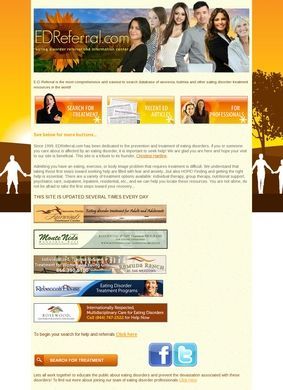
Running since 1999, the Eating Disorder Referral and Information Center is a free-to-use directory of treatment resources built around a provider database that someone in crisis, or someone helping a family member, can search without paying or registering. Its monthly journal goes out to more than 140,000 subscribers, which is a meaningful number for a niche health resource and says something about how long and steadily the operation has been building an audience.
Search tools for treatment providers
The search tools are the Eating Disorder Referral and Information Center's main practical offer. A referral site lives or dies on how well it narrows results, and this one offers several entry points. There is a clickable US state map and an interactive location-based map for people who think geographically. Filters cover insurance coverage, distance, specialty or keyword, provider name, and treatment center type. A separate path handles international searches outside North America, which is worth noting because most American resource lists stop at the border and leave overseas families without guidance.
Conditions and therapy options
Condition coverage runs the expected range: anorexia nervosa, bulimia nervosa, binge eating disorder, ordinary overeating, body image problems, and exercise-related disorders. Treatment filters let a user specify individual therapy, group therapy, nutritional support, or psychiatric care, and sort by intensity level across outpatient, inpatient, and residential programs. Anyone who has tried to find a residential bed that takes a particular insurance plan knows how much time those filters can save.
Blog, newsletter, book reviews
The Eating Disorder Referral and Information Center is more than a searchable database. There is an ED Blog, the newsletter mentioned above, and a searchable archive of past journal issues for people who want to work back through older material. A book reviews section points readers toward published titles on the subject. For families at the start of a long process, having reading material and a running publication in one place spares them some of the scattered searching that usually comes with a new diagnosis.
Financial assistance and support groups
Two pages go beyond what most referral sites bother to include. One covers financial assistance, gathering details on grants, scholarships, and loans aimed at treatment costs. Eating disorder care is expensive and frequently under-covered by insurance, so a page that addresses money directly is more useful than vague reassurance. The other is a free support groups listing, paired with a calendar of events, giving people a no-cost next step when formal treatment is out of reach or still being arranged.
Jobs board serves clinical community
Rounding things out are a jobs board aimed at the clinical community and a section on celebrities who have lived with eating disorders. The jobs board makes clear that the Eating Disorder Referral and Information Center serves treatment providers as well as patients. The celebrity section is the lightest piece of the offering and reads more as an awareness hook than a clinical tool, though it may lower the barrier for a hesitant first-time visitor.
How the membership model works
The provider side runs on paid membership listings, and treatment centers can also advertise on the site or in the journal. That model deserves a plain statement. Because providers pay to be listed, the database is not a neutral census of every clinic in a given area, and a user should treat it as a starting set of options to vet rather than an exhaustive or ranked one. That caveat applies to nearly every referral directory in the health space, and the Eating Disorder Referral and Information Center is open enough about its membership and advertising structure that the trade-off is at least visible.
From external citations to contact gaps
On outside reputation, the picture is quiet. A search across Google, Trustpilot, Yelp, and similar platforms turns up no notable third-party reviews or aggregated user ratings for the Eating Disorder Referral and Information Center. Referral directories rarely attract the consumer-review traffic that restaurants or retailers do, so the absence of ratings is not damning by itself. There is one meaningful external reference: the Eating Disorders Resource Center of Santa Barbara cites the Eating Disorder Referral and Information Center as a trusted resource on its own site. A citation from a regional nonprofit in the same field is more credible than a pile of anonymous star ratings.
Contact transparency is the softer spot. A Contact Us link sits in the footer, so there is a route in, but the homepage does not put a phone number or address front and center. A phone number, a fax line, and a Del Mar, California address do exist and surface through a separate third-party listing, yet pulling that information off the main site takes more effort than it should. For an organization handling a sensitive subject, where a worried parent may want to reach a person quickly, more prominent contact details would close a real gap.
What the Eating Disorder Referral and Information Center does well, it has been doing for a quarter of a century: it puts a broad, filterable map of treatment options, plus money-and-community resources, in front of people at no charge. The membership-funded model and the understated footer contact are the caveats worth keeping in mind. The search tools alone make the Eating Disorder Referral and Information Center worth opening when someone needs to find an inpatient program that takes their insurance within driving distance, and the journal archive and financial assistance pages are there for the longer work that follows the first appointment.