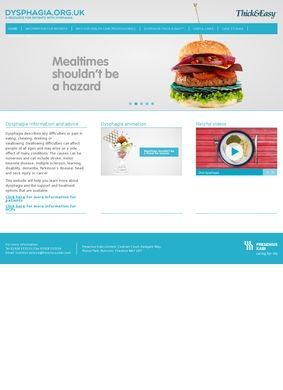
Anchoring everything at Dysphagia.org.uk: Swallowing Difficulties Service is a range of nutritional products formulated at different viscosity levels, made by Fresenius Kabi to help people who struggle to swallow safely. That product line sits at the centre of what the site does, and it tells you a lot about why the pages were written. This is a resource built by a company that sells thickened and texture-modified nutrition, and the educational material around it is genuine, but it is never far from the commercial reason the site exists.
Two tracks for one swallowing condition
Dysphagia is a swallowing difficulty, often a symptom of stroke, neurological disease, head and neck conditions, or simply ageing, and it carries a genuine risk of choking, aspiration, and disease-related malnutrition. A site dedicated to it has a clear reason to exist, and Dysphagia.org.uk: Swallowing Difficulties Service knows who it is talking to. The content is split into two tracks from the start: one for healthcare professionals who want clinical detail, and one for patients and the carers who feed them day to day. Keeping those audiences apart is sensible, because a speech and language therapist and a worried daughter looking after her father need very different things from the same subject.
Everyday guidance for carers
On the patient and carer side, the material covers what dysphagia is, the signs to watch for, and how swallowing problems can be managed in ordinary life. That last part has more immediate value than the clinical theory for most families, because the practical question is usually how to keep someone eating and drinking without frightening them at every meal. Dysphagia.org.uk: Swallowing Difficulties Service leans toward that support role, with guidance written to be readable by people who have no medical background.
Clinical resources for professionals
The professional track points the other direction, toward clinical information that a nurse, dietitian, or therapist might want when working out a management plan. A resource hub gathers materials meant to support safer swallowing, the kind of downloadable or reference content a clinic can hand to a patient. None of this is interactive. There is no symptom checker, no booking tool, no account to set up. Dysphagia.org.uk: Swallowing Difficulties Service is an informational and product-facing site, and it does not pretend otherwise.
That informational character is both its strength and its ceiling. Someone who arrives knowing nothing about thickened fluids or viscosity levels will come away better informed. Someone hoping for a personalised assessment, a forum of other carers, or a way to compare products across rival brands will not find it here, because the only nutrition on offer is Fresenius Kabi's own. The scope is narrow by design, and Dysphagia.org.uk: Swallowing Difficulties Service is honest enough not to dress it up as something broader.
Company behind the site
Dysphagia.org.uk: Swallowing Difficulties Service is operated by Fresenius Kabi Ltd, the UK arm of the Fresenius SE and Co KGaA healthcare group. The site does not hide this, and the company behind it is large and established in clinical nutrition, which lends the medical content a certain credibility. A multinational with a real research and manufacturing base is a different proposition from an anonymous health blog, and that pedigree is worth something when you are reading about something as consequential as choking risk.
Balancing education and product sales
At the same time, the educational pages exist alongside a sales motive. The condition information is accurate and useful, but it routes naturally toward Fresenius Kabi's range, formulated at viscosity levels that map onto recognised swallowing safety standards. That is not dishonest, and it is openly the company's site. A reader simply has to hold the two halves together: the dysphagia explanations are sound, and the product recommendations come from the firm that makes the products. Treating it as neutral, brand-free advice would be a mistake. Treating Dysphagia.org.uk: Swallowing Difficulties Service as a manufacturer's well-built education and support hub is closer to the truth.
For a clinician, that framing is second nature, because they already know how to read pharma and nutrition company resources critically. For a carer who has just been told a relative cannot swallow normally, it is worth noting that the guidance here sits next to a catalogue. Used as one source among several, including an NHS speech and language team, the site has a clear and useful place.
Checking contact details and credentials
Contact and transparency are handled reasonably, if not generously. The homepage does not put contact details front and centre, which takes a moment to work around, since a worried reader should not have to hunt. The Imprint page does carry the substance, though. Fresenius Kabi Limited lists a physical address in Runcorn, Cheshire, a phone number, and a company registration number for England and Wales. That registration detail is the kind of disclosure a serious operator includes and a fly-by-night one skips, and it lets anyone confirm the company at Companies House.
There is a real address and a real phone line behind it, which puts the site well ahead of the many health sites that float without any traceable owner. The placement of that information could be better; the information itself is solid. A reader who wants to verify who is talking to them can do so in a couple of clicks.
Reputation without third-party reviews
On wider reputation, a search did not surface notable third-party reviews or ratings of Dysphagia.org.uk: Swallowing Difficulties Service itself, which is not unusual for a condition resource of this kind. People tend not to leave star ratings on a clinical information page the way they would for a restaurant. The absence cuts both ways: there is no chorus of praise to lean on, and no pile of complaints to worry about either. The credibility here rests on the named company behind the site more than on any crowd verdict.
Dysphagia.org.uk: Swallowing Difficulties Service is a competent, clearly organised resource on a condition that genuinely deserves one, backed by an identifiable healthcare company that discloses who it is. The split between professional and lay readers is well judged, the dysphagia information is accurate, and the support material has practical value for carers. The honest caveat is the one that runs through everything: this is a manufacturer's site, the product range is the destination, and the education is the path to it. A reader who needs a single, authoritative resource on dysphagia as a whole will want to combine it with NHS guidance and a speech and language therapist's input. A reader who wants to understand thickened-fluid options in some depth will find Dysphagia.org.uk: Swallowing Difficulties Service more directly useful.