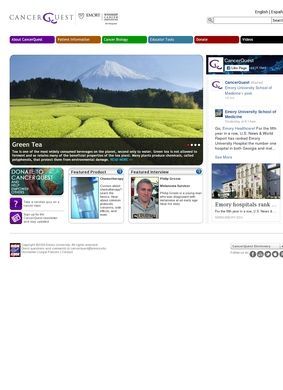
Cancer Quest keeps dedicated resource pages for more than nineteen specific cancers, running from bile duct at one end of the list to thyroid at the other. That detail sets the tone. This is a program built to explain the disease in depth, one cancer type at a time, and its whole reason for being is teaching, through text, graphics, and multimedia, how cancer works and how it is treated.
The audience is broad by design. Cancer Quest serves patients trying to understand a diagnosis, caregivers who need to follow what a doctor said, medical students learning the biology, and general readers who simply want to know more. Few education sites try to reach all four groups at once.
Serving that mix is a genuine balancing act. A patient wants reassurance and clarity, a medical student wants accuracy and detail, and a caregiver wants enough to ask the right questions at the next appointment. The answer here is layering, plain summaries near the surface and deeper biology underneath, so a reader can go as far into the science as they have the appetite for and stop where it stops helping. That design respects the reader's time and state of mind, which for a person newly hit with a diagnosis is worth more than exhaustive coverage they cannot take in.
How the biology is taught
The Cancer Biology section is where Cancer Quest does its most distinctive work. It presents educational materials and graphical guides that break the mechanics of the disease into pieces a non-specialist can follow, using diagrams and illustrations to carry ideas that dense paragraphs of text would lose. Cancer is, at bottom, cellular machinery gone wrong, and pictures do a great deal of the explaining that words cannot. A diagram of a cell dividing the wrong way lands faster than a paragraph describing it, and that speed counts when the reader is anxious and short on patience.
This is the part that separates Cancer Quest from a plain library of articles. Here the graphics carry the lesson themselves.
Cancer biology in graphics
Drill into the biology materials and the approach holds steady. Complex processes, how tumors form, how cells divide out of control, and how the body's systems respond, get laid out visually, step by step. For a medical student, this is revision made concrete.
For a patient, it is a way to grasp what is happening inside their own body without a degree in molecular biology. Cancer Quest pitches the same material at two very different reading levels and mostly pulls it off, which is a harder trick than it looks.
What the Multimedia Center holds
The Multimedia Center gathers the videos, graphics, and teaching tools into one place. Video suits some of this material better than static text ever could, since a process that unfolds over time is easier to watch than to read. For educators, the teaching tools are the draw: ready-made resources a lecturer or a patient-support group can put to use without building visuals from scratch.
Because the same graphics and videos can travel from a patient's late-night search to a lecture hall, the material does double duty, which is efficient use of what a non-profit can produce on a limited budget. It extends the reach of Cancer Quest from solo readers to whole classrooms.
What patients and caregivers find
The For Patients section of Cancer Quest is the front door for anyone facing a diagnosis. It carries cancer type information and treatment details organized around the practical questions a newly diagnosed person asks first: what is this, and what happens next. The organization by cancer type means a caregiver can go straight to the diagnosis in front of them without wading through material on a dozen other conditions first.
Alongside it sits the Treatment Information section, which walks through the main modalities: chemotherapy, immunotherapy, radiation, and surgery. Each is treated on its own terms, which helps a reader see how the pieces of a treatment plan fit together instead of as one blur of medical words. Having plain explanations in a single place matters when a care team throws all four terms at a frightened patient inside one appointment.
The treatment pages in plain terms
What the treatment pages do is demystify. Chemotherapy and radiation are words most people arrive already fearing; immunotherapy is newer and less understood. Cancer Quest lays out what each one does and why a doctor might choose it, which turns a wall of jargon into something a patient can ask informed questions about.
That shift, from passive recipient to informed participant, is the practical value of the whole resource. Even a rough grasp of how the approaches differ changes how a conversation with a specialist goes.
Nineteen cancers, bile duct to thyroid
The dedicated pages for individual cancer types are the deepest layer. More than nineteen specific cancers each get their own resource, so a person diagnosed with a rarer form, bile duct cancer, say, finds material aimed at their exact situation instead of a generic overview. Awareness and funding tend to cluster around the common cancers, which leaves patients with less familiar diagnoses short of accessible, trustworthy reading.
Carrying pages for the uncommon types is where Cancer Quest proves most useful, and where the effort behind it shows.
Who stands behind it
Provenance is worth a straight word. Wikipedia describes Cancer Quest as a non-profit education program based at Emory University, academic backing that lends weight to medical information. The site itself currently credits an operator called Cellular Journeys. Those two facts are not in conflict, but a careful reader will notice that the site is run by a named operator while its academic roots trace to a university program, and the distinction is worth keeping in mind when weighing where the material comes from.
The non-profit framing is worth holding onto. There is no product for sale here and no treatment being marketed, so the material reads as education first. For a subject where a great deal of online information exists to sell something, that independence sets it apart, and the Disclaimer and Legal Policies pages the site keeps make its boundaries explicit.
The Cancer News section keeps Cancer Quest from going stale, carrying articles on research and treatment developments so a returning visitor finds more than a fixed textbook. Medicine moves. A cancer-education site that never updated would quietly mislead the people who trust it most, and for a student the news feed doubles as a way to see textbook biology connect to a live field.
For all its strengths, the resource has clear limits, and they are the limits of any education site. It explains; it does not diagnose or treat. A graphical guide to how immunotherapy works is no substitute for an oncologist, and Cancer Quest does not pretend otherwise. What it offers is understanding, which is a real thing to hand someone whose world has just narrowed to a single word.
The value depends on what a visitor needs. For plain understanding of the biology, the treatments, and a specific diagnosis, Cancer Quest is a deep and unusually well-illustrated place to start reading. Some people want that clarity when a diagnosis lands close to home; others would rather leave the explanations to the doctors and just get through the appointments. Cancer Quest is built for the first group, and it does that job well.