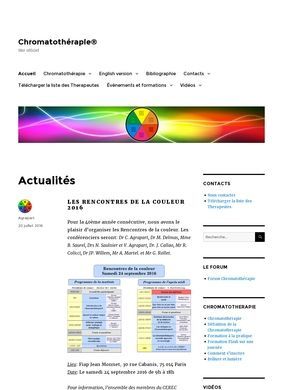
Can colored light treat a burn, a scar or a case of arthrosis? That is the claim sitting at the center of Chromatotherapy, the official site of a color-therapy method built around shining specific wavelengths of colored light at the body for therapeutic effect. The method, spelled Chromatotherapie with an accent on the site and carrying a registered trademark, was developed by Dr. Christian Agrapart, a physician trained in neuropsychiatry who is credited as its inventor.
The premise, as the site states it, is that colored light can act on both biological and psychological levels. Whether a reader accepts that premise or not, Chromatotherapy lays out its stall clearly, and the site is worth walking through on its own terms.
The offering is broader than a single treatment room. Chromatotherapy runs on three legs: patient consultations, a training pipeline for would-be practitioners, and the sale of the equipment the method depends on. Each is documented on the site, and together they explain why this reads less like a lone therapist's page and more like the hub of a small professional network built around one man's method.
What the method sets out to do
The clinical claims are specific, which is unusual for alternative therapy and cuts both ways. Chromatotherapy lists treatments and consultations aimed at trauma, burns, surgical scars, arthrosis, insect bites, herpes and craniocerebral trauma. That is a striking spread, running from the minor to the serious, and the site does not soften it into vagueness. A prospective patient at least knows exactly what conditions the method is being pitched for, which is more than many alternative-therapy sites bother to state.
The specificity is also the thing a careful reader should weigh hardest. These are strong claims, and the site presents them as the method's own framework instead of pointing to independent clinical validation a visitor can check. The principles behind all of it get their own explanatory page, a "definition" section that walks through how Chromatotherapy holds colored wavelengths to act on the body, and there is a CEREC reference, a research center for color and energetics, attached to the method's intellectual side.
Supporting material sits alongside: a section of scientific articles, a set of videos, and a bibliography for anyone wanting to read further into the theory. It is a well-stocked library. Whether the library amounts to proof is a separate question, and one Chromatotherapy leaves the reader to settle.
Consultations and conditions
On the treatment side, Chromatotherapy is organized around consultations delivered by registered practitioners. The list of targeted conditions is the practical core of what a patient is being offered, and it is concrete: scarring after surgery, burns, the joint pain of arthrosis, herpes outbreaks, the aftermath of head trauma. The method's reach into serious territory like craniocerebral trauma is the part that should give a cautious visitor pause, because that is a domain where conventional medicine is heavily involved and where a patient would want to understand exactly what a light-based session is and is not claiming to do.
Chromatotherapy names the conditions plainly, which is to its credit, but naming them is a different thing from proving results, and the site does the first far more thoroughly than the second.
Training in the Agrapart method
The larger share of Chromatotherapy is aimed at people who want to practice the method themselves. There is a formal training pipeline, headed by a 152-hour certification course in what the site calls the Agrapart Method, with future session dates published for prospective students to plan around. For anyone who wants to test the water first, a two-day introductory seminar, a "journee decouverte" or discovery weekend, works as a lower-commitment entry point ahead of the full certification.
That structure, a short taster feeding a long certification, is a sensible way to run professional training, and it signals that Chromatotherapy is being managed as an ongoing practice with a pipeline of new practitioners instead of a static information page. The 152-hour figure is substantial enough to suggest the certification is meant to count for something within the method's own world, though its standing is internal to Chromatotherapy and its trademark holder, not tied to any outside medical accreditation the site points to. A prospective trainee should go in clear-eyed about what the certificate does and does not represent.
Equipment, practitioners and outside standing
Two practical threads run through the rest of the site: how a patient finds someone to treat them, and how a practitioner gets the tools to practice. Both are handled on-site, and both come with a detail worth flagging.
The equipment side is the one to note. The therapeutic devices the method relies on are sold exclusively through a single affiliated company, Laboratoires Helios. Exclusivity like that is common enough in trademarked methods, but it does mean the treatment, the training and the hardware all flow through one connected orbit, which a skeptical reader will register.
Chromatotherapy also publishes books on color therapy, extending the same ecosystem into print, so the theory, the certification, the devices and the reading list are all sourced from within the same circle. That is not automatically a strike against it, since a specialized method reasonably controls its own equipment and materials, but it does mean a buyer has no second supplier to compare against on price or quality, and the whole apparatus rests on the credibility of the founder's original work.
Finding a therapist and the equipment
For patients, Chromatotherapy maintains a "Liste des therapeutes," a directory of registered practitioners that lets a visitor find someone offering the method near them. Some of those practitioners take bookings through resalib.fr, a third-party appointment platform, which is a normal and convenient way to handle scheduling.
The directory is genuinely useful: it turns an abstract method into a list of real people a patient can contact, rather than leaving the idea abstract on the page. This is closer to a curated practitioner list than a general listing you would find in a broad business directory, since everyone on it is tied to the same certification and the same trademark.
Reaching the organization directly is easy, which counts in its favor. Chromatotherapy publishes phone numbers for its Paris training office and a separate Lyon contact, lists office hours running Monday through Saturday mornings, and provides an on-site contact form for written enquiries. For a method that expects patients and prospective trainees to make real appointments, that visible, staffed contact route matters, and the site does not hide behind a single anonymous form.
As for what independent reviewers say, though, the trail runs cold, and honesty requires saying so. Chromatotherapy has a Facebook page with a dedicated reviews tab, but the content there is gated behind a login, and no rating or review count was visible from the outside. Individual therapists in the directory may carry their own client reviews on the resalib.fr booking platform, yet no aggregate third-party rating or review total for the Chromatotherapy organization itself turned up in searching.
Most general web results about color therapy point to the broader topic on reference and medical sites, not to this specific practice. So a prospective patient gets clear information from the method itself and next to nothing from independent reviewers, which is a real gap when the claims being made are this ambitious.
The verdict, then, is a qualified one. As a piece of the web, Chromatotherapy is well organized, transparent about its contact details, specific about what it treats, and structured so that its training and its practitioner directory are easy to navigate. What it cannot supply from within its own pages is the thing a health claim needs most: independent evidence, or even independent reviews, that the method does what it says. Everything, the treatments, the certification, the devices through Laboratoires Helios, the books, sits inside a single trademarked ecosystem built around one physician's framework.
Chromatotherapy makes a strong first stop for someone already curious about color therapy. It does not supply the outside confirmation someone would want before booking a session for something serious, and that gap is the harder question the site leaves standing.