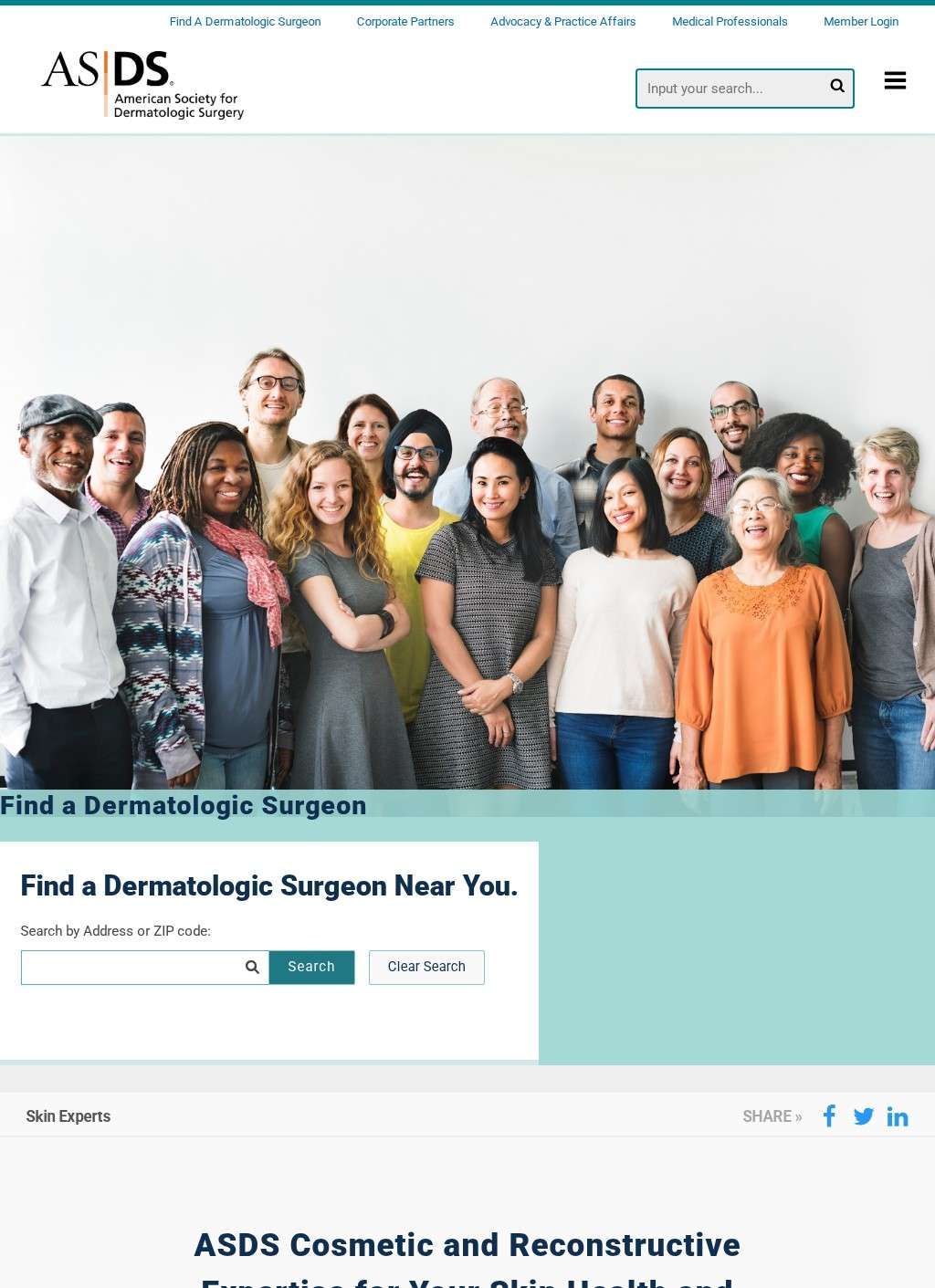
Two very different visitors land on the same site, and the American Society for Dermatologic Surgery is built to send them in opposite directions from the first click. A patient worried about a mole and a board-certified surgeon hunting for continuing medical education credits both arrive at asds.net, and the structure keeps them from tripping over each other. That dual purpose explains most of what the resource does and does not do well.
Finding a credentialed surgeon
On the patient side, the practical centerpiece is the "Find a Dermatologic Surgeon" locator, which lets someone search for a credentialed physician rather than guessing from a general web search. Around that tool sits a layer of condition-specific reading: acne scars, aging skin, birthmarks, skin cancer, vein problems, and disorders of the hair and nails each get their own coverage.
Condition-specific patient resources
The treatment material is organized the way a curious patient would actually think about it, by what gets done rather than by clinical taxonomy. Lasers, injectables, Mohs surgery, chemical peels, and reconstructive procedures all have overviews written for someone deciding whether a given approach fits their situation. I found the age-banded skin-care guidance, running from newborns up through the 50-plus bracket, a smarter piece of organization than the usual flat list of tips, because skin concerns shift across a lifetime and the site treats that as the spine of its advice.
Treatment options organized by procedure
What the American Society for Dermatologic Surgery is careful to define, and this shapes expectations usefully, is its own scope. The organization frames its field as the diagnosis and treatment of both medically necessary and cosmetic conditions of the skin, hair, nails, veins, mucous membranes, and adjacent tissues, handled through surgical, reconstructive, cosmetic, and non-surgical methods. That breadth is worth noticing. Listing this under cosmetic treatments captures only a slice of it. A reader who came expecting nothing but wrinkle injections and peels will find that the same specialty covers skin cancer removal and reconstruction, which reframes the cosmetic work as one branch of a larger medical discipline.
Scope of dermatologic surgery
The other half of the site speaks to the profession itself, and it reads like the working backbone of a national association. Membership enrollment is here, along with continuing medical education, practice management tools, and advocacy resources. The American Society for Dermatologic Surgery also coordinates an annual meeting, the kind of event that anchors a specialty's calendar, and it runs a member portal plus a corporate partnership program aimed at industry exhibitors. None of this is consumer-facing, and the site does not pretend otherwise. A patient browsing treatment pages will rarely stumble into the professional sections by accident, which is a quiet sign of decent information design.
Professional membership infrastructure
Credentialing is the throughline that ties both audiences together. The American Society for Dermatologic Surgery represents board-certified dermatologic surgeons, and that single qualifier is what gives the patient locator its value. Anyone can advertise cosmetic skin procedures; far fewer can claim board certification in this specialty, and a directory built and maintained by the membership organization is a more reliable filter than a paid listing elsewhere. The advocacy and practice-management resources on the professional side reinforce the same point: the American Society for Dermatologic Surgery is the body setting and defending standards for the field, not a referral mill.
Credentialing as the connecting principle
For reach into the wider public conversation, the American Society for Dermatologic Surgery keeps an active social footprint across Facebook, Twitter, Instagram, YouTube, and TikTok, all under the @ASDSSkinMD handle. The presence on TikTok and YouTube in particular shows willingness to meet a younger audience where skin-care questions increasingly get asked, which is not something every long-established medical association bothers with. There are no third-party review platforms that cover the American Society for Dermatologic Surgery in any meaningful volume, which fits: patients do not rate professional membership associations the way they rate individual clinics.
Social media presence across platforms
The honest limitation is that the patient-facing content stays general by design. The American Society for Dermatologic Surgery educates and points you toward a qualified physician; it does not, and should not, diagnose. Someone hoping to self-assess a specific lesion or settle on a treatment from the website alone will hit the natural ceiling of what an association can responsibly publish. The material is a starting point for an informed conversation with a surgeon, and the entire architecture, locator and condition pages and treatment overviews, is pointed at producing exactly that visit.
Patient education with appropriate limits
Weighing it as a whole, the American Society for Dermatologic Surgery does the two jobs it sets for itself with little wasted motion. The patient resources are well sorted and tied to a verifiable credential, the professional infrastructure is substantial, and the scope is stated plainly enough that nobody should leave confused about what dermatologic surgery actually covers. That gap between board-certified dermatologic surgeons and the broader, noisier market of cosmetic skin services has practical consequences, and the American Society for Dermatologic Surgery remains one of the few places where that distinction can be checked against an authoritative source.