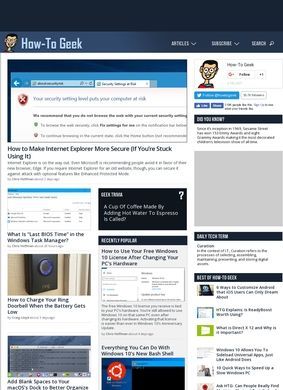
Type "how do I open ports on my router" or "what is the difference between an SSD and an HDD" into a search engine and there is a fair chance a How-to Geek page lands near the top. The site has been doing this since 2006: plain-language walkthroughs for the stuff that trips people up on a Windows machine, a phone, a home network, or a smart plug that refuses to pair. It now sits under Valnet Inc., the same media group that runs a stack of enthusiast publications, and the editorial machinery shows. This is a working consumer-tech reference, not a hobby blog that updates twice a year.
What How-to Geek does well is breadth without becoming shallow. The topic spread covers PC hardware down to the component level (networking gear, storage, peripherals, internal parts), both major desktop operating systems in Windows and Linux, plus software and a bit of programming. Mobile gets real attention on Android and iOS, and from there it branches into smart home, single-board computers like the Raspberry Pi crowd, streaming services, automotive tech, and whatever new category is currently making people nervous. A reader who lands on How-to Geek for one fix tends to find a neighbouring article that answers a question they had not gotten around to asking yet. That sprawl reads as unfocused on a weaker site; here it reads as a map of where ordinary people get stuck with their devices.
How-to library and explainer pieces
The core of the place is the how-to library and the explainer pieces that sit alongside it. A how-to tells you the steps; an explainer tells you why the thing works the way it does, which is the part most quick answers skip. How-to Geek tends to pair the two, so you can fix the immediate problem and walk away understanding it a little better. That is harder to write than a numbered list, and it is the reason the site has held an audience for so long. The articles assume you are smart but not necessarily technical, which is a tone a lot of tech writing gets wrong in one direction or the other.
Refreshed tutorials for current software versions
The seams that typically show on a big content operation are harder to find here than expected. Tutorials get refreshed as Windows shuffles its menus around, because a screenshot from three versions ago is worse than no screenshot at all. The explainer pieces age more gracefully, since the underlying concepts move slowly. Someone who wants conceptual grounding, say how DNS resolves a name into an address, will get a cleaner read here than from a forum thread where the answer is buried under ten replies of bickering.
Emerging technology coverage for general audiences
Coverage of emerging tech is the area worth treating with the usual care any general outlet deserves: competent and timely, though a specialist site will go deeper on a narrow subject. For the broad audience How-to Geek is aimed at, the depth is well calibrated, explaining enough to make you confident without losing the casual reader.
Product reviews and buying guides
The product side is the second pillar. How-to Geek says it evaluates hundreds of devices a year and turns that testing into structured buying guides across consumer electronics. The reviews are stated to be editorially independent, with affiliate commission disclosed where links earn money. That disclosure is the right call and it is the standard a tech publisher should hold itself to. Plenty of sites bury the affiliate relationship and hope you do not notice; stating it plainly is a point in How-to Geek's favour and worth registering before reading any "best of" list here.
Affiliate disclosure and editorial independence
Independence as a stated policy is one thing, and the open question with any review operation that runs on affiliate income is how hard it leans on the highest-commission product. That cannot be adjudicated from the outside, and the disclosure alone does not settle it. What the buying guides do show is organisation by use case and price tier, which is a reasonable sign the testing feeds the recommendation rather than the reverse. Read them as a starting shortlist, then cross-check the item you are about to buy against a second opinion.
One external rater, GadgetReview.com, assigns the site a 42 percent trust score for product-review reliability, though that figure rests on a single category out of fifteen evaluated, so a buyer should treat it as marginal in either direction.
External trust scores and user reviews
Outside opinion of How-to Geek is scattered across the kind of platforms you would expect, and it is mixed in the way real reputation usually is. Trustpilot carries a small set, around eleven reviews, with no aggregate score surfaced. SmartCustomer logs fourteen reviews averaging 3.9 out of 5, which reads as broadly satisfied with the odd grumble. Glassdoor shows seven employee reviews, which tells you more about working there than about the articles. The Facebook presence tied to the brand's review arm sits well above 429,000 likes, a genuinely large following for a tech outlet.
Media Bias/Fact Check ratings
The most useful credibility measure here is the Media Bias/Fact Check assessment, which rates How-to Geek Least Biased and gives it a Very High mark for factual reporting. For a publication whose whole job is telling people the correct way to do a technical task, a Very High factual rating is the metric to weigh. Paired with a long operating history and a named corporate owner, it is a reasonable basis for trusting the instructions you find on How-to Geek. The low third-party review counts are less relevant for an outlet like this than the factual rating.
Limited contact options through web form
Reaching the site is the most limited part of the How-to Geek package. There is a contact link in the footer that leads to a form, and that is the whole route. No phone number and no physical address appear anywhere on the public pages. For a media site funded by advertising and affiliate links this is normal, since most readers never need to reach the newsroom. Anyone hoping to pitch a story or chase a correction is working through a single web form with no fallback, which handles a typo report fine but is light if you need an actual human quickly.
The honest summary is that How-to Geek is a dependable general reference that does its strongest work on operating-system tutorials and conceptual explainers, holds its own on product reviews provided you treat any affiliate-funded buying guide as a shortlist to verify, and offers only a basic contact form. The factual-reporting credentials and the two-decade track record are the most durable points in its favour; the limited contact route and routine affiliate caveats keep it short of unreserved.
Windows or Android users trying to fix something specific, or people who want the reasoning behind a setting instead of only the click path, will find How-to Geek a sensible first stop. The explainer articles reward the extra two minutes of reading. Shoppers researching a laptop, a router, or a smart-home gadget can start from the buying guides there, then confirm the single product they have settled on against one independent source. Those needing to reach the site directly should go straight to the footer form, since that link is the only contact route available.