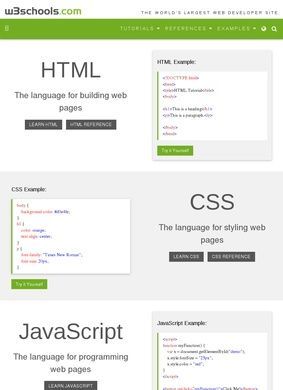
Where does a complete beginner go to write their first line of HTML without paying anything or installing software? For millions of people learning to code, the answer has been W3Schools Online Web Tutorials, and the reasons are easy to see once you spend time poking around the pages. The site teaches web development and programming through short, example-driven lessons you can read in a browser tab and try out immediately, with no account required for most of what it publishes.
Programming languages and frameworks
The coverage across W3Schools Online Web Tutorials is wide. HTML, CSS and JavaScript form the core, which makes sense given the audience, but the catalog runs far past the front-end basics into Python, SQL, PHP, Java, C, C++, C#, R and TypeScript, plus framework and library material on React, Node.js, jQuery and Bootstrap. There is still XML in there, a reminder of how long this resource has been around. Whether someone wants to style a page or query a database, the relevant tutorial usually exists, and it tends to start from zero assumptions about prior knowledge.
Interactive code editor
What separates W3Schools Online Web Tutorials from a static textbook is the interactive editor built into the lessons. The "Try It Yourself" panels let a reader change the sample code and run it on the spot, watching the output update without leaving the page.
That single feature does a lot of the teaching work. Reading about how a CSS property behaves is one thing; nudging the value and seeing the box move is what makes it stick, and the friction of setting up a local environment disappears entirely for a newcomer who just wants to see something happen. A misplaced bracket or a forgotten semicolon stops being an abstract warning and becomes a broken output you can fix in seconds. That feedback loop is fast, and for someone studying alone it substitutes for a lot of the back-and-forth a classroom would provide.
Reference tool for developers
Beyond the lessons themselves, W3Schools Online Web Tutorials doubles as a reference. The pages are structured so that someone who already knows the basics can drop in, look up the exact syntax for a method or a tag, copy a working example, and get back to their own project. This dual role, teaching tool for beginners and quick lookup for working developers, is probably why W3Schools Online Web Tutorials ranks among the most-visited programming reference destinations on the web. People who learned here in their first week keep returning years later to check a detail they half-remember.
Self-assessment on W3Schools Online Web Tutorials is handled through quizzes and exercises at the end of topic sections. They are modest in scope, but they give a learner a way to confirm that a concept landed before moving to the next one, which is more useful than it sounds when you are studying alone with no instructor to nudge you. There is also a "How To" library that collects recipes for common interface components and layout patterns, the sort of thing you reach for when you need a working dropdown or a responsive grid and do not want to reinvent it.
The offering on W3Schools Online Web Tutorials has grown well beyond plain pages. W3Schools Spaces is a cloud-based coding environment for building and hosting web projects, which closes the gap between reading a tutorial and shipping something real. A learner who has worked through the front-end track can put the result somewhere public without wrestling with separate hosting accounts. That progression, from reading to experimenting in the inline editor to building in a hosted space, gives the whole platform a sensible arc for a self-taught developer.
Paid options and certification
Not everything is free, and the paid tiers are worth understanding before you start. W3Schools Pro removes ads, adds offline support and offers personalized learning paths, which appeals to people who study heavily and want a cleaner, more guided experience. Separately, there is a certification program where users can pay to sit assessments and earn verified certificates in subjects like HTML, CSS, JavaScript, Python and SQL. How much weight a hiring manager gives such a certificate varies, but for someone building a portfolio or wanting a structured goal to study toward, it provides a concrete finish line. The core educational content stays open whether or not anyone pays a cent.
There is even a hiring angle, which is rare for a teaching site. W3Schools Jobs is a job board connecting learners with employers, a logical extension of a platform that has spent decades teaching people the exact skills those employers are hiring for. It rounds out the idea that W3Schools Online Web Tutorials tries to follow a learner from first lesson toward first role.
A word on who is behind it, because longevity matters for a reference people lean on. W3Schools Online Web Tutorials is operated by Refsnes Data, a Norwegian software company founded in 1998, and the site is available in multiple languages, which widens its reach to learners outside the English-speaking world. That history shows in how settled the material feels. This is not a project that appeared last year and may vanish next; the tutorials have been refined across many revisions, even if that same age occasionally means an older example sits next to newer best practice.
Trustpilot carries a few thousand reviews of W3Schools Online Web Tutorials with a broadly positive average, and forum threads on Reddit and Stack Overflow reference W3Schools Online Web Tutorials constantly as a first stop for beginners. The criticism that surfaces there is consistent and fair: the explanations favor a quick working result over exhaustive nuance, and someone chasing advanced architecture or edge-case behavior will eventually outgrow the lessons and need official documentation or denser books. For the audience the site targets, that trade is the right one.
The reading experience on W3Schools Online Web Tutorials deserves credit on its own terms. Pages load fast, the navigation between related topics is predictable, and the prose stays short enough that a tired beginner at the end of a long day can still get through a lesson. Each concept arrives with a runnable snippet rather than a wall of theory, and the consistency across hundreds of pages means that once you learn how one tutorial is laid out, you know how all of them work.
The value of W3Schools Online Web Tutorials comes down to breadth, immediacy and zero cost of entry. The free tier alone can carry someone from never having opened a code editor to building and publishing a small web project, and the interactive examples make the learning active instead of passive. The paid layers exist for people who want more polish or a credential, but nobody is locked out of the substance. Open the HTML tutorial, work through a few "Try It Yourself" examples, then look into whether the certification track or a W3Schools Spaces project fits the goal you are studying toward.