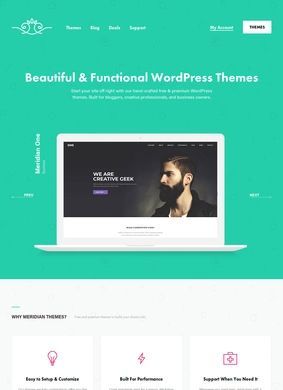
Someone starts a food blog, picks a free WordPress theme that looked fine in the demo, and three weeks later finds it mangling their recipe photos on a phone screen and breaking the moment a popular plugin gets installed. That is the exact frustration MeridianThemes has built its catalog around since 2015. The shop sells a small, deliberate set of themes for people who write and run sites for a living, or close to it: bloggers, small business owners, photographers, and the food-and-travel crowd that lives and dies by how images render on mobile. It is a narrow niche, and MeridianThemes leans into it rather than chasing breadth.
Themes built for content creators
The lineup is short enough to actually understand, which I appreciate after wading through marketplaces that throw hundreds of near-identical options at you. Meridian One and Meridian One Plus lean business. Stoked and Wonderwall are magazine layouts. Dahlia straddles blog and magazine, and The Traveler is built for travel writing. Each theme is sold as mobile-responsive and standards-compliant, with compatibility for the popular WordPress plugins and customization that does not demand a developer. Those are baseline promises in this corner of the market, so they function less as selling points and more as table stakes the shop appears to meet. What separates one theme shop from another at that baseline level is what they have built around the product itself, and that is where this one has something to show.
Support and documentation infrastructure
What gives MeridianThemes more weight than the theme count alone is everything wrapped around it. There is a blog that reads like it is written by people who use WordPress all day: plugin reviews, font guides, hosting coupon codes, and product write-ups on tools like OptimizePress and WPEngine. Documentation lives on its own subdomain at docs.meridianthemes.net, customers get a My Account dashboard, and support runs through both that documentation and one-on-one help. A theme you can install is one thing; a theme you can get unstuck on at eleven at night is another, and the support structure here suggests the second. The blog content in particular, because it covers the broader WordPress ecosystem rather than just the shop's own products, shows that the people writing it are not doing it purely as marketing copy.
Connections to WordPress publishing networks
MeridianThemes is affiliated with WPKube, eCommerceBooth, and DesignBombs, all names that circulate in the same WordPress and web-design publishing orbit. That connection cuts two ways. On one hand it explains the steady stream of blog content and the comfort with affiliate-flavored posts like hosting coupons, which is a normal way these properties earn. On the other, it means the people behind MeridianThemes are embedded in the ecosystem they sell into, not parachuting in from outside it. A shop run by people who also write daily about WordPress is more likely to know when a theme needs updating than one maintained by developers who only follow their own changelog.
Ratings and sales on ThemeForest
The themes also reach buyers through ThemeForest on the Envato marketplace, which is where the most useful outside data turns up. Selling on a marketplace that polices quality and exposes public ratings is a harder test than running a standalone storefront where the seller controls every word on the page. The MeridianThemes ThemeForest portfolio shows 8 ratings against 291 sales. A theme called Florentine sits at 4.69 stars across 13 reviews with 246 sales, and The Traveler holds a clean 5.00 stars over 7 reviews and 291 sales. The Facebook page lists 3 reviews and is not yet rated.
What developer endorsements reveal
None of these are large sample sizes, and anyone expecting thousands of testimonials will not find them here. But the ratings that exist are good, the sales numbers show real customers parting with money, and developer Tom McFarlin has publicly called MeridianThemes a high-quality shop with themes hand-crafted by a team of professionals. A working developer vouching by name carries more than a wall of anonymous five-star clicks from accounts with no posting history. The ratio of sales to reviews on ThemeForest is also worth noting: 291 sales and 7 reviews on The Traveler means most buyers did not bother writing anything, which is the normal pattern for products that worked without incident. The absence of large-scale third-party reviews is a practical gap, not a structural warning sign.
How to reach the support team
On the practical question of reaching the team, the picture is reasonable for a software shop. A contact form sits on the site and there is a support area backed by that subdomain documentation, which handles the questions that do not need a human response. There is no phone number and no physical address on the homepage or about page, which is worth flagging plainly. For a theme business this is common and not alarming, since the real support channel is the ticket queue and the docs, not a phone line. Buyers who want a voice on the other end before they pay should know that route is not available through MeridianThemes.
Does this shop fit your needs?
Putting it together: the catalog is small but coherent, the themes hit the responsiveness and plugin-compatibility bar that this audience needs, the support and documentation are genuinely built out, and the marketplace presence with solid (if low-volume) ratings backs the quality claim. The review counts are low and there is no direct contact number, though neither points to a cut corner on the product itself. The connected properties behind MeridianThemes, WPKube and the rest, add continuity and suggest this is not a one-person side project that goes dark when support tickets pile up. If the catalog fits your niche and you can work with a ticket-based support model, the published evidence here is good enough to move on.
Business address
MeridianThemes