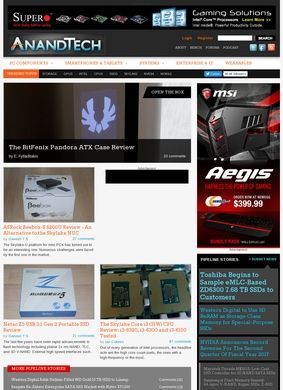
Type the old AnandTech address into a browser and it does not load a review. The root domain now issues a 301 redirect straight to the AnandTech forums, and the editorial magazine that made the name has stopped publishing. What was once a hardware-review destination is, at this address, a discussion board and nothing else.
That is the surprising part, and it reframes everything a visitor thinks they are getting. AnandTech began in April 1997, founded by Anand Lal Shimpi, and spent years doing deep testing of CPUs, GPUs, motherboards, storage and laptops before ending up under Future plc. Ars Technica marked its shutdown bluntly, reporting that AnandTech closed after 27 years as a hardware-review publication. The reviews are archive material now. The URL itself points somewhere else.
For a reader who followed a link expecting one of those deep GPU or storage breakdowns, the redirect is a small shock. There is no reviews tab to click, no new article, no editorial masthead waiting. AnandTech as a review publication is finished, and the domain has been repurposed wholesale into its community.
What the domain serves now
Where the redirect lands is a large, still-moving enthusiast forum, titled around technology, hardware, software and deals. It is organized into long-running sub-forums, and the volume of accumulated discussion is the real asset here.
This is not a graveyard. Active posts show up across multiple sections, several from within the last day at the time of checking. What AnandTech offers now is search depth, decades of threads in which a specific problem has probably already been chewed over by people who owned the exact part.
CPUs, overclocking, and graphics cards
The busiest rooms are the ones a longtime reader would expect from this name. CPUs and Overclocking runs to roughly 78,000 threads and about 1.4 million messages. Graphics Cards is bigger still, near 96,000 threads and 1.6 million messages, with separate AMD and Nvidia sub-forums underneath it. For someone weighing a specific chip or card, that is a deep well of prior argument, troubleshooting, and buying opinion to search before posting a question of their own.
The AMD and Nvidia split under Graphics Cards is the kind of structure that only accretes over decades, and it means a question about a particular GPU generation lands in front of people who were arguing about it the week it launched.
Memory, storage, displays, and the rest
The coverage fans out well past the marquee categories. Motherboards holds around 67,000 threads, Memory and Storage about 22,600, and there are dedicated boards for Displays, Power Supplies, Cases and Cooling (near 47,000 threads), Laptops, Networking (over 54,000 threads), plus a smaller Apple Laptops and Desktops corner and a Peripherals and Components section. The spread mirrors how a builder actually shops, one component at a time, and AnandTech has a room for each stage of the build. For someone who wants a second opinion before spending, that component-by-component structure is more useful than one giant catch-all thread.
The smaller boards show how complete the coverage is. Networking runs past 54,000 threads, Cases and Cooling sits near 47,000, Laptops around 24,000, and there is even a modest Apple Laptops and Desktops corner tucked inside what was always a PC-first crowd. A person troubleshooting a home network or hunting for a quiet case has a specific place to ask, and the odds that someone hit the same wall first are high. A Peripherals and Components board catches the odds and ends that do not fit a named category, from mice to fan controllers.
Old trust against current signals
Reputation is a split story here. GadgetReview ran an "Is AnandTech Reliable?" assessment and landed on a 71.40 percent trust rating, though the fine print is that this covered only 4 of 30 categories it set out to investigate, strong in some (gaming headsets, keyboards) and weaker in others (computer mice), with a related note citing an 87 percent figure in just 1 of 15 categories.
So the trust score is real but narrow, drawn from a sliver of what the site once covered. Wikipedia confirms the history and the Future plc ownership. The employer-side numbers that turn up, such as an AmbitionBox listing at 3.3 out of 5 from four reviews and a Glassdoor presence, measure what it was like to work there, and I would not read them as a signal about the forum's usefulness to a reader.
The gap worth naming is between the brand and the board. The old AnandTech name meant a great deal in hardware testing, and some of that reputation transfers to the forum by pure association, but a trust score built on a handful of product categories is a narrow proxy for whether the discussion a visitor finds today is any good. None of the outside numbers really measure the most useful thing: whether a given sub-forum answers the question a visitor actually brought.
For that, the raw activity is the better guide: threads that drew replies today, in the categories a builder cares about.
Getting in touch, or not
Contact is where the redirected AnandTech gives a visitor almost nothing. The forum homepage shows no phone number, no email, and no physical address, and no separate contact page turned up in this check. The only doors in are the login and registration links. For a community board that is fairly normal, since the point is to post rather than to phone anyone, but a reader hoping to reach an editor or an owner will not find a route from here.
There is no help desk and no published address, nothing past the account gate. That is the trade the redirected AnandTech makes: a visitor gets the archive and the crowd, and gives up any front desk.
What remains, then, is a name doing two different jobs. The reviews people remember are frozen in an archive the redirect no longer even points at, while the address itself now hands over an active forum with millions of accumulated messages and fresh posts landing across the CPU, graphics, networking and cooling boards within the last day.