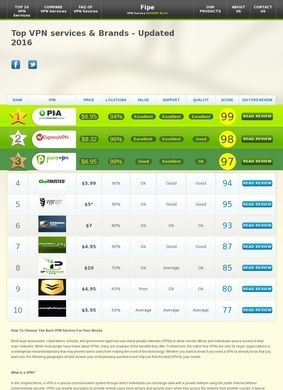
A post on Fipe.net walks a reader through switching on a free Chrome extension to reach a site that Indonesia's Internet Positif filter has quietly blocked. That is the flavor of the whole place: practical, local, aimed at someone who just hit a wall and wants around it. The writing is in Indonesian, the examples come from Indonesian browsing life, and the recurring worry is less about corporate espionage than about an ISP or a government filter standing between a person and a page they wanted to open.
Fipe.net is a blog, plain and simple. No product sits behind it, no subscription, no dashboard to log into. What a visitor gets is a stack of articles about virtual private networks, written for people who are still deciding whether they need one and, if so, which one to pick.
What the VPN coverage gives a reader
The backbone of Fipe.net is explainer and comparison content. Some pieces start from the very beginning, defining what a VPN is for someone who has never used one. Others assume a little more and push into specifics: protocol choices, logging policies, server counts in particular countries, granular points that come into play only once the basics are settled and a reader is comparing two services that both look fine on paper.
One thread on Fipe.net worth noting is the freemium angle: the difference between free and paid services, where the free tier quietly costs something, and when paying is worth it. That framing tends to get skipped on sites chasing affiliate clicks. Seeing the blog treat it head on is a point in its favor, and it is the clearest sign that whoever writes it has used the tools being described instead of summarizing a spec sheet.
Free versus paid, and the tools to avoid
Beyond the straight comparisons, Fipe.net runs at least one list of VPN services and tools a privacy-minded reader should steer clear of. That is a harder article to write than a cheerful roundup of favorites, because it means naming names and taking a position. A blog willing to say "not this one" is doing something more honest than a page that recommends everything with an affiliate link attached.
The best-free-Chrome-VPN angle sits alongside it, geared toward unblocking websites without spending money. It is useful, though free browser VPNs are exactly the category where the privacy tradeoffs bite hardest, and a reader should carry some skepticism into those posts. The site does not oversell the free options, and that restraint counts for something in a niche where most writers just chase the download button.
Getting around Internet Positif
The unblocking tutorials are where Fipe.net feels most rooted in its audience. Indonesia's filtering regime, Internet Positif, blocks a swath of sites at the ISP level, and Fipe.net treats getting past it as a normal thing a normal person might want to do. There are guides on reaching geo-blocked content and on opening pages that a government or ISP has cut off.
Whether that is a service or a workaround depends on a reader's view of the filter itself, but the instructional value is there. The posts on hiding search and browsing history fold into the same privacy-and-access theme, and together they give the blog a coherent center of gravity even without a single formal product line running through it. It reads like a site built by someone who ran into the same wall often enough to start writing down the fixes, then kept writing after the immediate problem was solved.
Credibility, focus, and the reachability problem
Here the picture gets bumpier. When checked, Fipe.net would not load directly at all: the domain failed to resolve, and a second attempt through a scraping service came back with a server error. A blog that cannot be reached is a blog nobody can read, and for a resource whose entire value is its articles, that is a real problem rather than a footnote. It may be a passing outage. It may be something more settled. Either way, a visitor arriving today could well meet the same dead end that turned up during this check.
Contact information could not be confirmed for the same reason. With the Fipe.net pages unreachable, there was no way to verify a contact form, an address, or a phone number, and nothing of that sort surfaced in the search snippets either. For a personal VPN blog that absence is unsurprising, and it does not by itself count against the site; it just means a reader has no obvious way to flag a broken link, correct an outdated tip, or ask a follow-up question about a service the site recommends.
The reputation trail runs cold
On outside opinion, there is almost nothing solid to hang a judgment on. Sitejabber shows a five-star rating for Fipe.net drawn from three reviews, which sounds encouraging until the review text turns out to talk about Ivacy, a VPN product, and not about the blog itself. That looks like contaminated or misfiled feedback, and it should count for nothing in any honest verdict on Fipe.net. It is a rating for something else wearing this site's name.
Nothing cleaner turned up. No Trustpilot presence, no Google reviews, no Better Business Bureau file that belongs to this Fipe.net. Muddying things further, the name collides with a well-known Brazilian institution, the Fundacao Instituto de Pesquisas Economicas, whose vehicle-pricing index and app dominate searches for "FIPE" and have no connection to the VPN blog. A reader trying to vet the blog is likely to wade through a lot of Brazilian car-value results before finding anything about the blog they meant to check.
One more quirk worth flagging: not everything on Fipe.net is about VPNs. There is a movie review sitting in the mix, a write-up of the 2014 film The Imitation Game. It is a fine film and the security-and-secrecy theme is at least loosely related, but it hints at a personal blog that occasionally wanders off its stated beat rather than a tightly maintained VPN resource.
What is a reader left with? A body of Indonesian-language VPN writing on Fipe.net that is well aimed at its audience, honest enough to point out services worth avoiding, and grounded in the real problem of Internet Positif blocking, paired with a domain that would not open, no verifiable way to make contact, and a reputation record that is either empty or belongs to somebody else entirely.
The content of Fipe.net, where it can be reached, reads like it was written by someone who cares about the topic. Getting to it is the catch, and until the site loads reliably and consistently, that catch keeps outweighing the real quality of the writing that sits behind it.
Business address
vpnreview
7402 summitrose st.,
tujunga,
California
91042
United States
Contact details
Phone: 8187203233