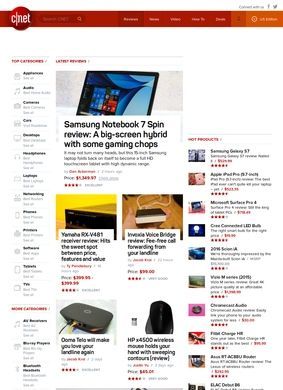
New Cnet is the reviews section of CNET, the long-running technology and consumer-electronics publication that has been testing gadgets since the mid-1990s. The page pulls together the editorial side of that operation: hands-on product reviews, buying guides, best-of roundups, and head-to-head comparisons, all written by staff journalists rather than crowdsourced from anonymous shoppers. If a category of consumer hardware exists, there is a decent chance someone here has written it up.
Product reviews across multiple categories
The breadth is the first thing that registers. Laptops, smartphones, tablets, TVs, streaming sticks, headphones, cameras, smart-home gear, kitchen appliances, software, and a clutch of financial products all sit under the same review umbrella. That spread tells you who the site is built for: a general buyer trying to narrow a shortlist, and the more committed enthusiast who wants to know why one mid-range phone clobbers another on battery life. The same review often has to serve both, which is a harder editorial trick than it looks.
Editorial scores paired with user ratings
What separates New Cnet from a pile of spec sheets is the testing posture. Reviews are written after editors have spent time with the product, and the verdicts carry editorial scores that sit alongside user ratings on the same page. That pairing is useful in a practical way. A laptop can earn a strong editorial mark for build quality and screen while owners flag a noisy fan or flaky trackpad months later, and seeing both numbers side by side gives a fuller read than either one alone. The user ratings act as a quiet check on the staff verdict.
That dual-source approach also shapes how trustworthy a given review feels. Editorial scores come from controlled testing, but they reflect one reviewer's window with one unit. Aggregated user ratings widen the sample to people living with the product through software updates, warranty claims, and the slow reveal of how a device ages. New Cnet putting the two next to each other is a small design choice with real consequences, because it lets a reader weigh polished first impressions against the messier record of ownership. Few competing outlets surface both so directly.
Roundups and buying guides as living documents
Beyond individual write-ups, New Cnet leans heavily on roundups and buying guides. The best-of lists (best laptop under a given budget, best wireless earbuds, best robot vacuum) do the work of comparison for readers who do not want to open a dozen tabs. These pieces tend to be revisited as new models land, so a roundup is closer to a living document than a one-off article. For someone buying once every few years, that maintenance matters more than any single rave review.
Price comparison tools and deal alerts round out the product pages, and detailed specifications sit alongside the prose. The structure rewards a specific kind of visit: you arrive knowing roughly what you want, read the category roundup, then drop into the full review of the two or three finalists. New Cnet handles that funnel well, partly because the categories are deep enough that the finalists are usually already covered. The connective tissue between roundup, review, and spec table is where a lot of the day-to-day value sits. New Cnet has built that path deliberately, and it shows in how little backtracking a typical research session requires.
Inside the financial products section
The financial-products coverage is worth flagging because it sits a little apart from the gadget core. Credit cards, banking, and similar territory get the same review-and-compare treatment, which makes sense as a business move even if it is a stretch from CNET's hardware roots. Readers should keep in mind that reviewing a savings account is a different exercise from testing a camera, and the rigour that applies to one does not automatically transfer to the other.
Affiliate links and commercial transparency
One thing worth naming plainly is the commercial reality behind a site this size. Much of the writing supports purchasing decisions, and roundups frequently link out to retailers. CNET has been transparent about affiliate arrangements over the years, and the reviews still read as independent assessments with real criticism in them, but a careful reader keeps the model in view. A best-of list that always recommends something to buy is doing two jobs at once. To its credit, New Cnet rarely buries criticism, and unflattering verdicts do appear when a product deserves them, which keeps the editorial voice from collapsing into a sales channel.
The news, how-to guides, and explainers that share space with the reviews give the section useful context. A reader weighing a new TV can jump from the review to a piece explaining the panel technology, then to a how-to on calibration, without leaving the property. That adjacency is one of the genuine advantages of a publication that does reviews as part of a wider tech-media operation, instead of a standalone review blog with no surrounding coverage. Because New Cnet has been publishing in this space for three decades, the back catalogue of explainers and guides is deep enough that the context a buyer needs is usually already written.
Consistency across such a large catalogue is the standing challenge, and New Cnet is not immune to it. With dozens of writers and thousands of products, the depth of any single review can vary, and an older piece may lag a firmware update or a price drop that changes the calculus. The roundups mitigate this by being refreshed, but a reader who lands on a deep-linked individual review should check how current it is before trusting the verdict wholesale.
How to use New Cnet effectively
For practical use, the site works best as a starting filter and a sanity check. Reading the editorial take next to the aggregated user score, then cross-referencing the spec table against your own priorities, gets you most of the way to a confident decision. New Cnet does not pretend the buyer's job is finished at the end of an article, and the layered structure (roundup feeding review feeding specs) reflects that. The volume of coverage means most mainstream purchases are already documented, which is the single biggest reason to start here.
The financial and lifestyle categories aside, the heart of New Cnet remains consumer technology, and that is where the testing experience shows most. Camera reviews that discuss real shooting conditions, laptop reviews that report sustained performance instead of a single benchmark run, headphone write-ups that describe how something sounds across genres: this is the material that justifies the time spent reading. The editorial scores are only as good as the testing underneath them, and on the hardware side that testing is substantial. A reader comparing two flagship phones will find the kind of side-by-side that takes hours to assemble independently, already laid out and updated when the next model arrives.