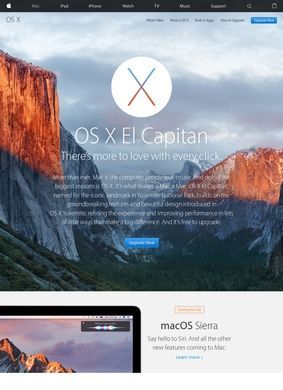
Landing on an entry named Apple OS X Mountain Lion and clicking through to apple.com produces a specific kind of disorientation: the destination is one of the largest technology companies on earth, organized entirely around what it sells today. The operating system this listing is named for is thirteen years old, and nothing on the front page acknowledges it. That mismatch is worth stating plainly before anything else, because it shapes what the resource can and cannot deliver.
Features introduced in version 10.8
Apple OS X Mountain Lion was version 10.8 of the Mac operating system, released in 2012. It folded iCloud into the desktop so documents and settings could follow a user across devices, brought a Notification Center over from iOS, and replaced iChat with the Messages app. Gatekeeper arrived in this release as a security layer controlling which downloaded apps were allowed to run. AirPlay Mirroring, Game Center, Reminders, Notes, and built-in Dictation also landed in 10.8. The system ran only on Intel Macs and was sold exclusively through the Mac App Store, which was a meaningful shift away from boxed install discs at the time. Read against what came before it, Apple OS X Mountain Lion was less a reinvention than a tightening, pulling the Mac and the iPhone closer together feature by feature.
iCloud integration and messaging
The site apple.com is now organized around current products. The M5 generation of MacBook Air and MacBook Pro leads the hardware section, with the Pro line stretching up through M5 Pro and M5 Max. On the phone side there is the iPhone 17 family, including the 17 Pro, the standard 17, a cheaper 17e, and the iPhone Air. The iPad Air runs on the M4 chip, the Apple Watch is on Series 11, AirPods Pro 3 are current, and Vision Pro and AirTag round out the lineup. The macOS name itself has moved on, with the system that Apple OS X Mountain Lion belonged to now carrying a different branding convention entirely. Finding the named subject in that environment takes some archaeology.
Security and app control systems
That does not make the resource useless for historical context. Apple's own pages remain the authoritative description of what each platform does and how hardware and software are meant to fit together. The current macOS owes a clear debt to the groundwork Apple OS X Mountain Lion laid: iCloud sync, a notification system, a unified messaging app, and an app-vetting security model are all still present, just matured across a decade of iteration. Anyone tracing the roots of those ideas can read the present-day platform pages and follow the through-line, even if the specific 2012 version is no longer documented at the front of the site. The history is implied in the lineage, not presented as a reference.
Current Apple ecosystem and services
Beyond operating systems, apple.com has grown into something much wider than a place to read about software. Apple runs a stack of digital services alongside its devices: Apple TV+ for streaming video, Apple Music, Apple Arcade, Fitness+, News+, Books, and Podcasts. There is a financial arm with Apple Card, Apple Pay, Apple Cash, and the Apple One bundle. For anyone evaluating Apple OS X Mountain Lion as a window into the broader ecosystem, this context is relevant: the 10.8 release was an early mechanism for tying all of this together, which is why the iCloud integration in that version felt like more than a convenience feature at the time.
How does apple.com organize its content?
Someone arriving via a business directory entry for Apple OS X Mountain Lion and clicking through is going to land on a thoroughly capable site that documents current hardware, operating systems, services, and technical support in considerable depth. The information is accurate and the platform pages are the closest thing to a primary source on how any of it works. Apple publishes technical specifications, developer documentation, accessibility features, and environmental reports. The depth is not in question. What is missing, at least not labeled and surfaced, is the named subject: a 10.8 operating system reference that the listing implies will be findable.
This is where the entry gets genuinely hard to assess. Apple OS X Mountain Lion is the name on the page and apple.com is a legitimate destination for information about Apple's ecosystem, but the relationship between those two facts is loose. A visitor who wants the historical record of what Mountain Lion changed will find the broad strokes scattered across Apple's current platform material. A visitor who wants to understand the company, its current software, or the arc from 2012 to today will find a well-organized and comprehensive site. The entry serves different visitors differently, and that gap is the most honest thing to note about it.
Historical significance of Mountain Lion
Apple OS X Mountain Lion also sits in an interesting position as an institutional reference point. The 10.8 release is documented in academic and technical literature as the moment Apple began converging the Mac and iPhone experiences in earnest. The decisions made in that version, from Gatekeeper to iCloud Drive to the retirement of iChat, are traceable in the current platform. Apple OS X Mountain Lion did not invent those ideas but it was the version that committed to them publicly and at scale. Pointing to apple.com as the source captures the institution but loses the specificity of that particular commitment, and there is no clean way to recover it from the homepage.
What the listing actually delivers
The practical verdict on Apple OS X Mountain Lion as a listing entry: the source it points to is authoritative, well-maintained, and covers Apple's full range of hardware and software. The lineage from 10.8 to today's macOS runs in one direction and is traceable for anyone willing to read across the current documentation with the history in mind. What the listing cannot deliver is a direct reference to the named release, and anyone who arrived expecting that will leave having learned something about Apple generally rather than the specific version the entry advertises.