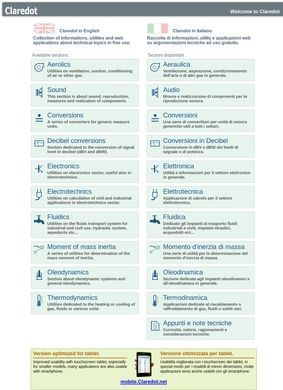
A fast duct-sizing figure or a quick decibel conversion does not always justify firing up a full simulation package, and that narrow gap is exactly what Claredot fills with a set of free web-based calculators. The site describes itself, in slightly rough English, as a "Collection of informations, utilities and web applications about technical topics in free use," and that plain framing is close to accurate. It is a toolbox, and access costs nothing.
The reach across engineering fields is the surprising part. Claredot covers aerodynamics and ventilation, audio and sound engineering, unit conversions of both the general and the decibel-specific kind, electronics and electrical engineering, fluid transport and hydraulic systems, thermodynamics, mass moment of inertia, and oleodynamic (hydraulic-power) systems. That is a wide spread for a free utility, and it points at an audience of practicing technical people and students who need a number quickly across more than one discipline.
Calculators across the engineering disciplines
The value of a site like Claredot rises or falls on whether the tools are the ones a working professional actually reaches for, and the selection here reads as chosen by someone who has done the work. HVAC sits alongside electronics alongside industrial hydraulics, exactly the fields where a quick, repeatable calculation saves real time on a job and where a wrong figure costs it.
What holds the collection together is a single purpose: give a number back fast. None of these are heavy applications that need installing or configuring; a visitor loads a page, enters values, and reads a result. For a technical user mid-task, that speed is the entire appeal of Claredot, and it is why a small tool like this survives even while far bigger engineering software exists. The trade-off is that a fast calculator shows its formula and its assumptions less openly than a full package does, which becomes a live concern the moment the stakes rise.
Aerodynamics, ventilation, and thermodynamics
The airflow and heat side of Claredot covers aerodynamics and ventilation-system work together with thermodynamics, the calculations that sit under HVAC design and any problem involving moving air or transferring heat. For a mechanical or building-services engineer, having ventilation and thermodynamic tools in one place is convenient, since a single sizing problem often crosses both at once. This is the cluster most likely to pull HVAC professionals back to the site more than once, because duct and airflow figures are the routine math that adds up over a working week.
Nobody opens a heavy simulation license to check a single duct velocity, and that everyday gap is exactly what a page like this fills.
Conversions, decibels, and sound
Two of the handiest tools are also the plainest. Claredot includes general unit conversions and a separate decibel-specific converter, the latter a genuinely useful thing to have bookmarked, because decibel math trips people up far more than ordinary unit swaps do. Alongside it sits the audio and sound-engineering section, which extends the same acoustic focus into working problems. A sound engineer or an acoustics student checking a level conversion has a real reason to keep Claredot open in a tab through a project.
The decibel converter by itself is worth a permanent bookmark for anyone who has fumbled the logarithmic math by hand one time too many.
Electronics, hydraulics, and oleodynamics
The other large cluster covers electronics and electrical engineering, fluid transport and hydraulic systems, mass moment of inertia, and oleodynamic systems, the branch dealing with hydraulic power transmission. This is the industrial end of Claredot, aimed at people working on circuits, pumps, and power-transfer machinery. Pulling oleodynamics and general hydraulics under one roof with the electronics tools is a sensible pairing for anyone maintaining or designing equipment, where those fields overlap constantly on the shop floor and a technician rarely gets to stay inside a single discipline.
For a maintenance engineer chasing a fault across a hydraulic press and its control circuit in the same afternoon, having both sets of tools on one site cuts down on tab-switching and half-remembered formulas.
Mobile access and what stands behind the site
Claredot puts real weight on mobile use, which fits how these tools get used. It advertises improved usability on touchscreen tablets and runs a dedicated mobile version at mobile.claredot.net for phones. A calculation tool that works cleanly on a phone is worth more than one that does not, because the moment an engineer or technician needs a quick figure is often on a site visit or a factory floor, not at a desk with two monitors.
Building a separate mobile edition is a deliberate choice that suits the on-the-go nature of the work, and it is a point in the platform's favor that many free tools skip.
The origins are Italian. Site-analysis tools describe Claredot in Italian ("Calcoli on-line e informazioni di carattere tecnico ad uso gratuito"), so an English-speaking visitor may hit occasional translated-sounding phrasing, though the calculators themselves are numbers and units that travel across languages without much trouble.
Contact and reputation are the site's weak spot. The homepage shows no phone number, no email, and no contact form, and there is no contact page at all, only links to terms, a privacy policy, and a site map. For a free tool that asks nothing of a visitor, the missing contact route is a smaller fault than it would be for a shop taking payment, but it does mean a user who spots an error in a calculation has nowhere to report it and no way to ask who maintains the formulas.
Outside verification is just as sparse. No customer-review platform carries ratings for Claredot; the search hits are automated site-valuation and traffic-estimate pages such as siteindices, rankank, and urlm.it, which report things like a ranking score of "112.918 in Italia" but no human feedback at all. One page even lists an estimated Net Promoter Score built from public web data instead of submitted reviews, which is not the same as anyone actually rating the tools.
None of those automated pages tell a visitor whether the results are accurate; they report only that the domain draws some traffic, which is a completely different question. An Italian web-tools blog describes the offerings in a write-up, and that is about the extent of independent coverage.
So the verdict lands mixed, and honestly so. Claredot is a broad, free, mobile-friendly set of engineering calculators that a working HVAC, electronics, or hydraulics person could reasonably keep bookmarked, and the range it covers is broader than a typical single-purpose calculator site offers. What it lacks is any track record a newcomer can check: no reviews, no visible maintainer to reach, no easy way to confirm the formulas are current or the results trustworthy beyond testing them against an already-trusted source. The free price tag cuts both ways.
It drops the cost of trying the tools to nothing, and it also explains the absence of a support desk, a changelog, or any obvious accountability if a formula quietly drifts out of date. For quick, low-stakes numbers it looks handy. For anything a professional would stake a real decision on, the sensible move is to treat Claredot as a fast first pass and verify the result somewhere accountable.