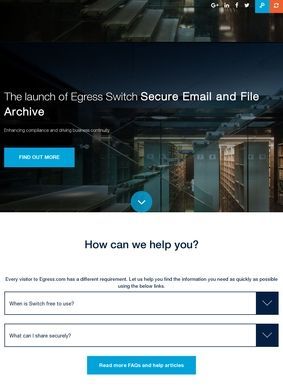
Egress Software Technologies is an email security platform now operating as part of KnowBe4, and the homepage makes that acquisition visible right under the company name. The takeover changes the context for any buyer evaluating the product: what was an independent UK vendor focused on corporate email risk is now a unit inside a large security-awareness business. That alignment with KnowBe4 is not coincidental. Egress Software Technologies built its offering around the idea of human risk management in email, which is exactly how KnowBe4 frames its own market. The fit is coherent, even if enterprise buyers will need to understand which roadmap decisions now happen at the parent level.
Product range across email security
The product range covers five distinct areas. Defend handles inbound phishing, using machine learning and neural networks to catch the kind of impersonation attack that standard filters miss. Prevent watches outbound mail for data loss, whether deliberate exfiltration or the far more common mistake of mailing the wrong person. Protect provides encrypted and certified email for regulated firms that need provable delivery and provable confidentiality. Workspace adds secure team collaboration and file sharing within the same security perimeter. Web Form is the last piece, a controlled channel for collecting sensitive data from external parties through online forms. Each of those covers a real failure mode in corporate communication, and Egress Software Technologies has organized the site around that logic. The navigation follows how problems present, not how product lines are licensed.
Behavioral baseline and adaptive intervention
The adaptive engine underneath, as the platform describes it, builds a behavioral baseline for each user over time and adjusts how it intervenes based on how that individual actually uses email. This is where the Egress Software Technologies model differs from rule-based security tools: the system is watching for deviation from established patterns rather than matching against fixed signatures. The language across the site consistently targets organizations with compliance obligations and security teams in place. There is no version of the pitch aimed at a small shop or an individual user, which keeps the positioning clear and the feature explanations appropriately dense.
Infrastructure separation for different users
On the infrastructure side, Egress Software Technologies has separated the access points sensibly. Recipients who need to open a secured message go to reader.egress.com. Paying customers who need technical help go to support.egress.com. Administrators looking for documentation and product downloads have their own section. A company deploying email security across thousands of users needs these to be distinct, and Egress Software Technologies has set them up that way. The staging of the site reflects operational reality, not marketing convenience.
Sales model requires demo request
The sales model is worth understanding. No phone number appears on the public site, no email address, and no physical address, despite Egress Software Technologies being a UK-headquartered business. Every path for a new contact leads to a demo request form. For a vendor working in enterprise security this is a conscious structure. Large buyers expect a scheduled call with a named account contact, not a switchboard, so the absence of a public phone line is not unusual in this segment. Someone who wants to verify that Egress Software Technologies is a functioning company before engaging will have to book that demo to find out, because the public site does not give them another way in.
Employee ratings and workplace stability
The employer picture, which is the most detailed public record for Egress Software Technologies outside of vendor-curated material, is a strong one. Glassdoor carries 168 employee reviews at 4.6 out of 5, and 92 percent of those reviewers say they would recommend working there. Reviews of the London office push that to 4.8 out of 5 across 78 responses. These are consistent numbers and they are substantial enough to matter. A vendor whose own staff rate working there that highly is more likely to have stable teams behind the product and support function. That is not the same as a customer review, but it is a real data point and one worth including in any vendor assessment.
Customer evidence from curated sources
Customer-facing evidence sits almost entirely on FeaturedCustomers, which lists 54 reviews and testimonials for Egress Software Technologies, plus 55 case studies and 7 customer videos. Case studies in this market tend to include named organizations and real deployment specifics, which is the type of reference material a procurement team wants to read. What is absent is the kind of broad independent scoring you would find on Trustpilot, Google, or similar platforms. No public scores turned up from those sources. For a B2B tool sold through enterprise sales cycles, that absence is not surprising, but it means the external picture rests on employer ratings and curated reference content with no open public scoring behind it.
Putting this together: Egress Software Technologies addresses a specific and real set of problems in corporate email security, has a product range that maps coherently onto those problems, and now operates with the backing and distribution of a major parent company. The technical infrastructure is in order, the customer evidence is substantial even if it is concentrated in one place, and the employer record is genuinely good. The part that requires adjustment is the expectation of engagement.
Egress Software Technologies asks every prospective buyer to start a scheduled conversation through the demo form, and there is no shortcut to a quick pre-sales question. The case study record and the employer data collectively give a reasonably clear picture. An organization that knows what problems it is trying to solve in corporate email will find Egress Software Technologies a credible candidate. The closed-door sales model is the main friction point, and buyers who need a quick self-serve path to information will have to work around it.