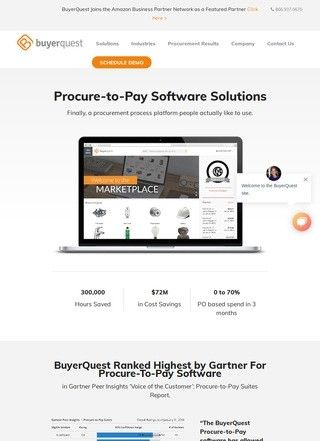
BuyerQuest is a focused procure-to-pay platform with one strong reference customer and almost nothing in the way of public customer reviews, and the published detail is enough to tell whether it belongs on a shortlist. The product is a cloud procurement system aimed at medium and large enterprises. Its central argument is that the buying experience employees get at work should feel as smooth as ordering something online at home, while finance keeps control of every approval and every dollar in the background. The core is a centralized marketplace where staff search for office supplies, IT equipment, services, and shipping, request sign-off, track delivery, and settle payment in one place rather than juggling several disconnected tools across the steps.
Procure-to-pay platform for large enterprises
The procure-to-pay path is the structural spine of what BuyerQuest sells. Purchasing, approval, and accounts payable run as a single connected route, with smart search pulling results across a pre-built supplier network so buyers are not facing an empty catalog on day one. The recurring emphasis is standardization: one consistent process across every department and location, which is where most large organizations quietly leak both money and compliance standing.
Integration depth with existing systems
The integration count stands at 15 or more connections into major ERP and backend systems. That number is load-bearing in enterprise software. A procurement tool disconnected from the finance stack already in place becomes a parallel island that nobody fully trusts and everyone works around. BuyerQuest positions its platform as something that fits into an existing environment, and the consumer-shopping design is meant to shorten onboarding to the point where minimal training becomes a defensible claim. The catch is plain: those 15-plus integrations have to include the specific ERP configuration a given buyer is running, and the published list is what a technical evaluator should check against the stack line by line.
BuyerQuest targets procurement and finance organizations at companies large enough that uncontrolled spending becomes a genuine cost and compliance problem. A smaller shop with a handful of vendors would be overengineering things considerably. A multi-site operation handling thousands of purchases a month is the right fit, and the solution pages stay close to that framing without wandering into adjacent problems the platform does not actually cover.
McDonald's as primary reference customer
The named reference customer is McDonald's, with the company's chief procurement officer cited as a source and compliance and savings listed as the documented outcomes. A global operator with that purchasing footprint does not put its procurement leadership behind a vendor casually, so the single logo counts for a great deal. It is also the only marquee name on display, which is a narrow base of proof, and a prospective buyer should ask for references in their own industry and at a comparable scale. In this corner of enterprise software, that is the normal evaluation route: deals happen through sales conversations and direct reference calls, not public star ratings.
Third-party ratings and review absence
The third-party rating picture splits in a way worth reading carefully. On the software-evaluation side it is nearly empty. ITQlick scores the product at 3.2 out of 5 editorially and 79 out of 100 in comparative analysis, which reads as capable without being a category leader. No ratings appeared on G2, Capterra, Trustpilot, Google, or the BBB.
That absence is ordinary for enterprise procurement, where buying decisions rarely surface as consumer-style reviews, but the practical effect is that a buyer has nothing external to triangulate against except the vendor's own claims and whatever reference calls they arrange. Employee sentiment, by contrast, is documented: Glassdoor carries 17 reviews at 4.2 out of 5 with 86 percent saying they would recommend the company to a friend, and Indeed lists employee reviews as well. Staff who rate an employer well tend to point to a more stable long-term engagement, though internal sentiment does not translate directly into customer experience or support quality.
Direct contact information available
The company publishes a phone number, an email address, and a full Boca Raton, Florida address on the site, alongside a contact page. Establishing first contact carries no friction, which is not a given among enterprise software vendors that prefer to gate everything behind a demo-request form.
Comparing BuyerQuest to Coupa and Jaggaer
Buyers comparing options at this level will likely weigh BuyerQuest against Coupa or Jaggaer. Both carry far deeper public review trails and broader suite coverage across spend management. Where BuyerQuest makes its case is focus: it does procure-to-pay and the supplier marketplace that feeds it, and the product does not appear to overreach. If an organization needs a wide spend-management suite, or wants crowd-sourced customer validation before it ever talks to a sales team, those competitors are the safer starting point and ask less trust upfront.
The verdict lands in the middle, and the published material is enough to place it without guessing. The procure-to-pay scope is coherent, the McDonald's reference is unusually strong for a company this size, and the contact details are open. Set against that, the customer-review record is essentially a single editorial score, so the McDonald's relationship is doing most of the work the public has to go on. The concrete next step is to pull the integration list off the site and match it against the ERP and backend systems already deployed; if the named systems are covered, a demo is a reasonable use of time, and if they are not, the rest of the pitch does not matter.