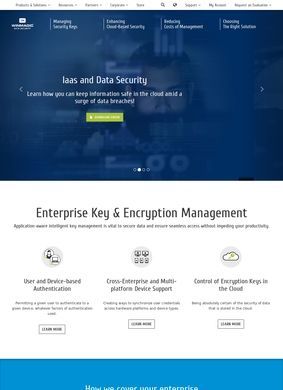
WinMagic Data Security builds its encryption around a single promise: your keys stay with you. That line, taken straight from the product pages, sits behind SecureDoc, the full-disk encryption software that anchors the catalog and runs across Windows, macOS, and Linux.
WinMagic Data Security sells two things that do fairly different jobs. One encrypts data at rest. The other decides whether the person at the keyboard is really who they claim to be.
Two products, two problems
SecureDoc handles the encryption side. It performs full-disk encryption in its own right, and it manages the encryption already built into the operating system, BitLocker on Windows and FileVault on macOS, along with self-encrypting Opal drives at the hardware level. That management layer is easy to skip past on a spec sheet, yet it is where the day-to-day value sits.
Plenty of organisations already run native encryption on every laptop and mainly need one console to govern the lot, prove it is switched on, and recover a locked machine without a helpdesk scramble. The keys-stay-with-you model is the point WinMagic Data Security keeps returning to: the customer holds the keys, not some third party, which is the difference between owning your security and renting it.
MagicEndpoint is the other half, a passwordless authentication platform that verifies identity continuously at the endpoint itself, which the company frames as a defence against phishing and stolen credentials. Kill the password and you kill the thing attackers phish for. That is the logic WinMagic Data Security runs on here, and it lines up with where a lot of corporate security is heading.
Passwordless log-in with MagicEndpoint
Continuous verification at the endpoint is a stronger claim than the usual sign-in-once-and-forget approach, and it is the feature that separates MagicEndpoint from a plain password manager or a bolt-on multi-factor prompt. Instead of checking who you are at the door and trusting you for the rest of the session, the platform keeps asking. It also feeds enterprise passkey rollouts, the phishing-resistant login method the wider industry has started to standardise on.
Whether it delivers in a given environment depends on the fleet and the identity stack, but the design intent is clear, and it fits the security-first framing WinMagic Data Security gives its whole range.
Coverage across systems and sectors
Beyond the two flagship lines, the WinMagic Data Security catalog widens out. There is SecureDoc Linux with remote onboarding, useful for organisations enrolling machines they never physically touch, plus server encryption, file-level encryption for individual documents, and the enterprise passkey work already mentioned. Compliance gets its own track, including CMMC 2.0 packaging aimed squarely at defence contractors who have to meet that bar to keep their government work. For an organisation juggling Windows desktops, Mac laptops, and Linux servers, having one vendor cover all three under a single policy is a real saving in the day-to-day work of running them.
The customer list the company points to is broad: government, including Canadian municipal and federal agencies, plus financial services, healthcare, legal, manufacturing, retail, education, and defence. That spread tells you WinMagic Data Security is built for regulated, audit-heavy buyers more than for a casual single-laptop user. Every one of those sectors carries a legal duty to protect the data it holds, and every one of them has to prove it did so after a breach. Encryption that answers to a compliance officer is the through-line.
Compliance built in for regulated buyers
The CMMC 2.0 focus is worth singling out, because it points at a specific and demanding customer. Defence suppliers do not pick encryption on price alone; they pick what will pass an assessment, because a failed one can cost them the contract that pays the bills.
By packaging its full-disk and endpoint tools against that standard, WinMagic Data Security speaks directly to buyers for whom the audit is the whole point. The same discipline shows up in the government and healthcare framing, where the paperwork around the encryption matters as much as the encryption itself.
Reputation and reaching a person
On outside standing, the coverage is respectable for a business-to-business security vendor. Product reviews sit on G2, generally warm on encryption strength and day-to-day manageability. Gartner Peer Insights carries SecureDoc feedback that praises the centralised console and the visibility it gives administrators. PeerSpot hosts reviews and category mindshare data, 360Quadrants adds positive user reviews, and there is a Better Business Bureau profile for WinMagic Data Security tied to the Mississauga head office. SecurityScorecard even publishes a cyber-risk rating on the vendor, a fitting mirror to hold up to a company that sells security for a living.
No single star rating or review count runs consistently across those sources, so anyone wanting one clean number will not find it. What the spread does show is an established track record for WinMagic Data Security: a product that working administrators have deployed, lived with, and rated on more than one independent platform, which counts for more in this market than a marketing page ever could.
Contact routes that sit behind a click
The WinMagic Data Security navigation offers Contact Sales and a Contact Us page, a Schedule a Demo option, and a separate customer support portal for existing clients. What the front page does not put in front of you is a plain phone number or a street address; you have to click through for specifics.
For a security firm that likely routes buyers through sales and support queues by design, that is a small friction, and the routes stay clearly labelled, so nobody arriving here through a business directory entry or a direct search is left guessing how to start a conversation.
The verdict lands in measured territory. WinMagic Data Security is a credible, focused encryption and authentication vendor with a clear point of view, a defensible key-ownership model, and enough third-party coverage to back the pitch. It aims at compliance-bound organisations, not individuals, and the homepage keeps hard contact details a click or two out of reach.
For a security buyer in government, healthcare, or the defence supply chain, the offering from WinMagic Data Security deserves a demo and a hard look at how the keys are held; for anyone outside that world, it will read as more machinery than the job needs.