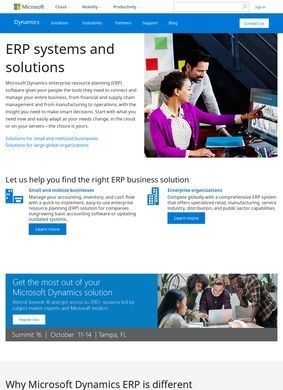
What is surprising about Microsoft Dynamics ERP in its current form is how much of the actual work it now hands to software agents. This is no longer a set of forms a person fills in. Under the Dynamics 365 banner, Microsoft ships pre-built autonomous agents with job titles of their own, a Payables Agent, a Procurement Agent, a Sales Qualification Agent, a Case Management Agent, each meant to take a routine task off a human's desk and run it start to finish.
That shift reframes what the product even is. For years the pitch was a database with good reports; the pitch now is software that acts, and whether a buyer finds that exciting or nerve-wracking says a lot about how ready they are for it.
The finance and supply chain core
Strip away the newer language and Microsoft Dynamics ERP is still an enterprise resource planning system, the software a company runs its money and its materials on. The core products carry plain names: Finance for the ledger and reporting, Supply Chain Management for inventory and procurement, and the operations tooling that ties them together. These are the modules a controller or an operations lead spends the day inside, and they are the reason a company signs a contract this size in the first place.
What Microsoft Dynamics ERP groups as Agentic ERP pulls finance, supply chain and operations into one bundle, and the pitch is that the three share data instead of passing spreadsheets between departments. Real-time business insights sit on top, so a supply-chain shortage is meant to reach the finance forecast without anyone rekeying it. Workflow automation handles the repetitive approvals in between, the purchase orders and sign-offs that otherwise clog an inbox.
That integration is the oldest promise in enterprise software, and the hard part has always been the implementation, not the brochure. A suite that shares data cleanly is worth a great deal; a suite that merely claims to is worth much less, and the page cannot tell a buyer which one they will end up with.
Business Central for smaller operations
Not every buyer needs the full weight of Finance and Supply Chain Management, and Microsoft Dynamics ERP answers that with Business Central, an all-in-one system aimed at small and mid-sized companies.
It folds accounting, sales, purchasing and inventory into a single application, which suits a business that wants one tool instead of a stack of integrated modules. Same family, sized down, and a far gentler starting point for a company that has outgrown spreadsheets but is not ready for a heavy rollout.
Agents that carry out the work
The agent layer is the part Microsoft is pushing hardest, and it is the clearest break from older ERP software. Within Microsoft Dynamics ERP and its CRM twin, the pre-built agents are designed to act on their own: the Payables Agent works through invoices, the Procurement Agent handles sourcing steps, the Sales Close Agent and Sales Qualification Agent push deals along. Generative-AI assistance runs underneath, drafting and summarizing on request.
How well any of this holds up in a live accounts-payable department is the open question that Microsoft Dynamics ERP does not answer on the page. An agent that files invoices correctly nine times and mangles the tenth is a different proposition from one a finance team can leave alone. The concept is legible. The day-to-day reliability is the thing a buyer would want to test hard before trusting it with the ledger, because the cost of a confident mistake in accounts payable is real money.
Building your own in Copilot Studio
Beyond the pre-built set, Microsoft Dynamics ERP lets customers build custom agents in Copilot Studio, so a company with an odd internal process can wire up an agent for it instead of waiting for one to ship. App integrations arrive through the Microsoft Marketplace, which extends the system with third-party pieces. That combination is the standard Microsoft play: a broad platform plus a store to fill the gaps, and it is a large part of why the ecosystem argument holds up.
Copilot Studio is also the hedge against the pre-built agents not quite fitting, since a company that cannot find the agent it needs can, in theory, assemble one, though building and maintaining a custom agent is a project in its own right and not the drag-and-drop afternoon the framing implies.
Where the CRM half sits alongside
The listing files this under ERP, but the same suite carries the customer-facing half, what Microsoft labels Agentic CRM: Sales, Customer Service and Contact Center, Field Service, and Project Operations. For a company already committed to Microsoft Dynamics ERP on the finance side, having sales and service in the same environment is the argument for buying the whole platform instead of stitching a separate CRM onto it.
Field Service and Project Operations extend that reach to companies whose work happens on a job site or across billable projects.
Who the suite is built for
Microsoft Dynamics ERP aims across a wide span, from a small business running Business Central to a large enterprise coordinating finance, supply chain and field teams on the full platform. Sales departments, customer-service groups, finance and operations staff and supply-chain professionals are all named audiences, which is another way of saying the suite tries to be the single system of record for most of what a company does.
That ambition is common to every serious ERP vendor, and it is exactly the ambition that makes these projects long, costly and prone to stalling when the promised integration meets a company's real, messy processes.
That breadth is the strength and the catch at once. A buyer already living in Microsoft's world, with the Marketplace and Copilot Studio close at hand, gets a version of Microsoft Dynamics ERP that reaches into nearly every department. A buyer who does not is signing up for a large platform with a real learning curve, and the agent features raise the stakes on getting the setup right.
Scaling from small business to enterprise
The span from Business Central to the full Finance and Supply Chain stack is the practical draw of Microsoft Dynamics ERP: a company can start on the lighter product and move up as it grows without leaving the family. Whether that upgrade path runs as smoothly in practice as it reads on the page is the kind of thing worth checking against a live reference first, since a migration between tiers is rarely as painless as a vendor makes it sound.
Set against Oracle NetSuite, the obvious alternative for a mid-market finance team, Microsoft Dynamics ERP wins on how tightly it binds to the rest of Microsoft's tools and loses ground for any shop that has no other reason to sit in that ecosystem, which leaves the decision resting less on the agents themselves and more on how much of the buyer's existing stack already carries a Microsoft logo.