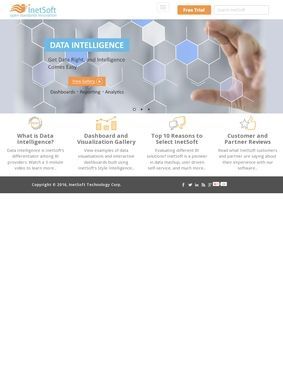
StyleBI comes in three forms, and that split tells you most of what InetSoft is about. There is StyleBI Cloud, a hosted version with dedicated-instance options for teams that want someone else to run the servers. There is StyleBI Enterprise, the on-premises build aimed at larger, heavily customised deployments. And there is StyleBI Open Source, a free community edition published on GitHub. One vendor offering a genuine open-source path alongside a paid commercial product is unusual in business intelligence, where the standard route is a closed platform with a trial period and a sales call.
Three deployment options for different team sizes
InetSoft is a US-based, independent BI software maker, and independence has real consequences in a market dominated by suites bolted onto Microsoft or Salesforce. The product builds interactive dashboards, lets non-technical users explore and visualise data on their own, and includes visual tools for cleaning and transforming data before it ever reaches a chart. Performance caching and cloud-native DevOps management round out the engineering side. None of that is exotic on its own, but the combination, with self-service analytics sitting on top of a real data pipeline layer, covers the workflow most analytics teams run from raw source to finished report.
Cloud hosting with dedicated instances
What InetSoft has chosen not to do is also telling. It has not tried to be a general productivity platform or a sprawling data-science suite. The focus stays on dashboards, visualisation and the pipeline feeding them, which keeps the product legible. A buyer evaluating it knows roughly what they are getting, and a tool that does a defined job well tends to age better than one that promises everything.
On-premises enterprise deployments
The piece that distinguishes InetSoft from a plain dashboard tool is the OEM and white-label story. StyleBI is built to be embedded inside other companies' applications, so a software vendor can drop reporting and visualisation into its own product and brand it as its own. That is a specific commercial use, and it shapes the design: a platform meant to disappear behind someone else's interface has to be flexible about styling, deployment and licensing in ways a standalone tool never bothers with. InetSoft has clearly priced this in.
Self-service analytics built on data pipelines
InetSoft leans on a strong customer list to make its case. It claims deployments at more than 3,000 organisations and says it reaches roughly 5 percent of the Fortune 500. The named accounts are heavy hitters: AT&T, Chase, Toyota, GE, IBM and NASA. Logo lists deserve a pinch of salt, since a single small project counts the same as a company-wide rollout, but names of that weight are not handed out casually. Software clearing serious procurement and security review inside large institutions tends to leave a paper trail, and a list this specific is easier to challenge than a vague claim of scale.
Visual tools for data cleaning and transformation
Where InetSoft sits competitively is clear enough. It goes up against Microsoft Power BI and Qlik, which means it is the smaller, independent option fighting platforms with enormous distribution. That is a hard lane. The open-source edition reads to me like a deliberate answer to it: give developers a free, inspectable way in, and convert the ones who need scale or support into Cloud or Enterprise customers. It is a sensible play for a vendor that cannot outspend the giants on marketing.
Embedding dashboards in other applications
The third-party record on InetSoft is modest but consistent. On G2 the platform holds about 4.3 stars across roughly 46 reviews. Gartner Peer Insights shows a higher 4.8 average, though from only 8 reviews, so the sample is small enough that one or two opinions move the number a lot. Software Advice has named InetSoft a FrontRunner in its BI category, and ITQlick lists it ranked 290 out of 553 BI systems it has reviewed, a middle-of-the-pack placement that fits a capable niche player more than a market leader. Glassdoor carries 26 employee reviews, which says more about the workplace than the software but rounds out the picture. No Trustpilot, Yelp, BBB or Facebook ratings turned up.
OEM and white-label flexibility
None of those figures are huge, and a buyer should read the G2 and Gartner reviews directly rather than trust the averages, but the ratings point the same direction across independent platforms. That cross-platform consistency is harder to manufacture than a high score on a single site where a vendor can focus its energy.
Customer base and market positioning
Contact is the weaker spot. The InetSoft site offers a "Contact Sales" link and a customer support portal, which is the expected setup for enterprise software sold through demos and quotes. A phone number, a plain email and a street address are absent from the homepage; you reach a contact form to start any conversation. For a company courting Fortune 500 procurement teams that is a fair trade, since those buyers expect a sales process anyway. A smaller business hoping to phone someone and get a fast answer will find the path more indirect.
Third-party ratings across independent platforms
That gated contact approach also fits the open-source-to-paid funnel well. Anyone can download the community edition and try it without talking to a salesperson at all, which lowers the barrier far more than a missing phone number raises it. Pull StyleBI from GitHub, build a dashboard against real data, and only then book a Contact Sales call to ask about Cloud instance pricing and OEM licensing once you know whether the tool justifies the rollout cost. Buyers weighing InetSoft against Microsoft or Qlik will want to run that calculation on working software, and the free edition makes that possible without any commitment at all.