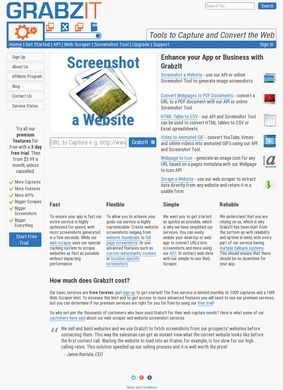
Developers often need to turn a live web page into a clean PDF, or grab a pixel-perfect screenshot of a URL from inside an application, and would rather call an endpoint than babysit a headless browser. That is the job GrabzIt sets out to do. GrabzIt, run by GrabzIt Limited, a company registered in the UK, sits at the point where you hand it a URL or a chunk of raw HTML and it hands back a rendered artifact: an image, a PDF, a DOCX file, an SVG, an animated GIF, even a short video of the page. The capture API is the spine of the whole thing, and most of what the site sells flows out from it.
Capture API and output formats
What makes the capture side interesting is the range of output formats behind one call. Plenty of services will give you a PNG of a page. Fewer will let you ask for the same page as a Word document, a vector SVG, or a looping GIF through the same integration. For someone building a feature that needs to archive pages, generate thumbnails, or produce printable reports, that breadth removes several separate tools from the stack. The HTML-to-format conversion also accepts raw markup as well as public URLs, so a developer can render content that lives behind authentication or is generated on the fly inside their own app.
Web scraping, monitoring, conversion tools
The GrabzIt product line goes wider than capture. There is a web scraper for pulling structured data out of pages, a web monitor that watches a page and alerts you when it changes, and a converter that takes an HTML table and exports it to CSV, JSON, or Excel. A separate tool extracts icons from a URL's metadata, handy for anyone building a link-preview or bookmarking feature. The rendered HTML tool is the quietly useful one: it returns the page's final HTML after JavaScript has run, which sidesteps the usual headache of scraping a site that builds half its content client-side. That same tool can flip a PDF back into HTML, which is a less common direction to support.
Language libraries for API integration
Integration is clearly the priority over hand-holding. GrabzIt publishes libraries across a wide spread of languages (the keyword set alone names PHP, ASP.NET, Java, Perl, Python, Ruby, Node.js, and JavaScript), so the API is meant to drop into whatever backend you already run. For people who do not want to write integration code at all, there are ready-made plugins for WordPress and other platforms. That two-track approach, raw API for developers and packaged plugins for everyone else, covers a fairly broad slice of the market.
Pricing and support
Pricing is laid out in a way that lets you try before paying. A free tier exists permanently, with captures watermarked and capped at lower limits, which is enough to wire up a proof of concept and confirm the thing behaves. Paid premium plans strip the watermark, lift the format and volume ceilings, speed things up, and add extras like custom cookies and custom watermarks. There is also a 7-day free trial that does not ask for a credit card up front, a detail that tends to separate companies confident in their product from ones hoping you forget to cancel. The permanent free option means a hobbyist or a small project can keep using the GrabzIt service at no cost indefinitely, watermark accepted.
Customer reviews across platforms
On reputation, the picture is mixed but mostly leans positive, with one clear soft spot. Trustpilot carries 22 reviews at a 4-star TrustScore, a modest sample but a respectable score. G2 hosts reviews as well, and the tone there runs positive, with reviewers pointing specifically at API reliability and the quality of the documentation, two things developers tend to weigh heavily when they pick a capture vendor. Cuspera has aggregated 65 or more insights, and the service turns up on SourceForge and SaaSAdviser with favorable user quotes, though neither shows an aggregate rating you can lean on.
The blemish is on the Chrome Web Store, where the GrabzIt Limited publisher page averages 2.7 out of 5 stars. That gap between the strong API feedback and the weaker browser-extension score is worth sitting with. The core paid service and its documentation are holding up well for developers who integrate it, while the free browser extensions are pulling lighter ratings, possibly from casual users with different expectations. Anyone whose interest is the API and the libraries should weight the G2 and Trustpilot numbers more heavily; anyone planning to rely on a Chrome extension specifically should go in with eyes open and read those store reviews first.
Getting in touch is functional but not generous on the front door. A /contact/ page is linked from the site, so there is a clear route in, but the home page itself does not surface a phone number, an email, or a street address. For a developer-focused SaaS this is fairly standard practice; support tends to run through tickets and documentation more than a phone line, and the presence of a knowledge base alongside the contact form points to self-serve support being the intended first stop.
Documentation quality for developers
The documentation deserves a second mention because it keeps coming up in the positive reviews, and for an API product that is the part that determines whether you succeed or give up on day one. A service can have the cleanest endpoints in the world, but if the examples are stale or the language libraries are poorly explained, integration stalls. Reviewers crediting GrabzIt on exactly this point are more persuasive than a generic star rating, because they speak to the experience of actually wiring the thing into a project. That is the kind of feedback worth tracking on a GrabzIt integration decision.
There is a coherence to the GrabzIt catalogue that not every multi-tool SaaS manages. Capture, scrape, monitor, convert, render: every one of these is a variation on the same underlying problem of programmatically getting at and transforming web content, so the tools reinforce each other rather than feeling bolted together. A team that adopts GrabzIt for screenshots may well find the GrabzIt scraper or the table converter solves the next problem on their list without onboarding a new vendor. That kind of overlap is where a platform earns repeat use.
Taken together, this is a focused, developer-leaning utility company with a solid core product, credible support material, and a fair pricing ladder. The format breadth on the capture API and the rendered-HTML tool are the standout pieces of engineering. The Chrome extension ratings are the one number that breaks the pattern, and they are specific enough that they should steer extension-only users toward checking that store page rather than assuming the strong API reputation carries across. The free tier and the no-card trial mean the cost of finding out is close to nothing.
Business address
GrabzIt
London,
United Kingdom