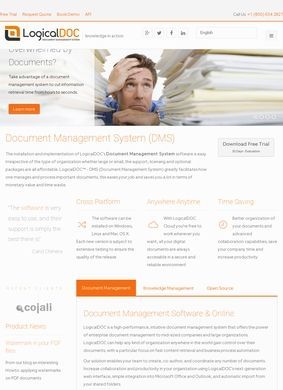
A growing company hits the same wall sooner or later: contracts, invoices, signed PDFs and revised drafts pile up across shared drives and email threads until nobody can say which version is current or who approved it. LogicalDOC is built for exactly that mess. It is a document management system from an Italian vendor based in Carpi, near Modena, and it treats a document not as a file sitting in a folder but as something with a history, an owner, a version trail and a place in a workflow.
Document lifecycle management features
The product spans full-text and OCR search, so scanned paperwork becomes findable text instead of dead images. There is electronic signing, version control that keeps older drafts retrievable, and workflow automation that routes a document from one person to the next for review or approval. The Microsoft Office angle is handled directly: Word, Excel and Outlook tie into the system, and there are collaboration and co-editing tools for teams working on the same file at once. Mobile access rounds out the picture for people who need to pull up a document away from their desk.
None of these features is exotic on its own, but the combination addresses the full lifecycle of a document instead of a single slice of it. The OCR and full-text search in particular tend to be where a system like this either proves its worth or falls flat. A law firm that has scanned twenty years of case files gains nothing from a tidy folder structure if it cannot search inside the scans, and that is the gap LogicalDOC sets out to close. The version trail does similar work on the other end, preventing the familiar situation where three people are editing what they each believe is the master copy.
Deployment options across cloud and on-premise
Where LogicalDOC separates itself from a lot of cloud-only competitors is the range of ways you can run it. You can take the cloud-hosted version, install it on your own servers on-premise, or split the difference with a hybrid-cloud setup. That flexibility matters to organisations bound by data-residency rules or internal policy about where files are allowed to live. It runs on Windows, Linux and macOS, and it even hooks into NAS hardware from QNAP and Synology, which is a practical touch for smaller offices that already store everything on a network drive.
Free Community Edition for evaluation
There is also a free open-source Community Edition, which is unusual in this market and gives a genuine path to evaluating the software without a sales call. For teams that need to make a case to finance before any purchase, that lowers the barrier considerably. Alongside it sit the commercial pieces: a free trial download, a bookable live demo, quote requests, professional support, and published API documentation for anyone planning to wire the system into other software.
The open-source edition deserves a second mention because it shapes how a buyer can approach LogicalDOC. A small IT team can spin up the Community version, load real documents, and see how the search and workflow behave with their own data before a single euro changes hands. If it fits, the upgrade path to a supported commercial tier is already mapped out. That kind of low-commitment evaluation is rare among enterprise content management vendors, most of whom gate everything behind a demo request.
Target industries and use cases
The audience the vendor aims at is broad but coherent. Mid-sized to large enterprises are the core, with specific attention to healthcare organisations, law firms, construction companies, and research and sales teams. Those are all settings where document trails carry real consequences, from compliance to billing disputes, and where version control stops being a convenience and becomes a requirement.
Global presence and contact information
The company is not a single-office operation. Beyond the Italian headquarters, LogicalDOC has offices in Fair Lawn, New Jersey, and in Germany, which puts it on both sides of the Atlantic. Contact information is laid out plainly: a phone number and the Carpi street address appear directly on the site, and demo and quote request forms are there for anyone who wants to move toward a purchase. That openness counts for something in a category where some vendors hide behind a single web form.
Third-party reviews across multiple platforms
Outside opinion is easy to find and broadly favourable. LogicalDOC shows up on G2 with positive sentiment, on Capterra and Software Advice with verified user reviews, and on GetApp and SourceForge as well. Trustpilot carries five reviews, which is a small number but not inconsistent with software sold through enterprise sales cycles rather than self-serve checkout. BetterBuys has also published an editorial review. A consistent tone spread across several independent platforms tells a buyer more than a single high-volume rating on one site would.
The honest caveat is scale of feedback rather than substance. Document management is a crowded field, and a buyer comparing options will likely also look at something like M-Files, which competes hard on metadata-driven organisation and has a deeper bench of public reviews. Against that yardstick, LogicalDOC trades some review-count heft for a wider deployment menu and the open-source on-ramp that M-Files does not offer. An organisation that wants on-premise control, a free edition to pilot, and a vendor willing to publish its address and phone number will find LogicalDOC worth investigating seriously.
Business address
LogicalDOC
14-25 Plaza Road, Suite N-3-5,
Fair Lawn,
NJ
07410
United States
Contact details
Phone: +1 (844) 576 0494