Clutch holds 283 reviews on Trustpilot at roughly four stars. That number is worth sitting with, because Clutch's entire commercial argument is that it can be trusted to vet other businesses. Tens of thousands of agency reviews are hosted on the platform itself; the external commentary on Clutch as a product buyers actually use is comparatively modest in count. That asymmetry does not make the platform useless, but credibility here rests on methodology and data architecture, not on any groundswell of independent buyer testimony about the Clutch experience specifically.
How filtering works in the developers section
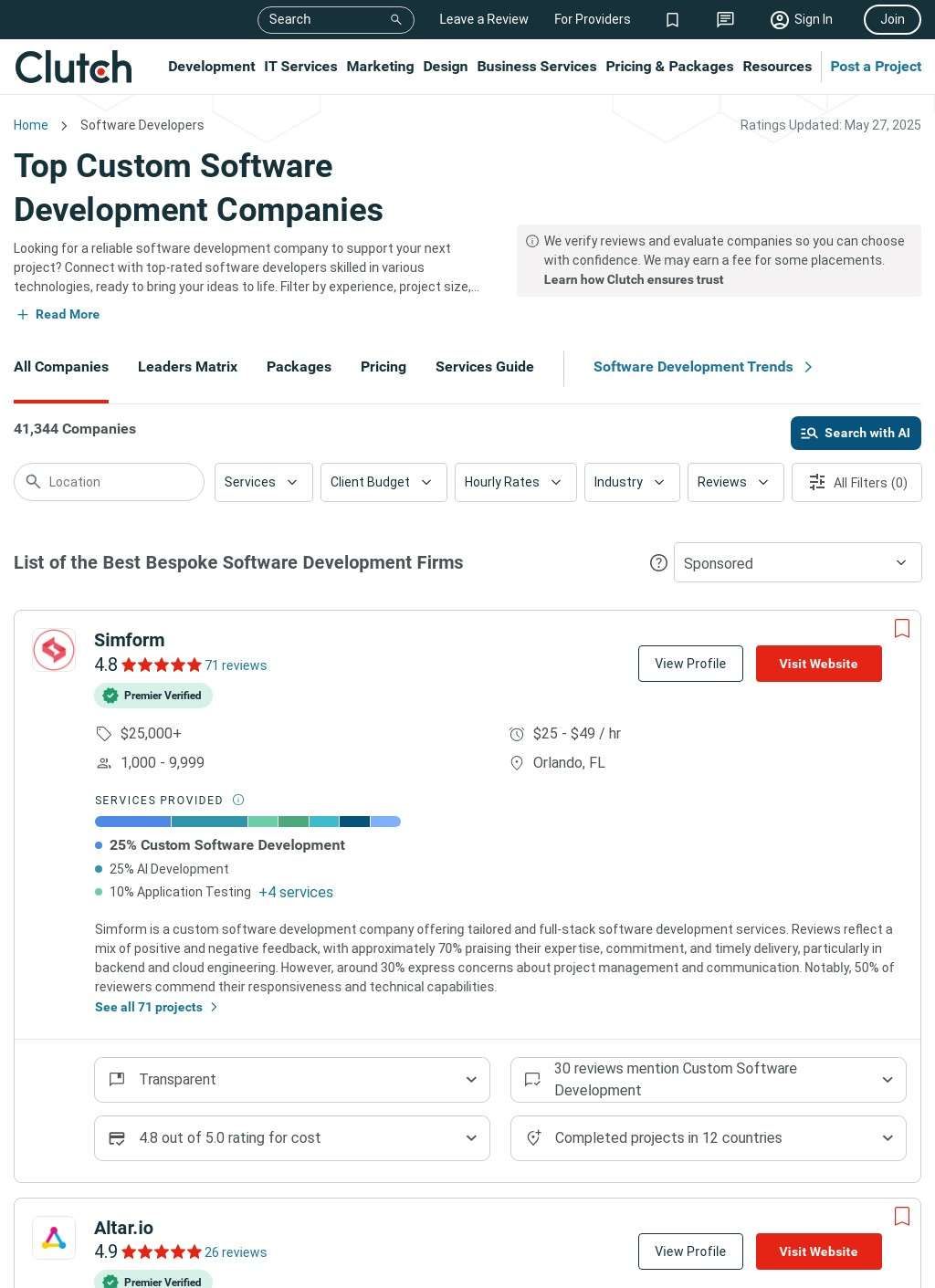
The /developers section is where most buyers arrive first. Each agency profile carries four data points that do real filtering work before a buyer clicks a single profile: team size, hourly rate band, minimum project size, and headquarters location alongside a technology focus. Budget ranges, geography, industry verticals including healthcare, fintech, and nonprofit, and technology stack can all be combined into a single filtered view. A small clinic looking for a HIPAA-aware team and a fintech startup chasing a specific framework are not reading the same undifferentiated list.
The elimination of the early discovery call, where a buyer learns an agency only takes six-figure projects or an agency learns the buyer cannot meet its minimum engagement size, is a genuine efficiency gain. Whether buyers consistently use the filtering depth or default to the top ten results is a separate question the platform cannot control.
Scoring framework across four dimensions
Featured names in the Clutch /developers section include Simform, Goji Labs, Mercury Development, Kingsmen Digital Ventures, and Closeloop Technologies, a spread running from boutique product studios to larger outsourcing operations. The same scoring framework applies uniformly across all of them. Clutch scores each firm across four dimensions: responsiveness, technical expertise, cost-effectiveness, and project management. Scores are visible per dimension, so a startup that cannot afford delays can weight responsiveness separately from a large enterprise running a longer procurement cycle. A small firm with strong, recent, verified feedback can sit alongside a much larger outsourcing operation without being buried by the bigger firm's raw review volume. That structure is healthier than layouts that primarily reward ad spend or profile size.
Verified reviews and case study evidence
Profiles on Clutch carry verified client reviews tied to named engagements, project case studies, and portfolio samples of shipped work. The chain of evidence on a single profile, a verified testimonial traceable to a case study that names the project budget and technology, is what most vendor directories skip entirely. A buyer can read a testimonial, trace it to the case study it came from, then check whether that project maps to their own budget and stack, all on the same page. Clutch's stated verification step is intended to prevent recycled blurbs and coordinated accounts from distorting the ranking. Whether that process holds depends on how rigorously the company enforces it; the platform does not publish specifics of its verification enforcement in auditable form, and that gap is consequential when interpreting individual scores.
Scale of the user base and review volume
Clutch reports drawing more than half a million buyers and sellers of services monthly, with its user base growing by over fifty percent. At that volume, most agency profiles in the /developers section carry enough verified feedback to reveal patterns, not isolated opinions from a handful of contacts. A directory with three reviews per listed company is close to useless for a software purchase. At the scale the platform claims, aggregate scoring becomes meaningfully diagnostic, provided the underlying reviews are genuine. The verification step is the mechanism meant to ensure that; it is also the mechanism buyers have to take partly on faith.
Agency incentives and score presentation
The two-sided commercial dynamic deserves plain acknowledgment. Agencies use Clutch as a reputation and lead-generation channel, which is why firms invest in keeping profiles current and actively soliciting reviews from past clients. That incentive keeps listings fresh. It also means every agency on the platform has a structural reason to maximize its score presentation, not merely to accurately represent its actual work. A buyer who reads only aggregate scores and skips the underlying case studies is using one layer of a multi-layer research tool and calling it due diligence. The rating, the case study, and the firm's stated specialization need to be read together for the chain to mean what Clutch implies it means. Shallow reading is the expected failure mode, and no design choice has prevented it.
Third-party standing adds texture but not decisive weight. G2 also lists and reviews Clutch as a product category. On Glassdoor the internal picture is more mixed: work-life-balance scores in the high-three to low-four range, with somewhere between half and just under sixty percent of employees indicating they would recommend the company. Those numbers describe Clutch as an employer, not as a directory product, but a platform that produces detailed, maintained, frequently updated agency profiles depends on editorial investment. Glassdoor data in the cautious range for employee satisfaction raises a mild question about whether that investment is stable over time. It is context, not a verdict.
The platform does not surface a phone number or direct contact address on the /developers landing page. Buyers are meant to reach agencies through individual profiles, and Clutch facilitates those connections accordingly. A visitor who needs to contact the company directly will need to look past the section page, minor friction for the primary use case. The friction grows if a buyer has a dispute about a review's validity and needs to reach someone to contest it.
Limitations of the ranking model
The four-axis scoring model produces one practical limitation worth naming. Ranking agencies simultaneously across responsiveness, technical expertise, cost-effectiveness, and project management means a fast, affordable shop and a slower, more methodical one can each rank well for different reasons. That flexibility is useful for buyers with different priorities. It also means a high overall ranking on a profile is not a statement that this is the best agency on the list, only that it scores well on its particular combination of factors. Buyers who treat a top-ranked profile as a recommendation are reading more into the score than the model claims to produce.
External validation compared to competitors
At 283 Trustpilot reviews and a four-star average, Clutch has more external validation than many comparable platforms at the agency-directory level. The filtering architecture, verified reviews, and per-dimension scoring are structurally sound. But 283 reviews covering Clutch as a product in its own right do not amount to strong independent validation at the scale the company claims for itself. Buyers who want denser external commentary on the directory's reliability, and specifically on how rigorously the verification process is enforced, will find GoodFirms more forthcoming: it publishes more of its review methodology in auditable form and carries a comparable volume of agency profiles. Clutch is a starting point for vendor research, with structural advantages that are only partly offset by an enforcement layer nobody outside the company can fully audit.