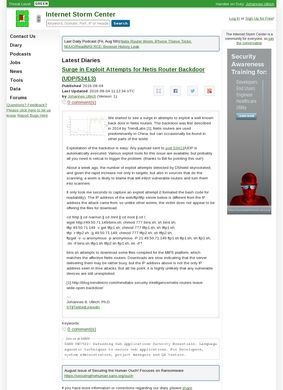
At the top of the page, a colored square shows the current threat level: green most days, shifting to yellow or higher when something notable is moving across the internet. That single indicator, backed by a worldwide network of volunteers feeding attack data from DShield honeypots and firewall logs, is the spine of the Internet Storm Center. Run by SANS Institute, the whole operation works as a cooperative early-warning system: thousands of sensors report what is hitting them, the data gets correlated, and the result is a picture of what attackers are probing right now.
Handler Diaries
The part most practitioners come back for is the handler Diaries. These are technical write-ups published daily by rotating ISC Handlers, who are senior security professionals and community contributors. The diaries do not read like blog filler. A typical entry might dissect an active malware campaign, break down a phishing technique, or trace a strange spike in scanning against a particular port. They tend to include raw observations, packet detail, sometimes the indicators of compromise, and enough reasoning that you can follow how the analyst reached a conclusion. For anyone who has to explain to a manager why a firewall is suddenly logging traffic on an odd port, that depth pays off.
Daily podcast on top threats
Alongside the diaries runs the SANS Stormcast, a short daily podcast the Internet Storm Center publishes that compresses the top threats into a few minutes. It is the sort of thing you can play while the coffee brews and walk away knowing what changed overnight. That format works better than long-form security news precisely because it respects the listener's time, and the cadence is consistent, day after day, which is harder to sustain than it looks.
Data tools for network administrators
The data tools are the other half of the appeal. The site offers IP reputation and port activity lookups, so a network administrator who spots a suspicious address can check whether it has been hitting honeypots elsewhere. There are aggregated statistics on scanning activity, port trends, and the top attacking IPs, which turn anecdotal noise into something you can chart. You can also submit your own firewall logs to feed the correlated threat intelligence, and in doing so you become part of the same sensor grid that produces the warnings everyone reads. The people consuming the intelligence are often the same people generating it, and that reciprocity is the quiet genius of the project.
DShield Honeypot Project
The DShield Honeypot Project deserves its own mention. It is open-source honeypot software that runs on a Raspberry Pi or other modest hardware, and community members deploy it to collect attack telemetry and submit it upstream. For a student or a hobbyist, it is a low-cost way to watch real attackers in real time instead of reading about them in a textbook. Setting one up and watching SSH brute-force attempts pile up within hours is, honestly, one of the more sobering introductions to how constant internet background scanning has become. For an organization it is also a way to contribute to a global dataset without much overhead.
Security professionals and students
The audience the Internet Storm Center reaches is fairly specific: security professionals, network administrators, incident responders, researchers, and students, with a natural gravity toward the SANS ecosystem. Some of the most interesting material comes from guest diaries written by SANS.edu interns and practitioner researchers who analyze real attack data. Recent examples have covered the behavior of SSH brute-force botnets and phishing evasion that abuses IPv4-mapped IPv6 addresses to slip past filters. These are not theoretical exercises. They are observations pulled from live sensors, written up by people learning the craft under the eye of experienced handlers, and that mentorship shows in the quality.
Depth over accessibility trade
There is a fair caveat worth naming. The Internet Storm Center assumes a reader who already speaks the language. A newcomer with no networking background will hit terminology that the diaries do not stop to define. This is not a beginner's portal, and it does not pretend to be. The trade is depth for accessibility, and for the intended audience that is the right trade. The flip side is that students who push through the curve get exposed to the same primary-source analysis the Internet Storm Center publishes that working incident responders rely on, which is a rare thing to find for free.
Cooperative model and credibility
What keeps the Internet Storm Center credible over the long run is the cooperative model itself. A single vendor's threat feed reflects that vendor's customers and blind spots. A volunteer-fed system spread across the globe sees a broader slice of what is happening, and the handler review layer keeps the published analysis from drifting into speculation. The color-coded status, the daily cadence of diaries, the podcast, the lookup tools, and the honeypot software all reinforce one another rather than competing for attention. The Internet Storm Center is one of the few places where the people reading the warnings are also writing the data, and where the analysis arrives daily instead of in glossy annual roundups.
How the community regards it
Outside reputation is hard to pin down through third-party review platforms: no aggregated ratings appear in a general search, which is typical for a professional resource that practitioners cite in conference talks and incident reports rather than rate on consumer sites. The absence of star reviews does not reflect how the Internet Storm Center is regarded in the security community, where DShield data and Internet Storm Center handler diaries are referenced routinely. The resource rewards regular visits more than occasional ones, and over a few weeks of daily checks you start to develop a feel for the rhythm of internet attack activity that no quarterly threat report can give you.