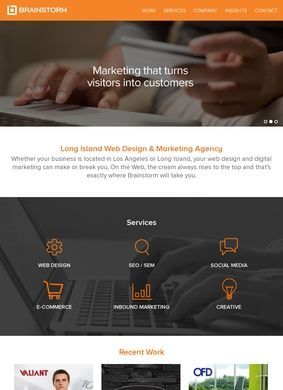
HubSpot Platinum Partner status is the first thing Brainstorm Studio puts in front of you, and it is not decorative. The agency was founded in 2002 by John McHugh in Melville, Long Island, and over more than two decades has built its entire practice around the HubSpot platform: setting up inbound lead-generation systems, tuning sales pipelines, and running content programs that feed those systems with qualified traffic. That focus separates the firm from the generalist shop that touches a little of everything. The pitch is inbound marketing for B2B companies, measured against return on investment, and the work on the site is consistent with that pitch.
Core services for inbound marketing
Three services anchor the offering. Inbound marketing covers content creation and promotion built to attract leads, which is the core of any HubSpot-aligned practice. HubSpot consulting goes a layer deeper, configuring scalable systems and refining the sales pipeline for clients who already run the platform or are moving onto it. Web development rounds things out, with a stated aim of brand-focused, conversion-oriented builds. The bundling makes sense: content brings people in, the website converts them, and the HubSpot setup tracks and nurtures everything afterward. Brainstorm can claim a coherent story across all three, and the certifications support that story. Alongside the Platinum tier, the agency lists Google Partner and Semrush Academy credentials, both of which require ongoing work to maintain, not a one-time signup.
Certifications that require ongoing maintenance
Named client work gives the offering some grounding. The site points to case studies for Essentium, RCN Telecom Services, CloudFirst, and AccuData Workforce Solutions, presented through a Work section that mixes written studies with video. Named clients are worth more than anonymous testimonials because they can be verified, and a company tends not to attach a real partner's name to results that do not hold up. Essentium and RCN in particular are recognisable B2B and telecom names, which fits the audience Brainstorm says it serves. The case study format is a reasonable standard for an agency at this level.
Client work and public reputation
The site structure is easy to follow: Home, Work, Company, Services, Insights, and Contact. The Insights blog is the section that usually reveals whether an inbound agency practises what it sells. A firm that builds its business on content marketing and then neglects its own content undercuts its argument immediately. Brainstorm maintains an active blog, so at a minimum it is producing the kind of material it asks clients to invest in. Whether the quality holds up requires reading a few posts, but the output exists and the category is not a ghost.
Active blog demonstrates content expertise
On outside reputation, the picture is honest but limited. The HubSpot Solutions Marketplace listing carries at least one published five-star review praising reliability and efficiency, which is a relevant venue for a HubSpot partner and a fair indicator as far as it goes. A profile exists on SemFirms.com, though no aggregate score appears there.
Where is the independent validation?
One note of caution: a Glassdoor entry with a single five-star review appears to belong to a Brazilian company at brainstormstudio.com.br, not the Long Island agency, so it should not be read as a reflection of Brainstorm Studio. Beyond the HubSpot Marketplace review, there are no Trustpilot, Google, Yelp, or BBB aggregate ratings to point to for this specific business. For an agency two decades old, that is a modest footprint of public feedback, and anyone weighing the agency should treat the single marketplace review as a starting point rather than a full picture.
Limited third-party review presence
Contact is handled straightforwardly. A phone number is on the site, the full Melville mailing address is published, and a form is available for anyone who prefers to write. For an agency selling lead capture, getting its own contact path right is a reasonable baseline, and Brainstorm clears it without friction.
A few caveats are worth stating. The certifications and client roster do the heavy lifting here, while independent third-party validation outside the HubSpot ecosystem remains sparse. The reported team size of 11 to 50 employees on LinkedIn puts Brainstorm in the small-to-mid agency band. That can be an advantage for clients who want senior-level attention on their account, and a constraint for those who need the depth of a larger shop running multiple campaigns simultaneously. Neither reading is a disqualification. Each shapes the type of engagement Brainstorm suits best.
Taken together, Brainstorm Studio reads as a specialist that knows its lane and stays in it. The HubSpot alignment is genuine and well documented, the service mix is coherent, and the named case studies give the claims something concrete to stand on. The gap is breadth of outside reviews, and that is the one thing a prospective client cannot resolve from the site alone. Brainstorm's natural fit is a B2B marketing lead at a mid-sized company that already runs HubSpot or plans to, and the evidence on the site is solid enough to justify a conversation with the Melville team. Ask to walk through the Essentium or RCN case study in detail and request references from clients in a comparable industry before any retainer discussion.