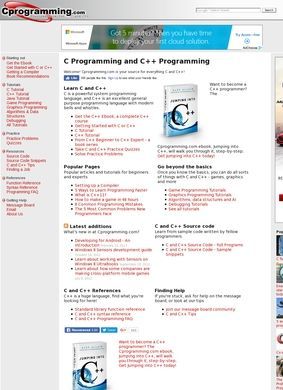
One corner of the cboard forum is handed over to a Programming Book and Product Reviews board, where members post their own verdicts on programming titles and the tools they have bought. That single detail tells you a good deal about CProgramming.com: it is an old-school C and C++ resource built around a working message board, closer to a long-running study group than to a polished modern course platform.
The CProgramming.com front page would not load on a direct visit, so the working picture here rests on the forum, on search results, and on what other programmers say about the site elsewhere. That is a real limitation, and it belongs up front, before any judgement gets passed.
What CProgramming.com puts in front of a learner
Two halves make up CProgramming.com. One is the reference-and-tutorial side, pitched at people picking up C or C++ for the first time. The other is the discussion side, the long-running cboard forum. Together they have kept the domain going for years, through stretches when plenty of flashier tutorial sites appeared and then quietly disappeared.
The tutorial half is what most newcomers land on first. It is also the half that draws the sharpest opinions, and those opinions matter if you are weighing where to spend your early study hours. A free resource is only a bargain if what it teaches still holds up. Old, in a place like this, cuts both ways: it can mean settled, well-trodden explanations, or it can mean advice written for a version of the language that has since moved on.
None of this is a modern bootcamp with graded exercises and a progress bar. It is closer to a reference you read and a forum you post in, and that shape suits some learners and frustrates others. A person who likes to poke around, read a page, then put a follow-up question to a real human will find the setup familiar. A person who wants a structured, hand-held course will find it dated and sparse.
The cboard forum and its sub-boards
The forum is where CProgramming.com still shows a pulse. It splits into topic boards that track the way C and C++ programmers actually work day to day. Windows Programming and Linux Programming each get a room of their own, which is sensible, because the two platforms diverge fast once you leave the standard library and start touching the operating system.
A Networking and Device Communication board serves the socket-and-hardware crowd. A FAQ Board gathers the questions that come up over and over, so a beginner is spared being the thousandth person to open a fresh thread on the same point. A set of Platform Specific Boards handles the rest, and the Programming Book and Product Reviews board gives members a place to compare notes on what to read next.
That segmentation is the practical strength. Someone stuck on a Linux build problem and someone wiring up device communication are not tipped into one undifferentiated help queue; each has a place to ask and a place to search. A learner who wants a human answer instead of a guess pulled off a search engine can still get real value from a board organised this way, and reading the archives costs nothing. Old threads outlive the people who wrote them, which is quietly one of the better arguments for a forum that has been running this long.
The C and C++ tutorials
The teaching material is the reason most people arrive at CProgramming.com, and it is also the part under the heaviest scrutiny. Two separate threads on Reddit's r/learnprogramming argue it back and forth. Some posters treat the tutorials as a usable on-ramp for a complete beginner in C or C++; others say the writing has aged and no longer tracks how the languages are used now. A thread on the OSDev.org forum takes direct aim at the C++ tutorial content and questions its accuracy in spots.
None of that makes the material worthless. It does mean a learner should treat CProgramming.com as one source among several and check anything important against a newer reference, C++ above all, since the standard has moved a long way across its recent revisions. A book from the C++98 era and a modern one describe two fairly different languages, and a tutorial written years ago can quietly teach the older one.
Read critically, the pages still explain something real about pointers, memory, and the underlying shape of both languages. Taken as gospel, they can leave a beginner carrying habits a modern codebase would flag on the first review. The honest reading is that this is a starting point to outgrow, not a manual to lean on for years.
Contact routes and outside reviews
Because the site would not open, its contact options could not be checked, and no phone number, email, or postal address for CProgramming.com came up in search either. For now the forum looks like the only practical route to whoever keeps the lights on, which works for a technical question and is awkward for anything past that. A visitor who wanted to license the material, flag a broken page, or reach an actual owner would have little to go on.
Formal reputation signals are not there to check. No Google, Trustpilot, Yelp, Facebook, or BBB entry with a star score or a review count surfaced for CProgramming.com. What turned up instead was conversation: the two r/learnprogramming threads, the OSDev.org critique, and an IsLegitSite.com check page that shows no numeric rating at all.
That is community opinion, useful for a gut check but nothing you could cite as proof, and it should be read that way. Nobody has scored this place on a five-star scale; people have argued about whether its lessons still hold, which says more than a star rating would. The debate itself is a mark of a site people still bother to have an opinion about.
So the picture comes down to the forum and the talk around it. The cboard boards are still reachable and still sorted into their Windows and Linux rooms, and the book-and-product reviews board sits where it always has, waiting for the next person with a recommendation to add.