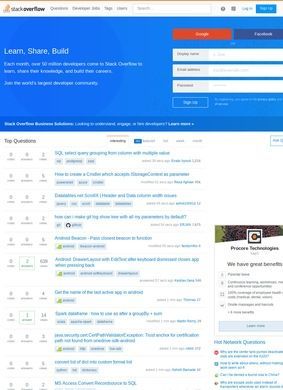
Where does a programmer actually go when a piece of code refuses to work and the official documentation has gone quiet? For a good two decades the honest answer has been Stack Overflow, and the reason is simple: someone else almost certainly hit the same wall, asked about it, and got an answer that a crowd of other developers then argued over, corrected, and voted on until the best fix rose to the top. The site did not invent the programming forum. It refined the format hard enough to become the default.
That mechanism is the whole thing. Ask a question, tag it with the language or tool it concerns, and the community responds. Good answers collect upvotes and float upward. Weak or wrong ones sink. Over time this has produced a searchable archive of technical problems and solutions that is hard to match anywhere else, and much of the value shows up sideways, through a search engine, when you land on a years-old thread that solves your exact error.
What the platform gives a working developer
The public Q&A database that Stack Overflow hosts is free, and it is the reason most people arrive. Questions sit under tags like Python, JavaScript, or SQL, which lets you browse by technology or narrow a search to one ecosystem. The tagging is not decoration. It is how the site stays navigable at the scale it operates on.
Underneath the questions runs a system of reputation points and badges that reward people for asking clearly and answering well. I have always found the reputation mechanic slightly gamified for my taste, but it does real work: it gives frequent contributors a visible track record, and it hands moderation tools to people who have earned trust through participation. Moderators are community-elected, which keeps the housekeeping in the hands of users instead of a distant staff.
Tags, votes, and the reputation economy
Voting is the quiet engine here. Because answers are ranked by the crowd rather than by posting order, the version that actually solves the problem usually sits at the top by the time you read the thread.
That is a meaningful difference from a plain forum, where you might scroll through pages of replies to find the one that works. Editing is communal too, so an answer that was correct three framework versions ago often gets revised to stay current.
Collectives and OverflowAI
More recent additions change the texture of the place. Collectives are sponsored, branded spaces built around specific technology ecosystems, AWS, Python, Docker and the like, pulling relevant questions and recognized contributors into one area. OverflowAI folds generative-AI search into the platform, letting you query that enormous body of accumulated answers conversationally instead of hunting through individual threads.
How much you lean on either depends on your habits, but both are attempts by Stack Overflow to make a very large archive feel less like a haystack. There is some tension in a Q&A site building an AI that answers questions from the very corpus its human contributors wrote, and the community has not been quiet about it, but the tooling itself is competent.
Beyond the public site
Stack Overflow is one node in the broader Stack Exchange network, and its ambitions run past the free Q&A everyone knows. The clearest example is Stack Overflow for Teams, a paid subscription that repackages the same question-and-answer machinery as a private internal knowledge base for companies, walled off from the public site. The pitch is straightforward. Organizations lose enormous amounts of time to knowledge that lives only in one engineer's head or a buried chat log, and a searchable internal Q&A, now with AI-assisted features layered in, aims to capture that before it walks out the door.
The corporate ownership behind all this has shifted over the years, moving under Prosus after Stack Overflow's own restructuring, which matters mostly in that it explains the steady push toward enterprise revenue and AI tooling.
Teams and the enterprise tier
For an engineering organization, the Teams and Enterprise tiers are a genuinely different product from the public site, priced accordingly. Whether they are worth the outlay depends on how badly a company's internal knowledge is scattered. The concept is sound. Execution, as always with internal tools, lives or dies on whether people actually contribute.
The API, the docs, and the Developer Survey
Three quieter resources round out the offering. There is a public API that lets developers query site data directly, which has fed countless side projects and research efforts. There is a substantial body of help and documentation pages explaining how questions should be asked, what counts as a good post, and how community moderation works, and reading them first spares a newcomer a lot of friction, because the site's standards are stricter than a lot of newcomers expect.
And there is the annual Developer Survey, a large report on programming languages, tools, and salaries that gets cited across the industry as a rough barometer of where the field is heading.
The jobs board that Stack Overflow once ran has been discontinued in its various forms, so anyone arriving in search of that will come up empty. Worth knowing before you go looking. The talent and hiring side was, for a stretch, a real part of what the company offered, and its absence is a genuine subtraction from what a developer used to be able to do here.
A fair caution: the site's exacting standards cut both ways. Beginners sometimes find their questions closed as duplicates or flagged for not meeting the guidelines, and the tone in comments can be brisk. That rigor is exactly what keeps the archive clean and trustworthy, but it does make the place less forgiving than a casual chat channel. The documentation on how to ask well is there precisely to soften that landing, and it rewards the reading.
A question that shows the code, the error, and what was already tried tends to draw help. A vague one tends to draw a closure notice.
Set against something like the official Python or MDN docs, Stack Overflow occupies a different lane. Vendor documentation tells you how a tool is meant to work; this site tells you what happened when thousands of people tried to use it and hit the messy edges the manual never mentions. For the specific, half-broken, why-does-this-throw-that-error moment, the crowd-verified answer usually wins, and that is why Stack Overflow remains the first place most developers open when the code is fighting back.