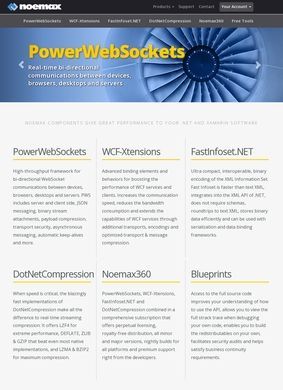
PowerWebSockets is the product that probably brings most developers to Noemax in the first place: a library for real-time, two-way WebSocket communication that spans browsers, desktop clients, and servers. It sits alongside three other paid components aimed squarely at the .NET world, and the whole catalogue has a clear, narrow personality. This is not a general toolkit. It is a set of low-level building blocks for people who already know they have a performance or interop problem to solve.
PowerWebSockets and the product lineup
The four products work as a family. WCF-Xtensions adds binding elements meant to push more throughput out of Windows Communication Foundation, on both the service and client side. FastInfoset.NET implements a compact binary XML encoding that follows the ITU-T Fast Infoset standard, which matters when XML payload size is the bottleneck. DotNetCompression covers a spread of algorithms in one package: LZ4, DEFLATE, ZLIB, GZIP, LZMA, and BZIP2. A developer who needs all four can take the Noemax360 subscription instead of buying piecemeal, and there is a separate Blueprints tier that hands over full C# source so you can build your own redistributables. Noemax also lists Blueprints pricing separately from the standard per-product licenses, which is a useful option for teams that need to ship the library inside their own product.
Four components for .NET performance
One thing worth dwelling on is that the libraries are described as 100 percent managed C#, with no native dependencies muddying the build. For a shop that distributes its own software, that makes deployment and signing far less painful than wrapping a native DLL. Noemax carries that promise across an unusually wide list of targets: .NET Framework 3.5 through 4.6, Xamarin on iOS and Android, Windows Phone, Xbox 360, and Silverlight.
Managed C# with no native dependencies
That list tells you a lot about when this codebase matured. Several of those platforms are long past their prime, and a developer working on modern .NET Core or .NET 6-plus should check carefully whether the framework versions here line up with the project at hand. The flip side is that teams maintaining older line-of-business systems, exactly the audience still running WCF in production, will find support for the runtimes they are actually stuck with. Licensing is royalty-free, with both perpetual and subscription options, and the subscription includes nightly builds for anyone who wants to track fixes closely. That combination of royalty-free terms and nightly access is a reasonable deal for what Noemax is selling.
Platform support across legacy runtimes
Finding Noemax through a business directory entry is a reasonable starting point, but the real evaluation has to happen at the code level. Free support comes through a dedicated section of the site, which is a fair promise for commercial libraries where integration questions are the norm. The contact page splits pre-sales, sales, general inquiries, and website help into separate routes, which should get a question to the right desk faster than a single catch-all form.
Free support and contact options
Noemax does not list a phone number or a street address anywhere on the public site, and there is no surfaced email. A contact form covers the practical need, and many software vendors skip a public inbox to avoid spam, so the missing email is not a surprise. The phone and address gap matters more for enterprise buyers who want a vendor they can call directly.
Limited public visibility or reviews
Searches for outside opinion on Noemax came up empty. I could not turn up any third-party reviews or ratings tied to Noemax Technologies at this domain; results were swamped by unrelated companies sharing a similar name. That is not a judgment on the product quality, but it does mean there is no crowd-sourced record to lean on. A prospective buyer is left with the published documentation, the trial download, and whatever comes out of a support exchange to form a verdict on Noemax.
When should you evaluate Noemax?
For evaluating commercial .NET components the hands-on path is the sensible one regardless. The royalty-free licensing and the source-code Blueprints tier both reduce the risk of lock-in, and testing a build against your own WCF service or compression workload will tell you more than any star rating. The platform list is the main reservation: Noemax reads as a product built for an earlier generation of Microsoft tooling, and that is not a small thing if your project targets modern runtimes.
Comparing Noemax to open-source alternatives
Weighed against free alternatives, the calculus depends on the specific need. For raw compression, a developer could reach for the open-source SharpZipLib or the built-in System.IO.Compression and pay nothing, so DotNetCompression has to justify itself on algorithm breadth and the convenience of one supported package. WCF-Xtensions and PowerWebSockets are harder to replace casually, because tuning WCF bindings or hand-rolling a capable WebSocket stack is exactly the work most teams would rather buy out of. If your project lives in classic .NET Framework and leans on WCF, Noemax is worth a trial download. If you are on modern .NET with no legacy interop, the open-source route likely covers you and the value here narrows considerably.