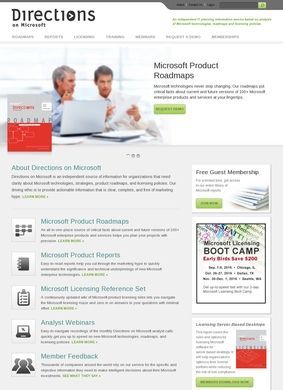
Who keeps watch on Microsoft so the people writing the cheques do not have to read every licensing footnote themselves? That is the gap Directions on Microsoft has filled since 1992, working as an independent analyst and advisory firm that pays attention to one vendor and nothing else. The focus is narrow on purpose. Microsoft alone is a sprawling commercial universe of products, agreements, and pricing rules, and a firm that does only that can go deeper than a generalist ever will. Directions on Microsoft has spent over three decades inside that single commercial universe, and the depth it has built there is the whole point.
The audience is plain from the client list. Nike, Home Depot, Amazon, and Morgan Stanley are named as customers, which tells you Directions on Microsoft is built for large enterprise buyers and Fortune 500 IT and procurement teams, not for someone running a small office with a handful of licences. These are organizations that spend serious money with Microsoft every year and want someone in their corner who reads the contracts for a living.
Atlas Membership and research library
The centrepiece is the Atlas Membership. It opens up a library that Directions on Microsoft puts at more than 7,480 analyst reports, alongside 231 or more webinars and videos, plus Microsoft product roadmaps. That is a deep archive, and the roadmap angle matters for buyers trying to time decisions around what Microsoft plans to ship or retire. A membership model like this lives or dies on whether the research stays current, and the volume of material points to a team that publishes steadily across the year.
Licensing training bootcamp
Then there is the Licensing Training, an 18-hour-plus bootcamp aimed squarely at the complexity of Microsoft licensing. Anyone who has tried to map out an Enterprise Agreement knows that complexity is not marketing language here, it is the actual problem. A multi-day course built around it is a reasonable response, and it shows that Directions on Microsoft expects clients to want their own people trained up, not simply to hand every licensing question to a third party.
Enterprise agreement negotiation support
The advisory and negotiation side is where the firm does its most consequential work with the biggest accounts. The services listed include Enterprise Agreement negotiation support, access to an expert desk, audit defense, and technology strategy assessments. Audit defense in particular is the kind of help a company only appreciates after the audit letter arrives, and having a specialist who already understands the licensing rules can change the outcome of those conversations. Negotiation support follows a similar logic: Microsoft negotiates these agreements constantly, the customer does so once every few years, and that imbalance is exactly what an advisor exists to correct.
Free guides on EA negotiation
Not everything sits behind the paywall. Directions on Microsoft also publishes free resources, including guides on EA negotiation, licensing fundamentals, the Power Platform, and Power BI. These give a prospective client a real sense of the firm's thinking before they decide to engage, and they double as a useful reference for anyone trying to get their bearings on a specific topic without a subscription.
Blogs, podcasts, infographics
Beyond the formal products, there is a steady stream of ongoing content: blogs, podcasts, infographics, and decision kits. The decision kits are worth singling out, because a kit aimed at a particular purchasing choice is more practical than yet another think-piece. The mix of formats also tells you Directions on Microsoft wants to reach buyers however they prefer to take in information, whether that is reading a report or listening to a podcast on the commute.
Coverage of Microsoft 365, Azure, Dynamics 365
The subject coverage spans Microsoft 365, Azure, Dynamics 365, and the wider Microsoft commercial licensing picture. That spread maps closely to where enterprise Microsoft spending actually goes now, with cloud and subscription products front and centre. A firm that stayed stuck on on-premises licensing would be of limited use today, so the attention to Azure and the 365 family is the right call, and Directions on Microsoft has clearly kept pace with where Microsoft itself has moved.
Named analysts on staff
Credibility for an analyst firm rests heavily on the people doing the analysis, and Directions on Microsoft names 18 or more Microsoft analysts and experts on staff. Naming them rather than hiding behind a faceless brand is a telling editorial choice, since it lets a client see who is behind the research and check their background. For a buyer about to lean on Directions on Microsoft during a high-stakes negotiation, knowing exactly which analyst is handling their account is part of what makes the relationship workable.
One honest limitation is worth stating. A search for independent commentary turned up material about Microsoft the company instead, and no notable third-party reviews of Directions on Microsoft itself surfaced. That is fairly common for a specialist advisory firm whose reputation travels by word of mouth inside procurement and IT circles, where a public star rating is not really how trust gets built. It does mean an outsider cannot lean on a crowd of posted opinions to gauge the experience, and a prospective buyer may want to ask the firm for client references directly.
Contact methods and social media presence
On the practical side of reaching the firm, the site does not make you hunt. A phone number is published, along with a fax line and a service email address, and Directions on Microsoft maintains a presence on LinkedIn, X, YouTube, and Bluesky. For a B2B operation selling to cautious enterprise buyers, that openness about contact is what you would hope to see.
The longevity deserves a final word. Operating since 1992 means Directions on Microsoft has watched Microsoft shift from boxed software to volume licensing to the cloud and subscription era, and it has stayed in business through all of it. That kind of staying power in a single-vendor niche implies a client base that keeps renewing because the advice keeps paying for itself, which is the only renewal logic that survives three decades. For large organizations facing complex Microsoft estate decisions, the depth of research and the named analyst roster give Directions on Microsoft a credible case to make, and that case is grounded in published evidence rather than reputation alone.