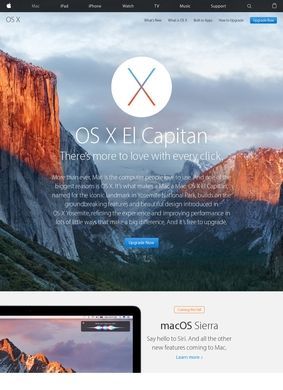
Apple's main website is the destination behind the listing name Macintosh OSX, and the gap between that name and that destination is worth noting before going further. Mac OS X stopped being Apple's label for its desktop operating system years ago; it is now called macOS, currently shipping as Sequoia. Macintosh OSX as a directory entry points to apple.com, which is Apple's global commercial front door and covers far more ground than any single operating system.
Hardware lineup across Mac and mobile devices
On the hardware side, the site runs through the full current lineup. Mac computers are split across the MacBook Air on the M5 chip and the MacBook Pro in M5, M5 Pro and M5 Max variants, so the buying decision is framed mostly around how much performance someone is willing to pay for. iPhone is represented by the 17 Pro, the 17 and the iPhone Air. There is iPad Air on the M4, Apple Watch, AirPods Pro 3, the AirTag tracker, and the Apple Vision Pro mixed-reality headset, which remains the strangest and most expensive item in the catalogue. That spread tells you the site is built to sell devices first and explain operating systems second, and Macintosh OSX as a name quietly misrepresents that priority.
Operating systems developed by Apple
The operating-system coverage that gave Macintosh OSX its original rationale is genuinely present, just folded into the larger picture. macOS sits alongside iOS and iPadOS, watchOS, tvOS and visionOS, each tied to the hardware it runs on. All of them are developed and distributed by Apple itself, which is the simple reason this resource has authority on the subject: it is the source, not a commentator on it. If someone wants to know what the Mac operating system does in its present form, reading about it on apple.com is about as close to the primary record as it gets, even if the marketing gloss has to be read past.
Services and subscription offerings
Software and services are where the page sprawls, and this is territory the Macintosh OSX listing name never anticipated. The App Store, iCloud for storage and cross-device sync, and the iWork suite cover the productivity and ecosystem layer. Then comes the subscription stack: Apple TV+ for video, Apple Music, Apple Arcade for games, Fitness+, News+, Podcasts and Books, with Apple One bundling several of those together at a single price. The bundling pitch is more honest than it first looks, because it does not pretend each service is essential; it just lets a heavy user consolidate. The financial side is unusually deep for a hardware company, running from the Goldman Sachs-issued Apple Card through Apple Pay, Apple Cash and the Wallet app.
Ownership support and purchasing options
There is also the practical machinery around ownership. Apple Trade In handles device recycling and credit toward a new purchase, financing options sit next to the prices, and AppleCare extended plans cover support beyond the standard term. Buying happens either through physical Apple Store locations worldwide or the online store, and the two are stitched together so an order can move between them. Developers get their own corner at developer.apple.com, and anyone with a broken device or a setup question is funneled to support.apple.com, which is a separate property doing its own job.
Macintosh OSX as a name belongs to an era when the Mac operating system was the headline product; the site it resolves to treats that operating system as one component of a hardware, services and payments business. Someone who genuinely wants the OS will find the relevant material reachable but surrounded by storefront. Someone who wants the whole Apple offering lands in exactly the right place under a slightly outdated label.
Reading past the marketing gloss
The breadth is the strength and also the only real caution. A site this large works well when you already know which product or service you are after, because every line of the catalogue is documented in depth and the cross-references between a device and its operating system are consistent. It is less helpful as a neutral explainer, since everything on apple.com is written to move you toward a purchase or a subscription. Reading the macOS pages here gives you the official version of what the system can do, with the understanding that drawbacks rarely make the cut.
Macintosh OSX points to a site that is authoritative by definition and limited in its independence for the same reason. As a route to the Mac operating system specifically, it works but overshoots, dropping visitors into a commercial hub when a tighter reference might serve better. As a route to Apple's full range of computers, phones, wearables, software, media and financial products, it is the definitive starting point. The listing for Macintosh OSX does its job; the name just stopped matching the destination some years back.