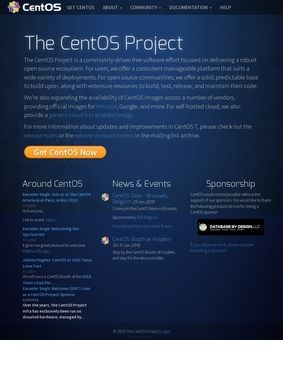
CentOS Stream sits at an unusual position in the Linux world: a rolling distribution that tracks just ahead of Red Hat Enterprise Linux, feeding into RHEL as its upstream development platform rather than trailing behind it as a free rebuild. That single design choice changes who CentOS is actually for. The site presents Stream as the primary download, alongside a Hyperscale variant tuned for very large fleets, plus Live ISO images and Windows Subsystem for Linux builds for anyone who wants CentOS running inside a Windows host. Visitors arriving with a clear idea of what they need will find the path laid out without much fuss.
Documentation, forums, chat
What the CentOS project gives away for free is the whole stack you would expect from an enterprise-grade Linux base, no licence to buy, no account to create. The documentation section carries manuals, GPG keys for verifying packages, and release notes, which is the unglamorous material a system administrator actually opens at two in the morning when a signature check fails. There is a forum, a set of mailing lists, and live chat over IRC and Matrix for the questions that documentation never quite answers. None of this is dressed up. It reads like infrastructure built by people who use it themselves.
Special Interest Groups
The part of CentOS I keep returning to is the Special Interest Groups, because they tell you a lot about where the project's energy actually goes. There are SIGs for Cloud, Storage, and Virtualization, the predictable enterprise pillars, but also one for Automotive, which is a less obvious bet and a sign CentOS follows real industry demand rather than guessing at it. Each group works on a defined slice of the ecosystem, which keeps the wider effort from collapsing into a single monolithic release that pleases nobody.
Platform building for cloud engineers
For a cloud engineer or someone running storage at scale, those groups are the difference between a distribution that ships and one you can build a real platform on. They also explain why CentOS can support so many specialized images without the core team drowning. The structure is the answer to a hard problem: how a community keeps enterprise-grade output flowing across many fronts at once. It works because the responsibility is split and named, not because of any one heroic maintainer.
Blog, events, governance
Beyond the code and the groups, the CentOS site runs a blog with project news and, usefully, recaps of board meetings, so the governance is visible to anyone who cares to read it. There is an events calendar and a library of video content with technical presentations, which suits people who learn better from a recorded talk than a wall of text. The sponsorship by Red Hat is stated openly, along with a roster of hosting and infrastructure partners, and that openness about who funds and hosts the work is more reassuring than any marketing claim.
Target audience and technical level
The intended audience comes through clearly from how the material is organized. Open-source developers get an upstream they can contribute to and influence. System administrators get a stable foundation and the documentation to run it. Cloud engineers and enterprises that want free, serious Linux infrastructure get a credible base without a procurement cycle. The project assumes a degree of technical competence and does not waste time explaining what a distribution is, which I find refreshing and most beginners will find slightly intimidating.
Community reception and mixed opinions
Outside reputation is limited. A search turns up active discussion on forums like Reddit and ServerFault, mostly around the 2020 shift from CentOS Linux to Stream, and the tone is mixed. People who wanted a stable downstream RHEL clone lost it; people building platforms upstream of RHEL found a clear home. That divide runs through most of the independent commentary you will encounter, and it has not fully settled even years later. There are no notable review aggregators covering CentOS specifically, which is not surprising for a developer infrastructure project where word-of-mouth among sysadmins carries more practical weight.
CentOS Stream's position as the upstream of RHEL is its defining strength and the exact thing that gives some administrators pause. The model shifted CentOS from a downstream rebuild mirroring RHEL release for release into a platform that moves ahead of it, and not everyone who relied on the old model was happy with the change. For a developer who wants to shape what lands in the next RHEL, tracking just ahead is precisely the appeal. For an administrator who specifically wanted a bit-for-bit free clone of the stable enterprise release, that older promise is no longer what CentOS makes.
The project is well governed, openly funded, generous with documentation and community channels, and structured through its interest groups in a way that scales. The Hyperscale and WSL images, the SIGs, the visible board recaps, all of it points to a genuine engineering community. The open question is whether a continuously delivered platform that sits upstream of RHEL gives you the stability footing you came for. If your workload demands something that moves at RHEL's release cadence, not ahead of it, CentOS Stream is the wrong answer, and the site does not disguise that. If you want to contribute upstream or run infrastructure at a scale where tracking Stream is manageable, the CentOS project is one of the more honest choices available.