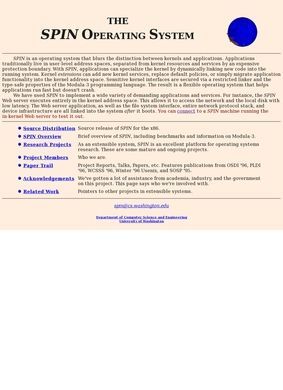
What happens when you let an application reach into the kernel and add its own code to it? The Spin Operating System is one of the more interesting answers from systems research of the mid-1990s, and the project site kept by the University of Washington Department of Computer Science and Engineering lays the experiment out in full. The Spin Operating System is extensible: applications can dynamically link new code into the running kernel through typed extensions, which deliberately softens the usual wall between kernel space and application space. The site documents how this was attempted, what it cost, and what it bought.
Modula-3 as the foundation for type-safe extensions
The technical core of The Spin Operating System rests on Modula-3. That language's type-safety guarantees protect sensitive kernel interfaces while still letting applications splice in their own behavior. That choice is the whole argument of the project, and the site does not hide it behind marketing. A technical overview gets into language-level detail and benchmarks, so a reader can see the actual performance numbers behind the safe-extension claim instead of taking it on faith. The source distribution targets the x86 architecture, which grounds the work in real hardware that people could obtain and run at the time.
In-kernel web server demonstration
One of the demonstrations stays with me precisely because it is so concrete: an in-kernel web server built using The Spin Operating System's extension mechanism. That is the sort of example that explains the idea faster than a paragraph of theory. Move the service into the kernel through a typed extension, skip the boundary crossings, and you have a measurable case for why dynamic kernel extension might matter. The site treats it as one documented application among the research projects built on the platform, not as a product feature, which is the right tone for what this is.
Research archive with papers from OSDI, SOSP, PLDI
Beyond the system itself, The Spin Operating System site works as an archive of the research around it. There is a directory of the team members who built and studied the system, and a collection of academic publications drawn from the venues that matter in this field: OSDI, SOSP, and PLDI, with papers spanning roughly 1995 to 1996. For anyone tracing the history of extensible kernels, having those papers gathered next to the code and the overview saves a lot of scattered searching. The publications are the part worth visiting first. They place The Spin Operating System inside an active debate of its era about how to make operating systems safely extensible, and reading them alongside the running source gives you both the theory and the artifact.
Comparison with contemporary extensible OS projects
The site also links out to related extensible OS research projects, so The Spin Operating System can be compared against its contemporaries rather than read in isolation. That comparative framing is genuinely useful, because this was one answer among several, and the design tradeoffs only make sense when you can see the alternatives. Whether the Modula-3 bet paid off relative to other approaches of the period is precisely the kind of question the linked papers help you work through.
It is worth being clear about what this site is and is not. The Spin Operating System is not an active product, not a download you would deploy in production, and not a commercial offering of any kind. The work was concentrated in the mid-1990s, and the site has settled into the role of a reference. Read with that understanding, the material holds up: organized, technically backed by benchmarks and papers, with the source still available to study.
The audience is narrow and the site knows it. The Spin Operating System was built for operating systems researchers and graduate students who care about extensible kernel architectures, language-based approaches to OS safety, and experimental systems design. A casual visitor looking for a desktop operating system to install will find nothing useful here, and that is fine. The value is in the design lineage and the question The Spin Operating System posed about where the kernel boundary should sit.
What makes the archive credible is the consistency between its parts. The overview describes a type-safe extension model, the Modula-3 implementation is the mechanism that delivers it, the benchmarks test whether it pays off, and the OSDI, SOSP, and PLDI papers subject the whole thing to peer scrutiny. The in-kernel web server then shows the model doing real work. Each piece supports the others, and you can follow the chain from claim to code without gaps.
If there is a limitation, it is the obvious one of age. The x86 target and the toolchain assumptions belong to the period, so anyone hoping to build and run The Spin Operating System today should expect to do some archaeology. The site does not pretend otherwise. As a record of a serious attempt to rethink kernel extensibility through a safe language, it remains coherent and complete, which is more than most research project pages from that era manage. Start with the technical overview, then read the OSDI and SOSP papers to see how the design was defended, and if you want to go further, pull the x86 source and trace how a typed extension actually links into the kernel.