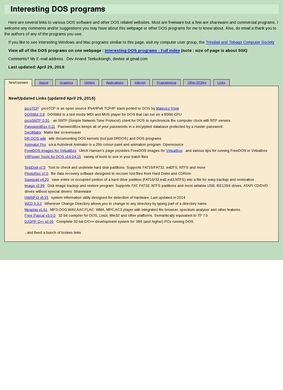
One of the programs catalogued here is LTOOLS v6.12, a set of DOS command-line tools that can read and write Linux ext2, ext3, and ReiserFS filesystems from a machine that never boots Linux at all. That single entry tells you the spirit of the place better than any description: Interesting DOS Programs is a personal collection put together by Dev Anand Teelucksingh, sorting through the corners of DOS software that most people stopped thinking about decades ago and pulling out the ones worth keeping.
Topical sections and pointer links
Interesting DOS Programs is split into plain topical sections. There are Applications and Utility Programs, a Sound Programs area that covers audio CD players, a Graphics Programs group, a Programming section, and a full index page that lists everything in one place. Each entry points outward to freeware, shareware, or commercial downloads, so the site works as a hand-sorted set of pointers more than a download host of its own.
Unusual software picks worth keeping
A few of the picks Interesting DOS Programs has surfaced are genuinely odd in a good way. Costa GUI v1.8.0 bundles a graphical shell for DOS with a theme and icon editor, a calculator, a text viewer, and some games tucked inside. MoonRock v0.50 is a BASIC-flavored language aimed at 8086 and later chips. AXS is a digital audio workstation compiled down to 350 KB, which is the sort of size constraint that feels almost unbelievable now. SciTech UniVBE 6.7 turns up too, the old standby for getting better video modes out of stubborn graphics hardware. These are not random links; someone clearly used this software and decided it deserved a slot in Interesting DOS Programs.
Other DOS repositories and resources
Beyond the curated entries, Interesting DOS Programs keeps a separate links page that sends visitors to other DOS software repositories and DOS-related websites. For a hobbyist trying to track down legacy tools, that outbound map is part of the value, since DOS resources tend to vanish or relocate and one well-kept index of where else to look saves a lot of dead-end searching.
Where is the site now?
This is where a visitor hits friction. The opus.co.tt/dave/ address now returns a 404 from Opus Networx, a Trinidad and Tobago internet provider that has been around since 1990. The content of Interesting DOS Programs has moved or been mirrored to dosprograms.info.tt, so the material survives, but anyone arriving at the old link lands on an expired page with no redirect to follow.
Trust score concerns and what they mean
An automated scanner from Gridinsoft gave the dosprograms.info.tt domain a trust score of 1 out of 100 and flagged it as possibly unsafe. Read that with care: scores like this usually punish small, low-traffic sites by default, and there are no actual malware reports behind it, just an algorithm that treats obscurity as risk. Worth knowing about before clicking, but it is not proof of any real problem.
Reputation elsewhere is quieter but more reassuring. There are no consumer reviews on Google or Trustpilot or the usual rating platforms, which fits a niche reference page over a commercial service. What does exist is recognition from the people who would actually use it: Interesting DOS Programs appears in the GitHub "awesome-dos" curated list and gets referenced in KVR Audio forum threads. Those are the right rooms for a project like this to be known in.
Reaching the author is the weakest part of Interesting DOS Programs. The page carries no contact form and no visible address or phone. The email dave at opus.co.tt shows up only in third-party cached references, never on the page itself, so a visitor with a question or a broken-link report has no obvious way to get in touch. For a curated list that depends on outbound links staying alive, that gap stings a little, since a dead entry is exactly what someone would want to report back.
What you are looking at is a labor-of-interest catalogue with real editorial judgment behind it and a maintenance situation that has drifted. The picks reward a retrocomputing enthusiast who wants pointers from someone with taste, not a generic dump of every DOS file ever uploaded. Interesting DOS Programs reads as the work of one person documenting software they cared about, and that personality is its strength even where the upkeep has slipped.
Hunting for something specific, say a tiny DAW or a tool to poke at Linux partitions from DOS, there is probably a thread to pull here. The catch is the homework: confirm the working mirror at dosprograms.info.tt, treat the low scanner score as a caution flag worth a second look, and expect to do the actual downloading from the third-party sites these entries point to. The original opus.co.tt home is gone; the index of what made it worth visiting is not.