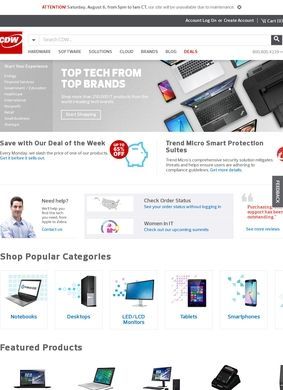
A procurement manager who needs five hundred configured Lenovo ThinkPads imaged with a corporate gold build, plus a Cisco switch refresh and a year of Microsoft 365 licenses, can source all three through a single CDW account. That breadth is the whole point of the operation. The catalog runs past 100,000 products spanning Microsoft, Apple, Cisco, HP, Dell, Lenovo, Adobe, VMware and dozens of other vendors, covering laptops, desktops, servers, networking gear, storage arrays, peripherals, printers, monitors and mobile devices. Software sits alongside the hardware: perpetual licenses, subscriptions, and SaaS bundles. For a buyer trying to consolidate scattered IT spend onto one paper trail, the appeal is obvious.
Segmented storefronts for different buyer types
What separates this from a straight online electronics shop is the segmentation. The site splits into distinct storefronts built around who is buying. CDW serves general business; CDW-G handles government accounts with their procurement rules and contract vehicles; CDW-E is aimed at schools, districts and universities; CDW-H targets hospitals and healthcare systems; and CDW Canada covers customers north of the border. Each segment carries pricing, compliance framing and product mixes tuned to that world. A school district buying Chromebooks under an education contract sees a different path than a hospital standardizing on clinical workstations, even though both pull from the same underlying inventory.
Configuration and deployment services
The company is more than a reseller moving boxes. It positions itself as a solutions integrator, which in practice means it sells the planning and labor alongside the products themselves. The site lays out data center infrastructure, networking, security, collaboration tooling, cloud migration, device lifecycle management and managed services. Configuration and deployment are handled in-house, so a customer can have machines arrive already imaged and asset-tagged instead of landing as bare units someone internal has to unbox and set up. That professional-services layer is where a large reseller justifies its margin, and it is a real differentiator against pure-catalog sellers.
Who benefits from the account portal?
That depends heavily on who is asking. The B2B account portal is built for procurement teams: it lets them pull quotes, place and track orders, and manage invoices in one place, with the kind of approval and reporting structure a finance department expects. For an organization with a defined IT budget and someone whose job is sourcing, that machinery saves real time and gives a clean audit trail. The whole experience is shaped around repeat institutional purchasing instead of one-off consumer checkout.
For an individual buying a single laptop, the calculus shifts. The segmented structure, the account-based portal and the solutions-and-services framing all assume a buyer operating at some scale. None of that is a flaw; it is the design choice of a company whose customers are businesses, agencies, schools and hospitals. A solo shopper can still buy from the business storefront, but much of what makes CDW valuable, the configuration services, the lifecycle management, the dedicated account handling, only matters once you are buying in volume and managing a fleet over years.
The numbers behind the company give the catalog weight. CDW has been operating since 1984 out of Vernon Hills, Illinois, and now runs annual revenue north of $20 billion with roughly 15,000 employees. It trades publicly on the NASDAQ under its own ticker. For anyone weighing whether a vendor will still be around to honor a multi-year managed-services contract or a large warranty pool, that scale and that public reporting are reassuring in a way a small regional reseller cannot match. The financial transparency that comes with being a listed company is itself a form of accountability.
Scale cuts both ways, though, and it is worth naming honestly. A company moving this much volume across this many segments is a machine optimized for predictable, repeatable institutional transactions. A buyer who wants white-glove attention on a small order, or who values the personal relationship a boutique IT shop offers, may find the experience more procedural than warm. The portal and the account structure exist precisely because the company is processing enormous order flow, and that efficiency is built for the buyer with a purchase order, not the one with a quick question.
Comparing CDW against direct manufacturers
The integrator angle deserves a closer look because it is where the real value concentrates. Plenty of competitors can ship a Dell server or a Cisco router, and pure reselling leaves little room to differentiate. What CDW packages around those products, the assessment, the configuration, the deployment, the ongoing management, is harder to replicate and stickier once a customer adopts it. A mid-size company that hands its device refresh, its security tooling and its cloud migration to one integrator gets a single accountable partner instead of a dozen point vendors. Whether that consolidation is worth the premium is the genuine question a buyer has to answer.
Vendor breadth across the catalog
The product depth is the strongest single argument for the catalog. Carrying Microsoft, Apple, Cisco, HP, Dell, Lenovo, Adobe and VMware under one account means a buyer rarely has to go elsewhere, and standardizing purchasing through one vendor simplifies licensing audits, warranty tracking and vendor management. For an IT department juggling a heterogeneous environment, that single-source convenience has a value that does not show up on any individual line item but accumulates across a year of purchasing.
Set against a direct manufacturer like Dell, the trade is clear. Buying laptops, servers and support straight from Dell can mean tighter pricing and a more direct warranty line for that one brand, and a single-vendor shop loses nothing on mixing. CDW earns its keep the moment a buyer needs more than one manufacturer in the same order, or wants the configuration and lifecycle services layered on top, which is exactly the multi-brand, services-heavy scenario a direct manufacturer storefront cannot cover. For an organization standardizing on a single brand and comfortable managing deployment internally, going direct may be cheaper and simpler; for the mixed-fleet buyer who wants one partner to source, configure and manage across vendors, the case for CDW is strong and well supported by the company's size, history and integrator depth.