An airport's ground team needs radio links that carry safety-critical traffic across the apron, and they need to know the gear from one vendor will actually talk to the next without a bespoke integration each time. That is the exact gap the WiMAX Forum exists to close. It writes the wireless broadband specifications, then certifies which products meet them, so a buyer can trust the label instead of testing every box by hand. Take away that shared standard and every deployment becomes a one-off negotiation between suppliers.
The organisation has run since 2001 as an industry association for wireless broadband technology. Its footer states that "WiMAX," "WiGRID" and related terms are its trademarks, which is the plain confirmation that this is the official standards holder, not a fan site or a reseller trading on the name. For anyone deciding whether a certification badge means anything, that ownership is the first thing worth knowing.
The initiatives that carry the standard
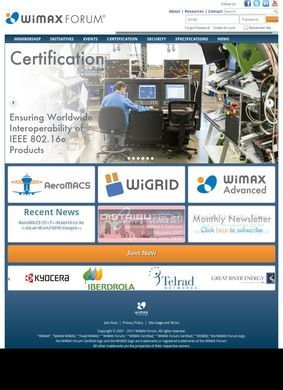
The technology work is organised into named initiatives, each aimed at a different industry with a different problem. Three appear across the site: AeroMACS for aviation, WiGRID for utilities, and WiMAX Advanced as the general forward track for the core technology.
Grouping the work this way is a sensible read of who actually buys standardised radio. An airport operator and a power utility have almost nothing in common except the need for a reliable, vendor-neutral wireless link, so the WiMAX Forum meets each on its own terms instead of selling one generic product to both. The membership, events and endorsement machinery all feed these initiatives, which keeps the association pointed at real deployments rather than abstract standards-writing for its own sake.
AeroMACS on the airport apron
AeroMACS is the aviation initiative, a wireless broadband profile built for airport surface communications. The value proposition is concrete. An airport buying certified AeroMACS equipment gets a documented standard behind it, which lowers the risk that a single supplier quietly locks in the infrastructure and the pricing that comes with it.
For a sector where downtime and radio interference are safety matters, a common specification is worth more than any one vendor's marketing claims, and it is a large part of why the WiMAX Forum still has a clear reason to exist.
WiGRID and the utility grid
WiGRID points the same idea at the electricity grid, giving utilities and smart-grid developers a wireless standard for the sensors, meters and control links a modern grid depends on. WiMAX Advanced sits alongside it as continued development of the underlying technology.
Together these keep the WiMAX Forum aimed at fixed, industrial deployments where a long-lived, dependable standard matters more than chasing the consumer phone market that moved on to other technologies years ago.
Certification, specifications and the member wall
Standards are only useful if someone enforces them, and this is where the WiMAX Forum does its most tangible work. It administers certification programs for compliant products and names the designated testing labs that carry the assessments out, which is the difference between a specification anyone can claim to meet and one a buyer can actually verify.
Around that sit the supporting functions: published technical specifications, a set of security standards, industry events and endorsements, and a directory of certified equipment. The site is sectioned to match, with Membership, Initiatives, Events, Certification, Security, Specifications and a News area covering press releases, newsletters, videos and articles. It reads as an association doing the ordinary, necessary paperwork of a standards body, the unglamorous work of writing rules, testing gear against them, and keeping a record of what passed.
Designated labs and compliant products
The certification chain is the substance. A vendor submits a product, a designated lab tests it against the specification, and a pass earns a place in the directory of compliant products that buyers can consult before they purchase.
This is the machinery that turns a written standard into something a purchasing officer can rely on, and it is the clearest reason a utility or an airport operator would visit the WiMAX Forum in the first place. Without it, the security standards and specifications would be so much published theory.
Behind the account login
Much of the deeper material is gated. The member area requires account creation, so the specifications, the full certification detail and the working resources sit behind a login rather than open on the public pages. Membership is plainly the intended way in, and the public site functions more as a front door than as the archive itself. A casual visitor gets the map, not the territory.
That gate is also where the doubt sets in. For a technology whose consumer moment passed years ago, a visitor arriving cold cannot easily tell from the public pages how active the certification pipeline still is, how recent the last events were, or whether the initiatives are advancing or simply being maintained. The trademark authority of the WiMAX Forum is not in question, and for AeroMACS and WiGRID the standards role holds up in practice.
Whether the wider program is a living, growing body or a caretaker for a shrinking niche is the question the open site leaves unanswered. Settling it would take a login, or a conversation with someone already working in aviation or utilities, not another pass through the public pages.