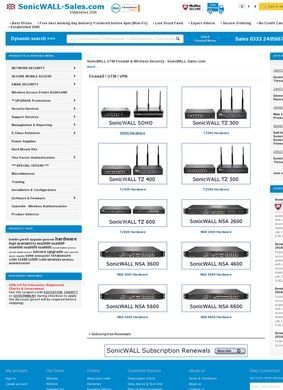
Where does a UK company turn when it has settled on a SonicWall firewall but has no clear idea which model, which licence tier, or which support plan it actually needs? Sonicwall sales is one answer: a UK-based IT reseller that sells SonicWall security hardware and, more to the point, advises on the choice before the purchase order goes out.
The distinction there is worth holding onto. This is a reseller and adviser, not the manufacturer. Sonicwall sales trades in SonicWall kit; it is not SonicWall the vendor, and that difference shapes everything from who answers the phone to whose reviews a buyer should trust when checking it out.
One caveat up front. The site would not respond on repeated attempts to load it, so the description that follows rests on the public record and search results, not on a firsthand click through the pages.
A reseller built around SonicWall firewalls
The proposition is narrow in a way that can work in a buyer's favour. Broadline resellers carry thousands of products and know a little about each; a specialist that lives on one vendor's firewalls tends to know the licensing traps and the model differences that catch people out. Everything on offer at Sonicwall sales points at that single focus: firewalls, the software subscriptions that keep them useful, and guidance on matching a box to a network.
SonicWall firewalls sit at the small-and-mid-business end of network security, the appliances a company puts at the edge of its network to filter traffic, run a VPN for remote staff, and shut out the obvious intrusions. A reseller in this space is really selling two things: the box, and the renewals that keep its threat feeds and support live. The second is where the money and the lock-in sit, which is why buying advice from someone who knows the licensing genuinely helps.
Whether that focus runs deep or thin could not be confirmed from the site itself, which is a real gap for a buyer doing due diligence.
The firewall range and the buying advice
Choosing a SonicWall firewall is genuinely confusing. The model numbers climb through several tiers, each rated for a different throughput and user count, and the licensing stacks on top in bundles that are easy to over-buy or under-buy. A reseller that advises before it sells is offering the thing a spec sheet cannot: a steer on which model fits an actual office rather than a theoretical one.
That advisory angle is the core of what Sonicwall sales appears to offer. The promotional side turns up too: a Facebook post from the business dangles a free-firewall style deal, the kind of offer resellers use to win a support or licensing contract wrapped around the hardware. Read it as a hook, and check what the ongoing subscription costs before a free box tempts anyone into a longer commitment.
The news section and pricing write-ups
The site carries a news or blog area, and the piece the search keeps surfacing is a SonicWall review covering features and pricing. That is a sensible thing for a reseller to publish. Firewall pricing is opaque, buyers arrive with exactly that question, and a straight write-up of features against cost is the sort of content that pulls in someone comparing models at two in the morning. For a reseller, it doubles as quiet proof of competence: you cannot write an honest comparison of firewall tiers without understanding them.
It also signals that Sonicwall sales wants to be found by researchers as much as by ready buyers. A pricing article does double duty: it answers a real question and it shows that whoever runs the site knows the product line well enough to explain it. How current or how deep that library runs is impossible to judge without the site loading, so it counts as a promising sign and no more.
A caveat sits on all of this. A single strong article is not a content library, and a search turning up one pricing piece could point to a focused blog or a mostly empty one.
Contact routes and the review gap
On paper the contact position looks workable. A third-party Facebook page for the business lists a UK phone number and an email address, so there is a way to reach a human. What could not be verified is how visible any of that is on the site itself: whether a contact page, a form or a phone number sits where a visitor would expect one. For a reseller asking a business to spend on security hardware, that on-page clarity matters, and it stays an open question here.
The reviews are the weaker spot, and honesty demands saying so plainly. The company's own Facebook page shows no rating at all, marked as not yet rated across zero reviews. No Trustpilot, Google, Yelp or BBB entries turn up for Sonicwall sales specifically. Plenty of ratings exist for SonicWall the manufacturer, on G2, TrustRadius, Gartner and the rest, but those belong to the vendor and its products, and treating them as if they vouch for Sonicwall sales would be a mistake.
That absence is not the same as a bad reputation; a young or low-volume reseller simply may not have gathered feedback yet. But it does mean a first-time buyer has nothing independent to lean on, which raises the value of a phone call and a couple of direct references before any money changes hands.
A UK business that wants a specialist voice on SonicWall specifically, and values buying advice over the lowest possible sticker price, has a fair reason to talk to Sonicwall sales. The obvious alternative is going through SonicWall's own authorized partner locator, which routes a buyer to vetted resellers with a public track record; against that, this reseller's pull is its apparent focus and its willingness to publish pricing detail, while its weakness is the sparse independent proof and a site that would not load on demand.
A cautious buyer would get a quote from both and see which one answers the awkward licensing questions more convincingly.