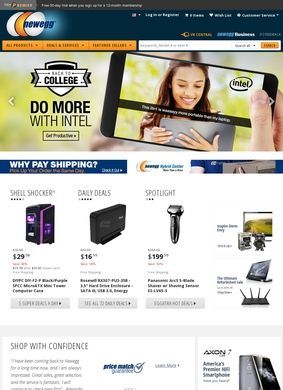
You have a motherboard in your cart, a CPU you think is compatible, and a nagging worry that the RAM you picked runs at the wrong speed or the power supply cannot feed a card that pulls 300 watts under load. That moment, half excitement and half doubt, is exactly where New Egg tends to catch people. The site grew up around enthusiasts piecing together their own machines, and the part of it that still works hardest is the set of tools aimed at that fear of buying the wrong component. A PC Builder walks you through a compatible parts list. A Power Supply Calculator estimates the wattage your build will actually draw.
Build tools for component matching
There is a Memory Finder for matching modules to a board, and configurators for narrower jobs like NAS Builder, Server System Configurator, Gaming PC Finder and Laptop Finder. Taken together, that toolkit is what sets New Egg apart from a generic electronics retailer and explains why it keeps appearing when people ask where to shop for PC components.
Memory Finder and system configurators
None of that would matter without depth of inventory behind it, and the catalog is the real spine here. New Egg covers the full width of a build: motherboards, processors, memory, solid state drives, graphics cards, power supplies, cases. Beyond the bare parts, the store carries pre-built desktops and laptops, gaming rigs, VR equipment, networking gear, and server-grade hardware for people working past the home tier. It reaches sideways into consumer electronics too, with televisions, cameras and audio, plus software and digital downloads. So the same checkout that handles a single replacement fan also handles someone assembling a workstation from scratch.
Inventory depth across PC parts
One structural detail shapes the whole experience, and it deserves attention before anyone treats New Egg as a single uniform store. The platform sells its own stock, but it also hosts third-party sellers in a marketplace arrangement. That breadth is why obscure parts turn up here when they have vanished elsewhere, and it is also why two listings for what looks like the same item can come from very different vendors with different handling. A shopper who reads carefully, checking who is actually selling and shipping a given product, gets the most out of the model. A shopper who assumes every order is fulfilled identically can be surprised.
Marketplace sellers and third-party fulfillment
The split goes further on the commercial side. There is a separate New Egg Business division aimed squarely at companies buying in volume or needing procurement features that a consumer account does not surface. That separation makes sense, since the person spec'ing forty workstations has almost nothing in common with the teenager buying a first graphics card, and forcing both through one storefront usually serves neither well. Keeping the business arm distinct lets each side see pricing, quoting and bulk options suited to its buyers.
Business division and regional operations
New Egg ships primarily to customers in the United States and runs a separate international presence rather than serving every region from one storefront. For a US buyer that distinction is invisible. For someone outside the country it is the first thing to sort out, because the catalog and shipping you see may not be the catalog and shipping that apply to you. That regional split sends first-time international visitors in circles if they do not notice it early.
From 2001 to catalog density
Founded in 2001 and headquartered in California, New Egg has had two decades to accumulate the catalog density that makes it useful, and that longevity shows in how thoroughly the component categories are filled out. This is not a storefront that lists the popular dozen graphics cards and calls it done. The long tail is where it draws regular return visits from people who build often, the ones who need a specific chipset or a power supply with an exact connector count and expect to find it in stock. Whether you found New Egg through a business directory listing or a forum recommendation, the depth of the component catalog is usually what confirms it is the right stop.
Consumer reviews and marketplace complexity
New Egg has accumulated a substantial number of consumer reviews across third-party platforms, with thousands of ratings on sites like Trustpilot and Google. The scores sit in the middling range, which for a store this size and age is not surprising. Marketplace complexity generates complaints at volume, and the reviews reflect that: shipping delays tied to third-party fulfillment, return friction, and occasional communication gaps. The company's own-stock orders fare better in the breakdowns. Anyone reading the reviews with the marketplace structure in mind will find them coherent and largely predictable.
Weighing the whole thing, a lot rests on the buyer doing their homework inside the marketplace structure. The configurator tools genuinely reduce the chance of a mismatched build, and for anyone who has ever opened a box to find the cooler will not clear the RAM, that is worth something. New Egg has clearly invested in making the hard part of self-building less intimidating, and for component shopping specifically it remains one of the deeper catalogs a US enthusiast can reach. The PC Builder in particular does work that a generic retailer simply does not attempt, and the presence of a Server System Configurator and NAS Builder points to a store still speaking to people who actually assemble hardware rather than just buy finished boxes.
Does the breadth dilute the focus?
The catalog reach across consumer electronics raises a fair question about identity, though. New Egg started as a hardware specialist and now sells televisions, cameras, smart home devices and software, which makes it harder to read at a glance. The deep component focus that made it valuable competes for attention with general merchandise it shares with every large online retailer. The mix can dilute the very thing that distinguishes it. Whether the configurator-driven, component-first experience stays as sharp as the catalog keeps widening is the part worth watching. A buyer who wants the precision of the build tools has to find them inside a store increasingly arranged to sell everything, and that tension is worth naming plainly.