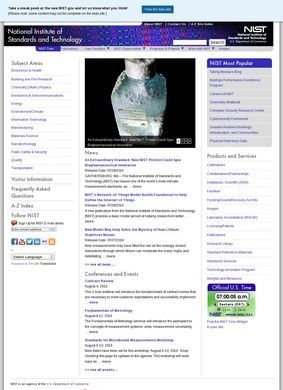
The clock your phone syncs to, the calibration behind a medical scale, the framework a bank uses to defend its network: all of them trace back to one federal agency. The National Institute of Standards and Technology keeps the official U.S. time standard and defines the physical measurements that most of American industry quietly relies on. That is an odd thing to find filed under hardware, but it fits, because almost every measured object eventually leads back to a reference NIST maintains.
Technical publications and standards documents
The site is the public face of a U.S. Department of Commerce agency, and it is built for people who need something specific from it. There is a large body of technical publications, including the NIST Special Publications and the standards documents that engineers and compliance teams cite by number. The 800-series on cybersecurity is probably the best known outside the lab world, sitting alongside the NIST Cybersecurity Framework and, more recently, the AI Risk Management Framework. These are the documents that end up quoted in contracts and audit checklists, and the site is where the current versions live.
Behind the measurement standards
Measurement is the older half of the mission, and it runs deep. The National Institute of Standards and Technology issues Standard Reference Materials, the certified samples other labs use to check that their own instruments are reading true, and it offers calibration services and standard reference data. It runs NVLAP, the National Voluntary Laboratory Accreditation Program, which is how a testing lab earns formal recognition for its competence. The physical side covers time and frequency, mass, and length, the base quantities everything else is measured against. If you have ever wondered who decides what a kilogram actually is in the United States, this is the answer.
Research areas across four laboratories
Not the casual browser, mostly. The research areas listed span physics, chemistry, materials science, engineering, information technology, nanoscale science, biosciences, and neutron research through the NIST Center for Neutron Research. That is a serious spread, and the work of the National Institute of Standards and Technology is organized under named laboratories: the Information Technology Laboratory, the Physical Measurement Laboratory, the Material Measurement Laboratory, and the Engineering Laboratory. Someone trying to find the right division, a specific researcher, or a particular program can navigate through that organizational structure, and given the size of the institution, that navigability is not optional.
Support for small manufacturers
There is also a side of the National Institute of Standards and Technology aimed squarely at smaller players. The Manufacturing Extension Partnership, or MEP, exists to help small and mid-size manufacturers with the kind of technical and process problems they cannot easily solve alone. It is a reminder that the agency writes standards for multinationals and government labs while a modest shop floor stays inside its remit too. Conformity assessment services round out the practical offering, helping organizations demonstrate that a product or process meets a defined requirement.
Checking news, careers and funding
News and publications carry the current work: research news, technical updates, and the steady output of documents that keep the standards current. The site also lists career openings, grants and funding opportunities, and events and conferences, so the National Institute of Standards and Technology functions as a working hub for the community that orbits it, well beyond a static archive. A graduate student hunting funding, a vendor tracking a standards revision, and a facilities engineer looking for a calibration service are all served by different corners of the same site.
From bureau to institute
What makes the whole thing coherent is the throughline from abstract measurement to concrete use. A cybersecurity framework and a kilogram feel like unrelated things until you notice both are answers to the same question: how do we agree on what is correct? The National Institute of Standards and Technology has been answering versions of that question for a very long time. Its lineage runs back to the National Bureau of Standards, founded in 1901, which is a long institutional memory for a field where a small measurement error compounds into expensive failures.
Audience across industry and academia
The audience is genuinely broad despite the technical depth: industry, academia, other federal agencies, and international standards bodies all draw on this material. That international reach is worth noting, because measurement standards only work if they are shared across borders, and the National Institute of Standards and Technology sits inside that global conversation as the American voice. A metrology lab in another country and an American manufacturer need to be measuring against compatible references, and this agency is one of the anchors that makes that possible.
Is this site for casual browsing?
For the ordinary visitor, the practical value depends entirely on the need. There is no reason to read NIST for entertainment, and the writing does not pretend otherwise. It is dense, precise, and aimed at people who already know roughly what they came for. That is the correct choice for what it is. A site like this succeeds when a specialist can find the exact publication number, the right calibration service, or the current framework revision without friction, and the structure here is clearly organized around that goal.
The material rewards patience and specific intent, and it punishes vague browsing, which is fair for a reference of this scale. If you work anywhere near measurement, testing, standards compliance, cybersecurity policy, or advanced research, the National Institute of Standards and Technology is less a website to visit than a resource to keep bookmarked and return to. That is the whole verdict: a specialist reference that does exactly what it sets out to do, nothing more and nothing less.