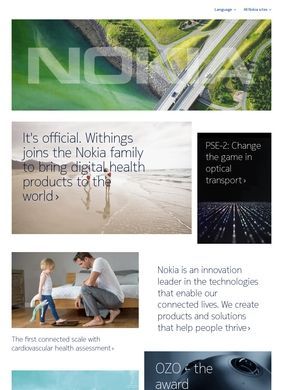
Nokia is a Finnish multinational whose corporate site sits squarely in telecommunications infrastructure, and the version listed here has almost nothing to do with the handsets many people still associate with the brand. The homepage leads with network technology aimed at operators, enterprises, and cloud businesses. Anyone arriving expecting a phone catalogue will need to recalibrate within a few clicks, because the whole architecture of the site is built around who buys carrier and data-center equipment.
Solutions organized by customer type
The Solutions area does the heavy lifting, and it is organized by customer type instead of by product family, which I found genuinely useful for cutting through the sheer volume. Three groups anchor it. The first is AI and cloud providers, where the material runs to data center switches, IP routers, optical and IP interconnection, pluggable coherent optics, and event-driven automation branded as Nokia EDA. There is also a security block covering XDR and a package called Cyberdome, DDoS detection under the Deepfield name, and quantum-safe networking. It is dense, and it reads like it was written for network architects who already know what a coherent optic is.
Cloud providers and data center infrastructure
The second group targets mission-critical enterprises, and this is where the breadth becomes almost hard to hold in your head. Defense sits under Nokia Federal Solutions in the US, alongside tactical communications, then energy in several forms (mining, oil and gas, power utilities, renewables), industrial campus networks, financial services, manufacturing, private networks, public sector, healthcare, and public safety. Transportation gets its own long shelf: aviation, highways, ports, railways, and supply chain logistics. Each of these is a distinct vertical with its own page, which tells you Nokia is selling private wireless and mission-grade connectivity to buyers who rarely appear in consumer coverage.
Mission-critical enterprises across verticals
The third group is the traditional core: telecommunication providers. Fixed access shows up through the Altiplano access controller and fiber PON gear (ONTs and OLTs quoted up to 100G), with the Corteca suite handling home connectivity. Mobile is represented by AirScale 5G radio access and core network products, and the optical and IP routing lines reappear here tuned for carriers. This is the part of the catalogue that maps most directly to what Nokia has sold to operators for years, and it is presented with less marketing gloss than the AI-cloud section, which is probably the right call for that audience.
Carrier networks and access technology
That question kept nagging at me while clicking around. The solution-area overviews (autonomous networks, broadband access, data center networks, IP networks, microwave transport, multimedia, network APIs, optical networks, and radio access) are pitched a notch higher and give a decent conceptual entry point. Someone trying to understand the shape of Nokia's portfolio, without a procurement mandate, can start there and get oriented before descending into the product-level pages. It is a sensible two-level design.
Inside the insights and innovation section
Even so, the site assumes a lot. Terms like PON, OLT, XDR, and coherent optics are used freely, and the customer-segment framing only helps if you already know which segment you belong to. A curious student or a journalist will find the Insights and Innovation section far friendlier, and honestly that section is the most inviting corner of the whole property. It carries the Nokia Bell Labs history, a blog, thought-leadership pieces, standardization work, and a Technical Advisory Board. Bell Labs alone gives the company a research pedigree that very few competitors can point to, and putting it front and center is a smart way to signal that Nokia is more than a box vendor.
Partner programs and patent licensing
The Collaborate section rounds things out with a partner program and patent licensing. Licensing deserves a note, because Nokia's patent portfolio is a real part of its business and a real revenue stream, so surfacing it here is honest about how the company actually makes money. It is not a decorative afterthought tucked into a footer. A search for independent customer reviews of Nokia's corporate site turned up nothing on the usual review platforms, which is expected for a B2B infrastructure vendor rather than a storefront listed in some business directory; buyers here work through account teams and RFPs, not star ratings.
Navigation strengths for sprawling catalog
What the site does well is scope. It is comprehensive to a fault, and the segment-first navigation keeps that comprehensiveness from collapsing into a maze. A telecom operator, a hyperscaler procurement team, a defense integrator, and a port authority can each land on a page written more or less for them, and that is not trivial when the underlying catalogue is this large. The consistency of the layout across dozens of verticals suggests a disciplined content operation behind it.
The weaker side is the same as the strong side, seen from a different angle. Because the site tries to speak to every serious buyer of network gear on the planet, it rarely commits to a sharp, memorable statement of what makes Nokia the choice over its two obvious rivals. The AI-native framing appears everywhere, applied to networks, automation, and infrastructure alike, and after a while it starts to blur. When a term is attached to fixed access, radio, optical, and security in roughly the same breath, its edges wear down. I would have traded some of that repetition for a few concrete, named deployments.
Where depth falls short across industries
Depth is also uneven. The carrier and data-center pages feel written by people close to the products, with specifics like the 100G PON figure and named platforms. Some of the enterprise vertical pages read thinner, more like category placeholders that establish Nokia serves mining or aviation than pages that prove it with detail. That is a common pattern when one company chases this many industries at once, and it is worth flagging for anyone evaluating a specific sector: the page for your industry may be shallower than the flagship telecom material.
From description to persuasion
There is a lot to respect in how Nokia has structured a genuinely sprawling business into something navigable, and the Bell Labs lineage plus the openness about patent licensing lend it a seriousness that marketing gloss alone could not buy. The product pages that matter most to operators are specific and unfussy. For the intended audience, this is a competent, well-organized reference.
The doubt I cannot shake is whether the site actually helps a buyer decide, or only helps them browse. Nokia sells into markets where the same fixed, mobile, optical, and security capabilities are offered by a small number of very large competitors, and the site describes what Nokia builds without ever making the case for why its version wins. The AI-native message is repeated often enough to lose meaning, the enterprise verticals vary from detailed to sparse, and nowhere did I find the proof points (a reference customer, a measured outcome) that turn a catalogue into an argument. For a company of this weight, that gap between exhaustive description and actual persuasion is the thing I would want answered before treating the site as anything more than a well-indexed brochure.