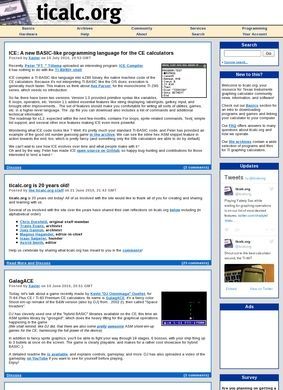
You have a TI-83 Plus sitting in a desk drawer, a half-remembered program someone showed you in school, and no idea where to find it again. That is the moment Ticalc.org was built for. It has been collecting and organizing software for Texas Instruments graphing calculators since 1996, and Ticalc.org still runs as a volunteer-maintained archive sorted the way a calculator owner actually thinks: by model. Pick your device, and you get programs, games, and utilities that other people wrote and uploaded over the years.
File archive organized by calculator model
The file archive is the spine of Ticalc.org. It is organized so you can drill straight into the section for your specific model and browse what is available, with user-submitted reviews attached to many of the files so you are not downloading blind. Around that core sit sections that each answer a different question. Basics holds getting-started guides for people who just unboxed a calculator and have no clue how to put anything on it. Archives is the software repository proper. Programming gathers development resources for people who want to write their own assembly or BASIC. Hardware covers the devices themselves, and Help is the FAQ corner for when something refuses to transfer.
SourceCoder for browser-based programming
What raises the site above a static dump of files is SourceCoder, an online editor for writing and editing TI calculator programs in the browser. For a student or hobbyist who does not want to install a desktop toolchain just to fiddle with a program, that lowers the barrier a fair amount. The site also runs news articles about calculator developments, a bimonthly newsletter, and RSS feeds for both news and new file uploads, so someone who wants to keep up with the TI community can subscribe and let updates come to them.
Serving students, educators, developers
The audience splits a few ways, and Ticalc.org tries to serve all of them at once. Students show up needing a specific program for a class or a game to survive a long lecture. Educators look for tools they can hand to a roomful of calculators. Hobbyists and developers come for the deeper end: the programming references, the source code, the place to publish their own work and get it in front of an audience that actually owns the hardware. Because everything is community-contributed, the depth varies by model and by how active people were around a given device, but the breadth across the TI lineup is genuinely wide.
Preservation work for calculator software
I spent a while clicking through the model categories and what struck me is how much of this material would simply be gone otherwise. Calculator software is not the sort of thing that survives on app stores or gets re-hosted by big platforms. A volunteer archive like Ticalc.org, up for nearly three decades, is doing quiet preservation work, and the file reviews from users give it a layer of curation that a plain mirror would lack. It also functions as something of a niche business directory for the calculator-software ecosystem, listing community developers and their tools in one indexed place.
Safety ratings from third-party checkers
On reputation, the picture for Ticalc.org is modest but clean. ScamAdviser rates it as legitimate and not a scam, and a separate safety check flags it as safe to use. MyWOT has a scorecard entry for the domain, though no specific numeric trust score turned up. There is nothing on Google, Trustpilot, Yelp, or the BBB, and no notable consumer reviews floating around, which is about what you would expect for a niche hobbyist resource that nobody is buying anything from. The absence of complaints reads as a fair sign in a case like this.
Email contact for submissions
Contact is where Ticalc.org shows its age and its volunteer nature. There is an email address published for news and file submissions, and an About section that links through to a contact page, so a route in does exist. What you will not find is a phone number or a physical address anywhere on the site. For a community archive run by volunteers, that is not surprising and not really a fault: nobody is expecting to phone a calculator file repository. Still, anyone hoping for a formal organization to stand behind it should set expectations accordingly.
User reviews guide file selection
A couple of practical notes for anyone weighing up Ticalc.org as a destination. Because the content is contributed by users rather than produced by a staff, quality and documentation differ from one upload to the next, and the user reviews on each file are the best guide to what is worth your time. The interface is plain and dated, which is less a complaint than a description: it loads fast, it nests logically, and it gets out of the way. Someone arriving from a slick modern site might find it spartan, but the information density is high and nothing is buried under marketing.
Active community with recent uploads
The newsletter and the news section keep a slow pulse going, which tells you the community around TI calculators has not vanished even as smartphones swallowed most of what these devices used to do. For the specific job of finding software for a TI graphing calculator, browsing by model, reading what other owners thought, and maybe writing a program of your own in the browser, Ticalc.org remains the obvious first stop and one of the few that has lasted this long. The archive is still being added to, and the file dates run right up to recent uploads.